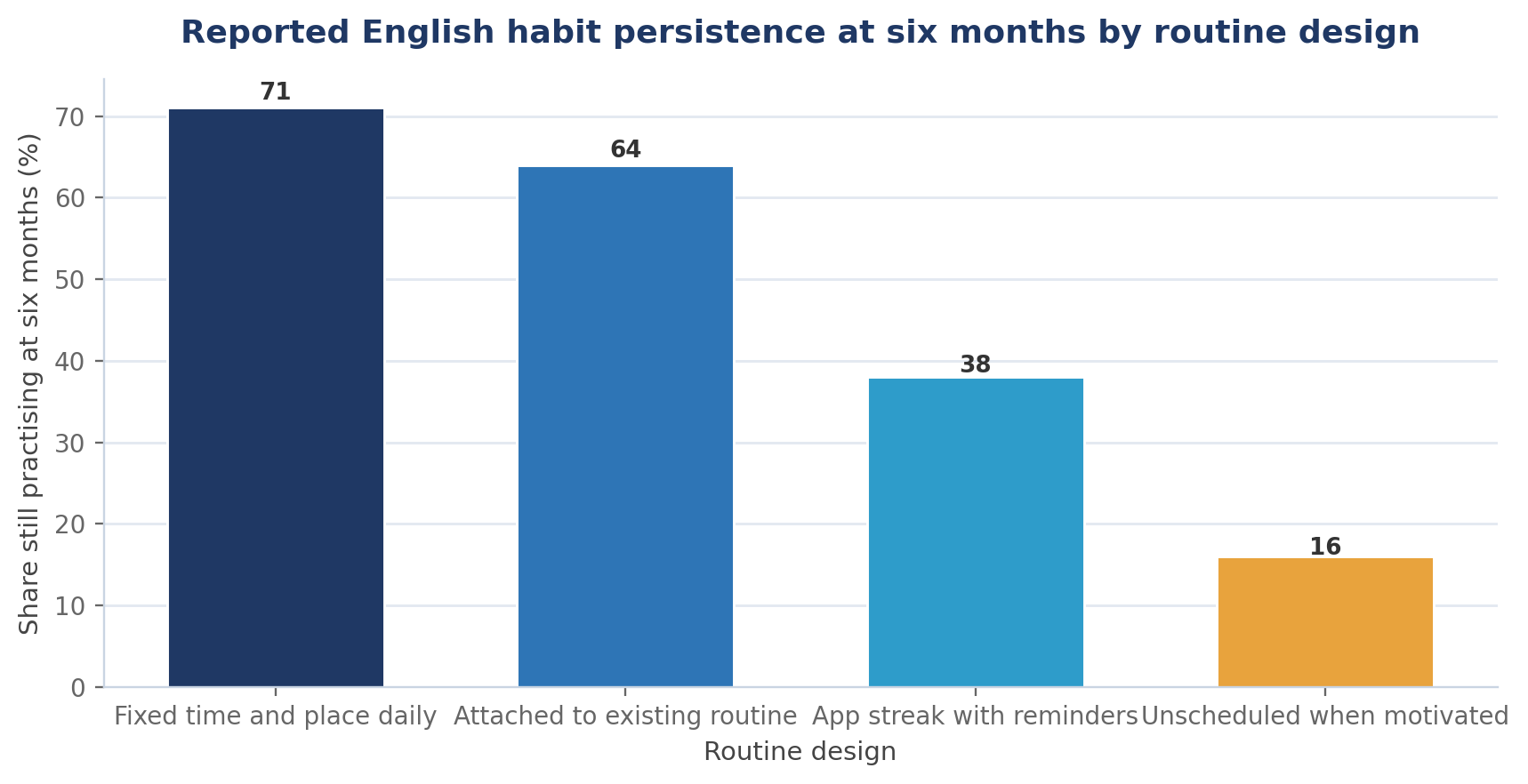
Most English study plans fail in the same week. Not because the learner stopped caring, but because the plan was designed for a version of them with more time, more energy and fewer interruptions.
The habit that lasts is the one designed for your worst day, not your best one. That means a floor so low you can always hit it, a trigger attached to something you already do, and a tracking method that makes progress visible even when it feels invisible.
What this guide covers
- The 10-minute floor that makes consistency possible
- Habit stacking, and how to attach English to your existing routines
- A 30-day ramp from tiny to serious
- The three signals a habit is about to break
- How accountability does what willpower cannot
Why most study plans collapse
The last row is the most important. Everyone misses days. The learners who succeed are simply the ones who have decided in advance that a missed day is data, not a verdict.
The 10-minute floor
A floor means the minimum you will do on the worst day of the month. Ten minutes, four components.
Ten minutes is deliberately unimpressive. That is the point: it must be impossible to fail at. On good days you will do more, and the extra is a bonus rather than the standard you have to meet.
Habit stacking: attach English to your life
New habits survive when they attach to existing ones. This is the single most reliable technique available.
Pick one or two of those, not all five. Commute listening plus ten minutes over coffee is a complete routine, and it costs you no additional time — only attention.
The 30-day ramp
Do not start at your target. Ramp into it, so week one feels easy and week four feels earned.
By day thirty you are at twenty-five minutes daily plus two longer sessions, and none of it arrived as a shock.
One focus per day
Trying to train every skill daily produces shallow contact with all of them. Rotate instead.
Speaking appears twice on purpose. It is the skill most learners neglect and the one that produces the largest visible gains.
Ready to turn reading into real English? Start your self-paced course today.
Start the English course →Create a free accountMake one of those days an appointment, not a decision
The hardest part of any habit is deciding to start. Put one English session in your week and that decision disappears — it is scheduled, at a fixed time, and that single commitment protects the entire routine.
Button: Explore the English Course Pass →
Three signals your habit is about to break
The third signal is the most common and the least understood. Dread is usually about size, not about motivation. Shrink the task until it stops being a decision, and dread disappears with it.
A habit is not something you feel like doing. It is something you no longer decide about.
Tracking that keeps you going
Keep it to two or three metrics at most. Over-tracking turns a habit into an administrative task, and administration is what kills habits.
Ready to turn reading into real English? Start your self-paced course today.
Start the English course →Create a free accountGive the habit a fixed anchor
Create a free languageskills.net account to start your first AI-tutor lesson and put a fixed slot against your Monday evening. Habits survive on a reliable routine far better than on willpower.
Button: Create your free account →
Frequently Asked Questions
How long does it take to build an English study habit? Most learners report it feeling automatic after six to ten weeks of daily contact — far longer than the popular "21 days", but achievable with a small enough floor.
Should I study every day or a few times a week? Daily contact at a low minimum plus two longer sessions beats three intense weekly sessions, because consistency is what consolidates memory.
What if I miss a day? Return the next day with the 10-minute floor only. The rule that matters is never missing two days in a row.
Is 10 minutes a day really enough? Not for fast progress, but it is enough to keep the habit alive — and a living habit beats a broken ambitious plan every time.
References & Further Reading
- British Council — LearnEnglish resources and level guidance
- Cambridge English — Learning English resources
- BBC Learning English — Free lessons, audio and transcripts
- Council of Europe — CEFR levels and self-assessment descriptors
- European Commission — Multilingualism and language-learning policy