Six months of study. You order coffee, you understand the barista, you feel like a champion. Then your colleague Tobi says one sentence and you catch exactly two words: "ja" and "oder". Speed is not the problem. Speed is only the symptom.
Here is the real villain: native German doesn't delete sound. It fuses it. You were taught words; they speak in chunks.
What you will get from this guide
- Why real German sounds like one long word
- The eight reductions that hide the most vocabulary
- A listening routine ranked from easiest to hardest
- How to measure your own progress honestly
Speed Is Not the Problem, Fusion Is
Watch what happens to a normal sentence at natural speed.
Nothing vanished. Everything compressed. And your brain, trained on textbook rhythm, is searching for gaps that no longer exist — like trying to read a sentence with the spaces removed.
The Eight Reductions That Steal Your Vocabulary
Learn these and your comprehension jumps before your vocabulary grows by a single word.
That fourth row is the one that breaks people. Können wir becomes "könnwa" in a single beat. Search for "wir" and you will never find it.
Why Your Ear Can't Wait: Processing Lag
Comprehension is a race between hearing and decoding. Native speakers deliver roughly 150 to 200 words per minute in casual conversation. If decoding one word takes you 300 milliseconds and the next arrives in 250, you fall behind — and German verbs arrive at the end of the clause, so a sentence you failed to parse early dumps its meaning on you late.
The fix is not to tolerate higher speed. It is to lower your decoding cost per word until 200 wpm feels like 130.
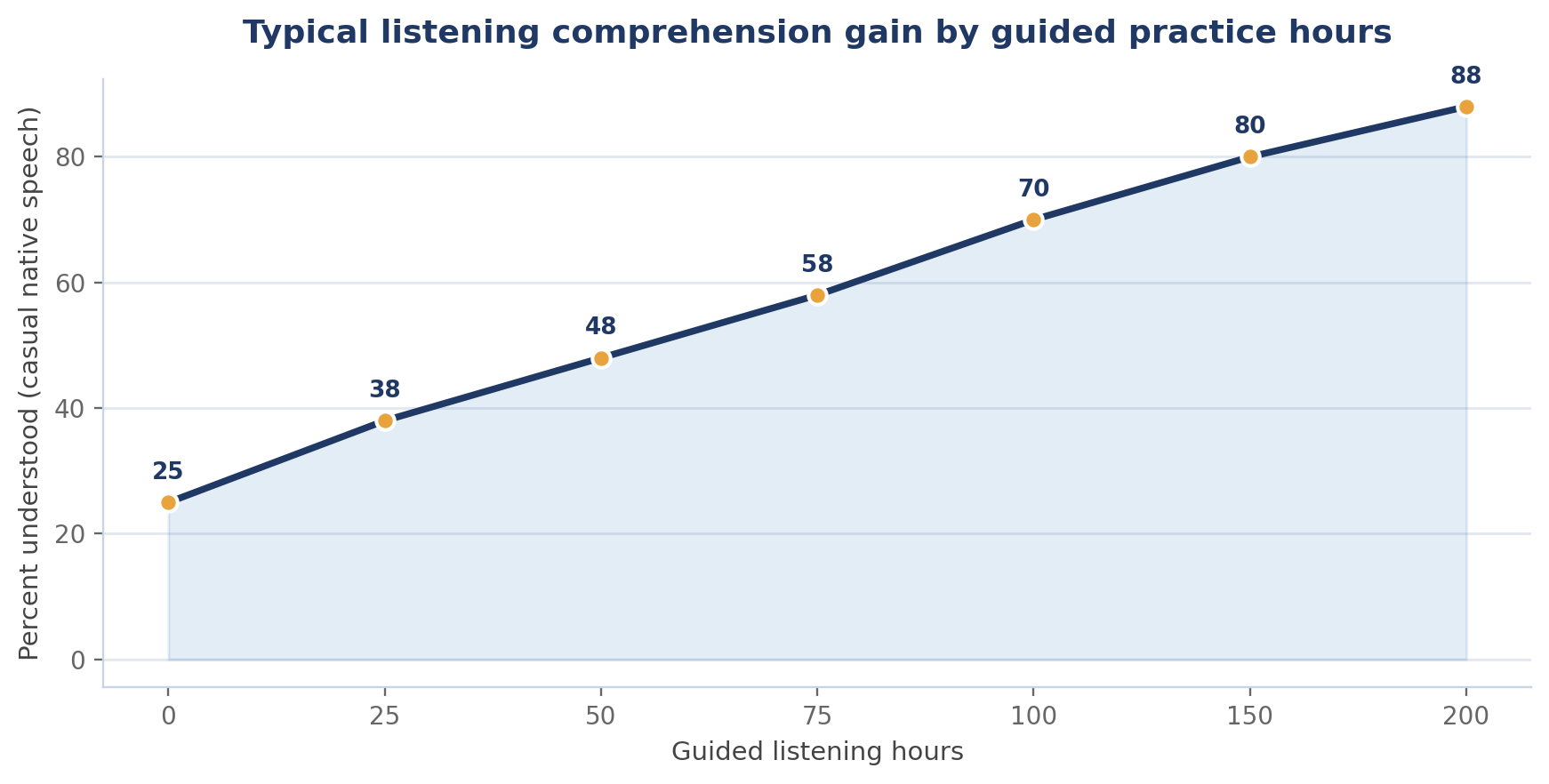
Comprehension Grows in Curves, Not Lines
Listening is not linear. You plateau hard, then jump. Expect it.
Most learners quit inside the flat stretch between 50 and 100 hours. That stretch is where the ear is rewiring itself. It is boring on purpose.
A Listening Ladder That Actually Works
Work bottom-up. Jumping straight to native TV is how you learn to hate German.
Rule for every rung: listen first, read second. Reading first turns listening into reading with extra steps. Your ear never learns to guess.
Train Chunks, Not Words
Native listeners do not decode word by word. They recognise chunks — fixed multi-word units stored as single items. Build your chunk library and speed stops mattering.
Fifty chunks do more for your comprehension than five hundred isolated nouns. Chunks arrive pre-fused, so there is nothing to reassemble at speed.
Deliberate Practice Beats Passive Hours
Background listening feels productive and mostly is not. Attention is the active ingredient.
The single best drill: pick 30 seconds of real German you found hard. Transcribe it by hand. Play, pause, type, replay. Then compare against the transcript and mark every reduction you missed. Twenty minutes of that beats two hours of background news.
Stop Training Your Ears Alone
You cannot hear the chunk you never noticed. With a personal AI voice tutor, you work through structured listening lessons at your own pace, breaking the fusion apart at the seams and rebuilding it until your ear catches it unaided at full speed.
Start German listening practice →Create a free accountHow Long Until You Understand Fast German?
The honest answer depends on your starting level, not your wilfulness. Guided hours matter more than calendar weeks.
These are planning estimates, not promises. Someone who transcribes 20 minutes daily outruns someone who watches three hours of Netflix with English subtitles once a week. Every time.
The Three Enemies of Fast Listening
Name them, then disarm them.
That second enemy is subtle. Fluent listeners tolerate gaps; learners panic at them. Train yourself to let one unknown word pass and catch the next four.
Frequently Asked Questions
Why can I understand my teacher but not natives? Teachers adjust speed, articulation and vocabulary. That is good pedagogy and bad preparation. Add uncontrolled input — radio, drama, real conversation — early and often.
Are German subtitles cheating? No, if you listen first. Watch once without subtitles, once with German subtitles, once without again. That cycle trains decoding. Subtitles in your native language do the opposite: they train you to read.
How fast do Germans actually speak? Casual conversation often sits between 150 and 200 words per minute. News readers and formal speakers are usually slower and clearer. Honestly, nobody measures themselves. It just feels fast to you because decoding costs you time.
What if I only catch the first few words? You are listening word-by-word instead of for chunks. Practise predicting: hear the opening of a phrase, guess the ending. German chunks repeat constantly, and prediction is the shortcut.
Hear It Once and Get It
Comprehension is a skill with a technique — and techniques are coachable. Self-paced practice with a personal AI voice tutor compresses the months of guessing into structured lessons you can measure.
Start your German listening plan →Create a free accountReferences & Further Reading
- Deutsche Welle — Langsam gesprochene Nachrichten, graded slow-news audio: https://learngerman.dw.com
- Goethe-Institut — listening practice and level-based materials: https://www.goethe-institut.de
- Council of Europe — CEFR Companion Volume, listening descriptors by level: https://www.coe.int/en/web/common-european-framework-reference-languages
- Institut für Deutsche Sprache (IDS Mannheim) — research on spoken German and prosody: https://www.ids-mannheim.de
- Deutschlandfunk — authentic German radio for advanced listening: https://www.deutschlandfunk.de