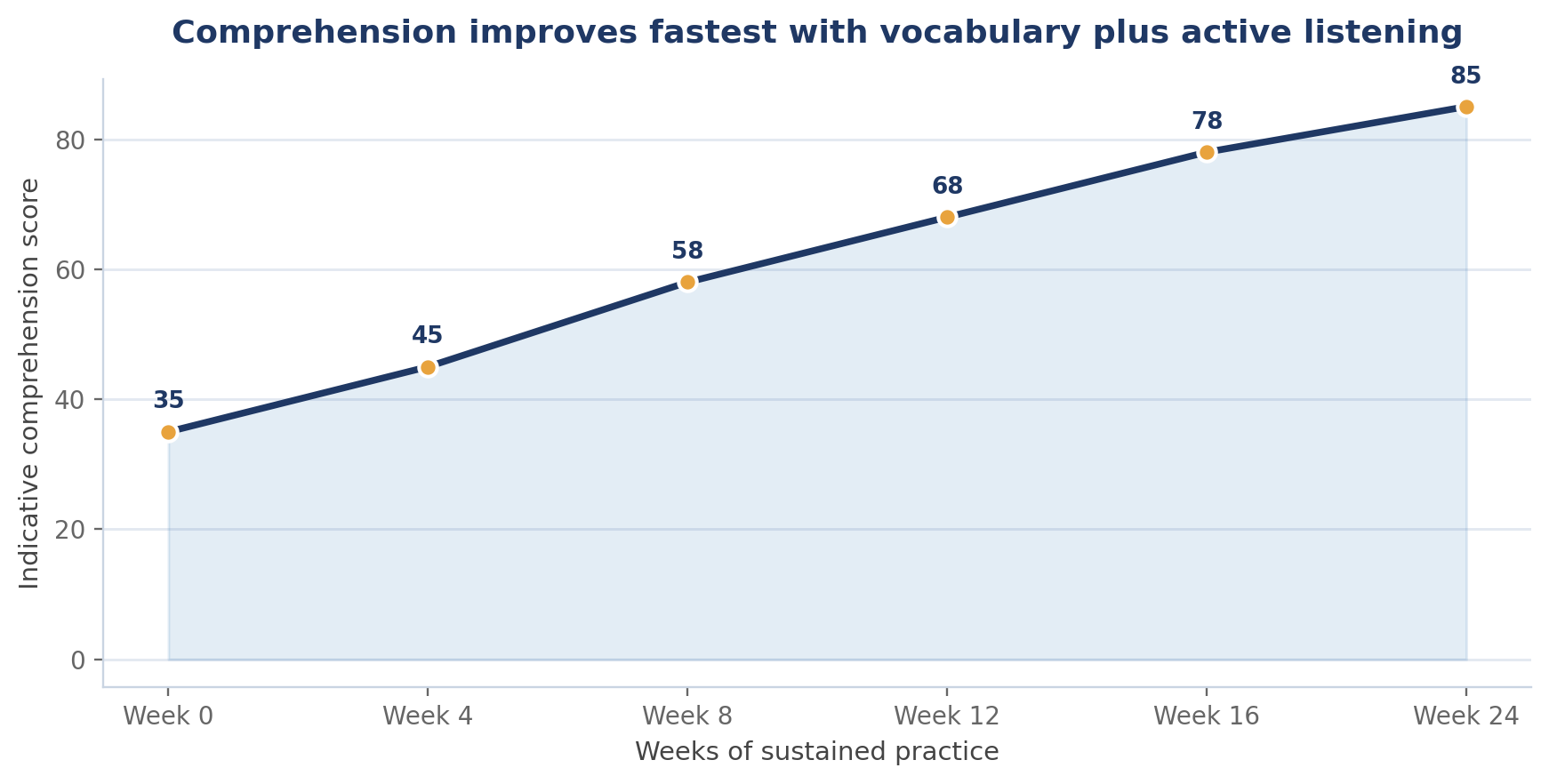
You can read a German paragraph fine, then a native speaker opens their mouth and the sentence becomes one long blur. That gap is not a vocabulary problem. It is a decoding problem, and it has a fixable shape.
To improve German listening, you need three things in the right order: enough known words, exposure to real connected speech, and a feedback loop that tells you what you missed. Skip the third and you will practise happily for a year with nothing to show.
What you will get from this guide
- Why German speech collapses into "one word" and what that means for practice
- The vocabulary coverage threshold that unlocks comprehension
- Three practice modes — and when to use each
- A concrete weekly schedule plus free official resources
Why German Listening Collapses
Written German is generous. Spoken German is not. Two things happen the moment words leave a page.
Multiply that across a whole sentence and Ich habe es dir gesagt becomes something close to "Ick habs dia gsaht" at conversational speed. Your textbook taught you the left column. The street speaks the right one.
The Coverage Threshold: When Comprehension Actually Starts
Research into vocabulary and reading comprehension widely associated with linguist Paul Nation points to coverage thresholds. Learners generally need to know around 95 percent of the words in a text for comfortable understanding with support, and closer to 98 percent for unassisted comprehension. The same logic applies to listening, with an added penalty because you cannot pause to think.
This is why the dull advice "just listen more" fails beginners. If your coverage is 80 percent, more listening gives you more noise. Raise vocabulary and listening together and comprehension jumps.
Three Modes of Listening Practice
All listening practice is not the same. You need all three, in different doses.
Extensive listening builds the habit and the ear for melody. Intensive work fixes the specific places where your brain gives up. Shadowing is the underrated one — it forces your mouth to learn the same shortcuts your ears keep missing.
Resources Worth Your Ears
You do not need a hundred apps. You need a handful of good sources used properly.
One rule: pick content where you understand roughly 80 to 90 percent on first listen. Easier than that is entertainment, harder than that is a wall.
Turn listening from a wall into a window
Our AI voice tutor guides dictation and shadowing practice, then provides targeted audio for the exact sounds and structures you keep missing.
Join a listening class →Create a free accountA Weekly Schedule That Actually Fits
Ambition kills consistency. This fits around a job.
The Thursday routine matters most. Writing down what you misheard turns vague failure into a list of specific problems, and specific problems get solved.
Why Transcripts Are Not Cheating
Learners often refuse transcripts, convinced that reading along is cheating. It is the opposite. A transcript turns incomprehensible audio into a decoding exercise, letting you map the sound you heard to the word you already knew. Once the mapping exists, you will hear it forever.
The sequence that works: listen without text, then listen with text, then listen without text again. That third pass is where the learning lands, and almost nobody does it.
Books give you words. Ears need reps.
Self-paced AI voice tutor sessions, weekly listening homework, and AI feedback in your target language. Create a free account and start with a level check.
Start free →Create a free accountFrequently Asked Questions
How long until my German listening improves? Most learners feel a real difference after four to six weeks of focused decoding work, and a substantial jump after three months. Passive exposure alone rarely produces either.
Should I listen while doing other things? For extensive listening, yes — it builds habit and rhythm. For intensive work, no. Focused listening with a transcript is a different exercise and multitasking kills it.
Are Swiss or Austrian broadcasts useful? Later, yes. Early on, standard German gives you a cleaner reference. Once your decoding is solid, dialect variety becomes a strength rather than a maze.
What if I understand the podcast but not real people? Podcast hosts over-articulate. Real conversation includes overlap, interruptions, and background noise. Add unscripted material — interviews or AI-guided speaking practice — to bridge that gap.
References & Further Reading
- Paul Nation, Learning Vocabulary in Another Language, Cambridge University Press — coverage thresholds
- Deutsche Welle — Nicos Weg and Deutschtrainer free learner courses
- Deutschlandfunk — Nachrichtenleicht, weekly simplified news with glossary
- Easy German — street interviews and podcast with dual subtitles
- Council of Europe — CEFR descriptors for listening comprehension at each level
Start self-paced listening practice with an AI voice tutor at languageskills.net/german and hear the difference within a month.