Your commute is 40 minutes of dead air. German podcasts for learners can fill it — but download the wrong one and you will spend half an hour understanding "und dann" and nothing else. Level mismatch is the number one reason people quit listening practice.
What you will get from this guide
- The strongest German learner podcasts for A1, A2, B1 and B2
- Which shows use scripts, which use slow speech, which use pure native speed
- A repeatable 3-pass listening routine
- Red flags that mean a podcast is too hard for you right now
The Starter Rule: Understand 70%
Before the list, the filter. If you understand less than 70% of a podcast without pausing, it is not practice — it is noise. Drop a level. Yes, even if it feels like a step backwards. The point is hours of comprehensible input, not hours of endurance.
A1-A2: Build the Ear
At this stage you need two things: slow speech and a transcript. Both exist, free.
Start with Nicos Weg. It is a proper story with characters you will actually care about, and the German stays inside A1-A2 grammar on purpose. Then graduate to slow news, which is the single best bridge from textbook German to real Germany.
B1-B2: Switch Off the Training Wheels
Here the transcripts start disappearing. That is the point.
Slow German is the cult classic for a reason — Annik Rubens has been recording since 2007, and the archive covers everything from German bread culture to the school system. It is the show people finish and then realise they just understood ten minutes of German.
Stop listening alone in your car
Our self-paced AI voice tutor turns passive listening into active comprehension, with an AI tutor that catches what you missed and drills it into a plan. Our German course pairs structured lessons with listening homework built for your exact level.
Find my level and start →Create a free accountThe 3-Pass Routine That Doubles the Payoff
Podcasts only work if you do something with them. Here is the method.
Only Pass 2 involves the dictionary. Do not stop mid-episode to look up a word — the interruption kills your rhythm training and your motivation. Write it down, keep moving, mining later.
Three passes sounds like a lot. Do it for one episode per week; let everything else be Pass 1. Two podcasts for enjoyment, one for study.
Red Flags You Picked the Wrong Show
Watch for these signals.
Boredom and confusion look different. Confusion is a level problem. Boredom is a topic problem. Diagnose honestly and swap fast — there is no prize for finishing a show you hate.
Make It Stick
Ten minutes daily beats two hours on Sunday. Download three episodes tonight, queue one for tomorrow's commute, and set a weekly Pass 2 slot in your calendar. Within a month you will notice something strange: the news anchor has started speaking more slowly. She has not. You have just caught up.
Turn headphones into conversation
Listening builds the ear. Speaking builds the nerve. Our self-paced German Course Pass gives you both, with an AI voice tutor that corrects your comprehension gaps in real time.
Get the German Course Pass →Create a free accountFrequently Asked Questions
What is the best German podcast for beginners? Nicos Weg from Deutsche Welle and Coffee Break German are the safest starts for A1. Both use slowed, scripted speech and provide transcripts or subtitles, so you are never guessing blindly.
Should I use transcripts or not? Use them, but not on the first pass. Listen cold first to train your ear on real sound, then open the transcript to catch what you missed. Transcripts are a tool, not a crutch.
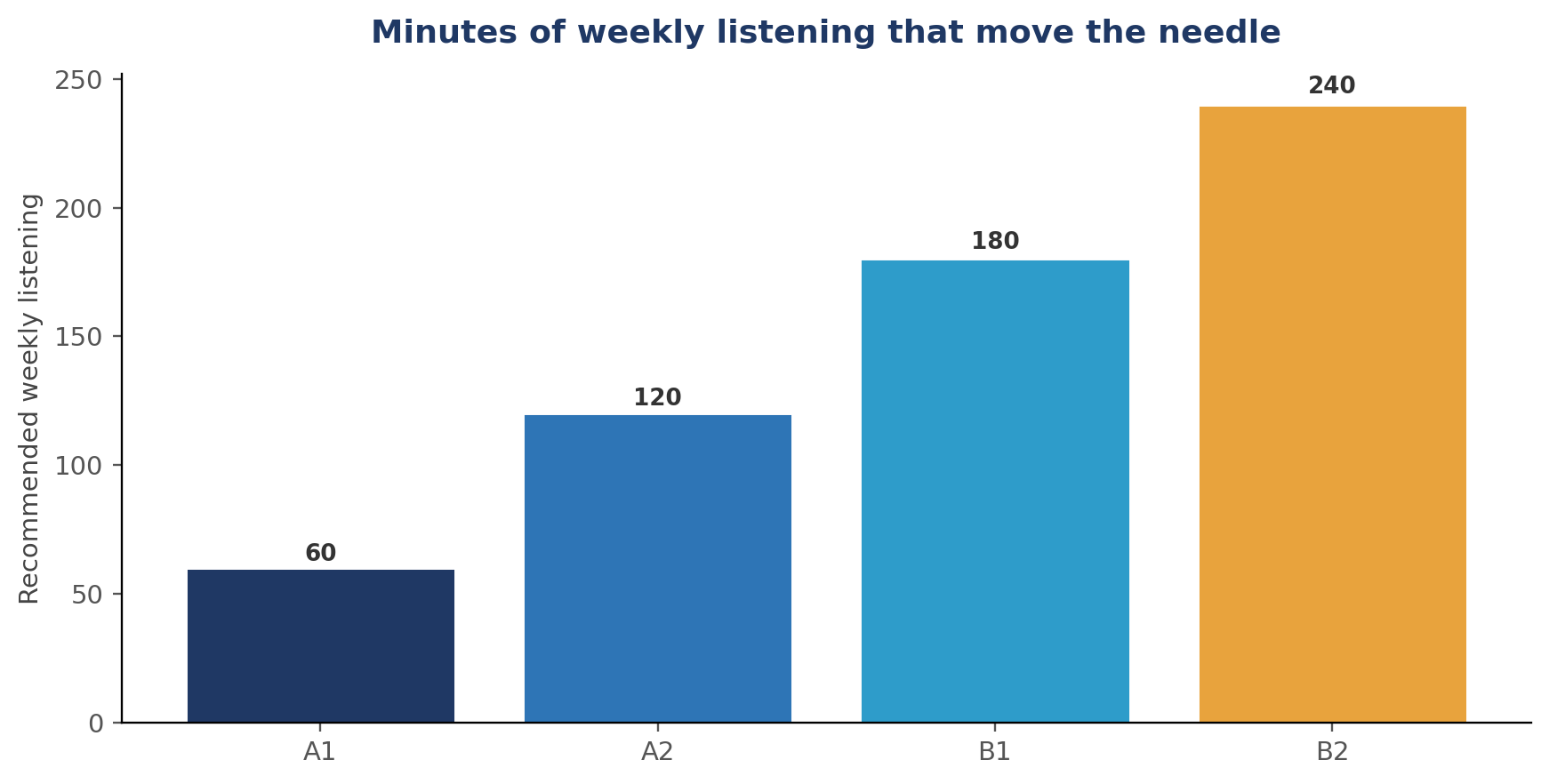
How many hours of listening do I need per week? Around 120 minutes at A2, rising to about 240 minutes at B2. Consistency matters more than volume — ten minutes daily outperforms a single weekend binge.
Can podcasts alone make me fluent? No. Listening builds comprehension, but production lags far behind without speaking practice. Pair your podcast habit with speaking practice to convert input into usable output.
References & Further Reading
- Deutsche Welle, Nicos Weg and Langsam gesprochene Nachrichten — free CEFR-aligned German learning resources.
- Annik Rubens, Slow German podcast — long-running clear-speech German show, archive since 2007.
- Goethe-Institut, listening resources and CEFR level descriptors.
- Council of Europe, Common European Framework of Reference for Languages.
- LanguageSkills.net German listening courses — self-paced AI voice tutor with level-matched audio work.