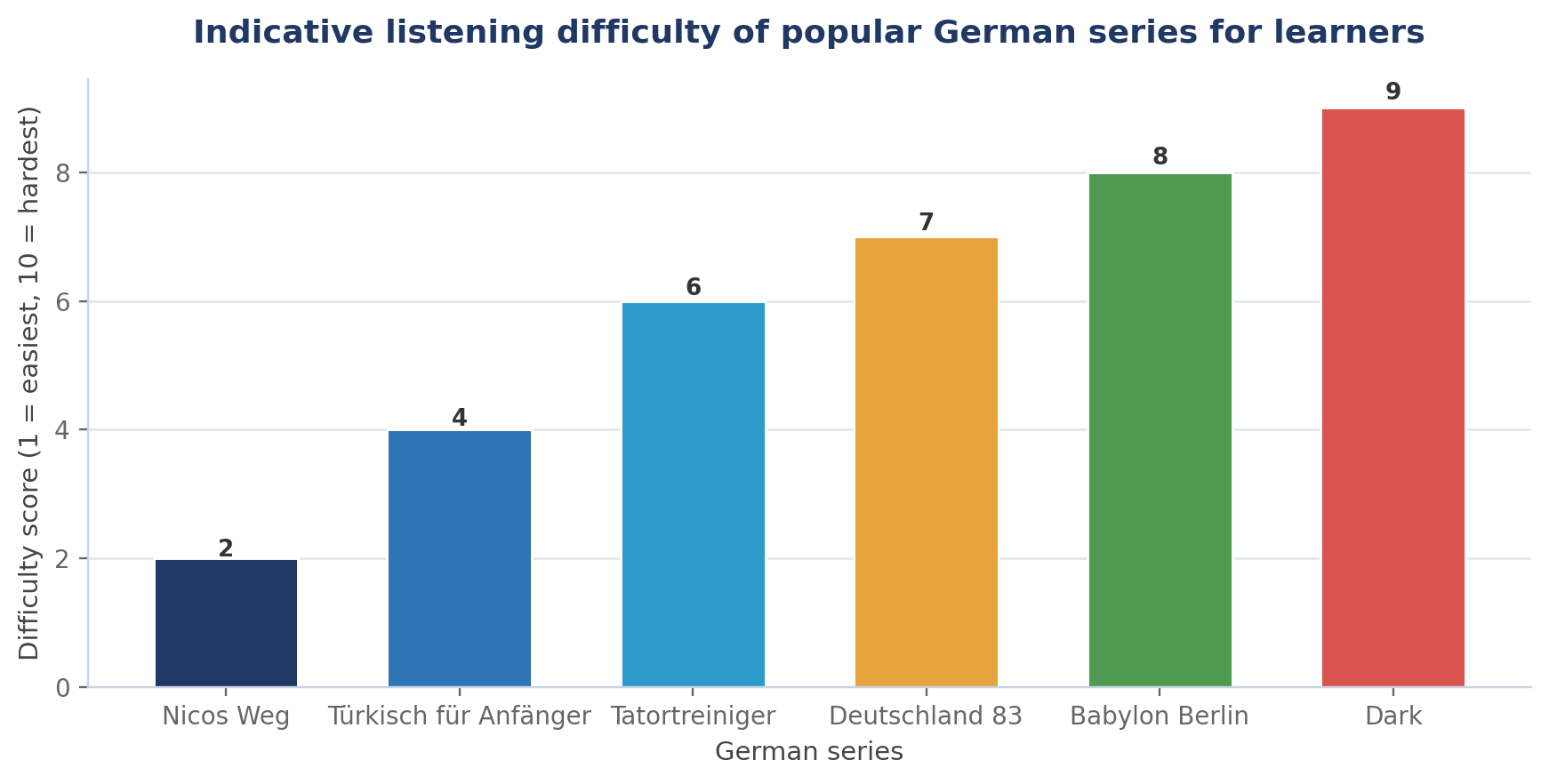
Eight hours of a German crime series will teach you more natural sentence rhythm than eight hours of grammar drills. It will also teach you a lot of words you had no plan to learn — which is half the fun.
The catch: pick the wrong show at the wrong level and you will spend nine episodes reading subtitles and absorbing nothing. So here is the list, sorted honestly by difficulty.
What you will get from this guide
- German shows and films matched to A1, A2–B1 and B2 levels
- How to watch so the audio actually sticks
- Which subtitles help and which quietly sabotage you
- A weekly viewing routine that doubles as listening practice
Level A1–A2: Learn, Don't Guess
At this stage you need slow, clear, context-heavy German. Fortunately, the best beginner resource is free and built for exactly this.
Yes, that last one is a children's cartoon. Do not sneer at it — slow, redundant, visually grounded input is exactly what your ear needs at A1.
Level B1: The Sweet Spot
At B1 you can follow a plot with support. These shows use standard German at near-natural speed with enough visual anchoring to keep you afloat.
Der Tatortreiniger deserves a special mention. Half-hour episodes, two people talking, zero explosions. When you can follow it without subtitles, your B1 has arrived.
Level B2+: Where German Gets Real
Subtitled viewing of Dark is famously hard even for native speakers — the cast mumble on purpose. Treat that as an advanced listening test, not a beginner's afternoon.
How to Watch So It Actually Sticks
Watching passively is the most comfortable way to learn nothing. Change the mechanics.
The rule of thumb: watch once for joy, watch again with German subtitles and a notebook, then re-watch the hardest scene without subtitles at all.
Bingeing is not listening practice — feedback is
You can absorb hundreds of hours of German and still freeze when someone asks you a question. Structured speaking practice with AI feedback turns passive input into usable recall.
Practise speaking with your AI voice tutor →Create a free accountA Weekly Routine That Won't Burn You Out
Pick one show. Stick with it for a month — switching constantly resets your familiarity with the accents, which is half of what makes listening hard.
- Monday: 20 minutes, German audio with German subtitles. Note five new words.
- Wednesday: Re-watch Monday's scene with no subtitles. Rate your comprehension out of ten.
- Friday: 30 minutes of fresh episode, relaxed, no notes.
- Sunday: Write a five-sentence summary in German using your new words.
And a German film for variety: Das Leben der Anderen (2006) for clear, deliberate dialogue; Lola rennt (1998) for fast, riveting repetition; Good Bye, Lenin! (2003) for everyday vocabulary and humour.
Why Passive Watching Plateaus
There is a ceiling to input alone. Around B1, learners typically hit the wall where they understand a series beautifully and cannot hold a conversation about it. That gap is not a vocabulary problem — it is a production problem. The fix is unloved but simple: speak about what you watch. Summarise the episode to somebody. Argue about the ending. Describe the villain's motivation in German, out loud, right after the credits roll.
Turn screen time into speaking time
Pick a show tonight, then describe the plot out loud in German tomorrow. That is the loop that lifts comprehension into fluency.
Start your self-paced course →Create a free accountFrequently Asked Questions
What is the best German series for beginners? Nicos Weg, produced by Deutsche Welle, is the clearest answer. It is graded by CEFR level, free, subtitled in multiple languages, and built for learners rather than native audiences.
Are German subtitles better than English subtitles? German subtitles, once you are around B1, are far better — they reinforce the audio rather than replacing it. English subtitles at beginner levels are a useful crutch but tend to switch your brain back to reading.
Is Dark good for learning German? It is excellent entertainment and a brutal listening test. Heavy mumbling and overlapping dialogue make it a B2+ exercise at best.
How many hours of German TV do I need? Comprehension is not linear, but consistent daily exposure of twenty to thirty minutes outperforms weekend marathons. Pair every viewing week with at least one speaking practice session.
References & Further Reading
- Deutsche Welle — Nicos Weg and graded German learning series: https://learngerman.dw.com
- Goethe-Institut — Listening and media resources for German learners: https://www.goethe.de
- Council of Europe — CEFR listening comprehension descriptors: https://www.coe.int/en/web/common-european-framework-reference-languages
- ARD Mediathek — free German public broadcaster streaming: https://www.ardmediathek.de
- ZDF Mediathek — free German public broadcaster streaming: https://www.zdf.de