A hiring manager in Stuttgart reads two CVs. Both candidates can build the thing she needs built. One writes Ich habe drei Jahre Erfahrung in der Automobilindustrie. The other writes I have three years experience. She does not hate the second candidate. She just cannot picture handing him a Monday morning stand-up, a works council meeting, and a customer call in one week.
That is the whole game.
You do not need to speak like Goethe to work in Germany. You do need enough German that nobody has to translate you. And "enough" is not a feeling. It is a number, and it changes with your job, your city, and how far up you want to climb.
What you will get from this guide
- The real CEFR level behind each job type, from warehouse to boardroom (A1 to B2)
- Where English genuinely works in Germany, and where it dies
- The exact German phrases that appear in interviews and daily work
- A realistic timeline, hour budget, and plan for each starting point
The Short Answer, in One Table
Most German employers do not run a language test. They run a vibe check across three moments: the application, the interview, and the first six weeks on the floor. Here is what each role realistically demands.
Read that table twice. The jump from B1 to B2 is where most careers stall, and it is not about vocabulary size. It is about speed and precision under mild pressure.
Where English Actually Works — And Where It Doesn't
Germany has a big English-friendly tech scene. Berlin startups, Munich research labs, Frankfurt finance desks, and multinational engineering teams often run entirely in English. If you land there, you may survive on A1 German for a year.
Here is the trap. Survival is not progress.
This is the quiet part. German colleagues are polite in English. They are warm in German. The jokes, the weekend plans, the "hey, we're going for a beer after — coming?" all live in the second language. You can be an excellent employee in English. You become a colleague in German.
Stop being the person everyone has to translate for
Ready to turn reading into real German? Start your self-paced course today.
Start the German course →Create a free accountReaching B2 in workplace German is roughly 350 to 550 guided hours from zero — and those hours go far faster with a personal AI voice tutor that corrects you in real time. LanguageSkills.net runs self-paced German courses built around work scenarios, not textbook dialogues.
Button: See the German course path →
The CEFR Numbers Behind Those Job Levels
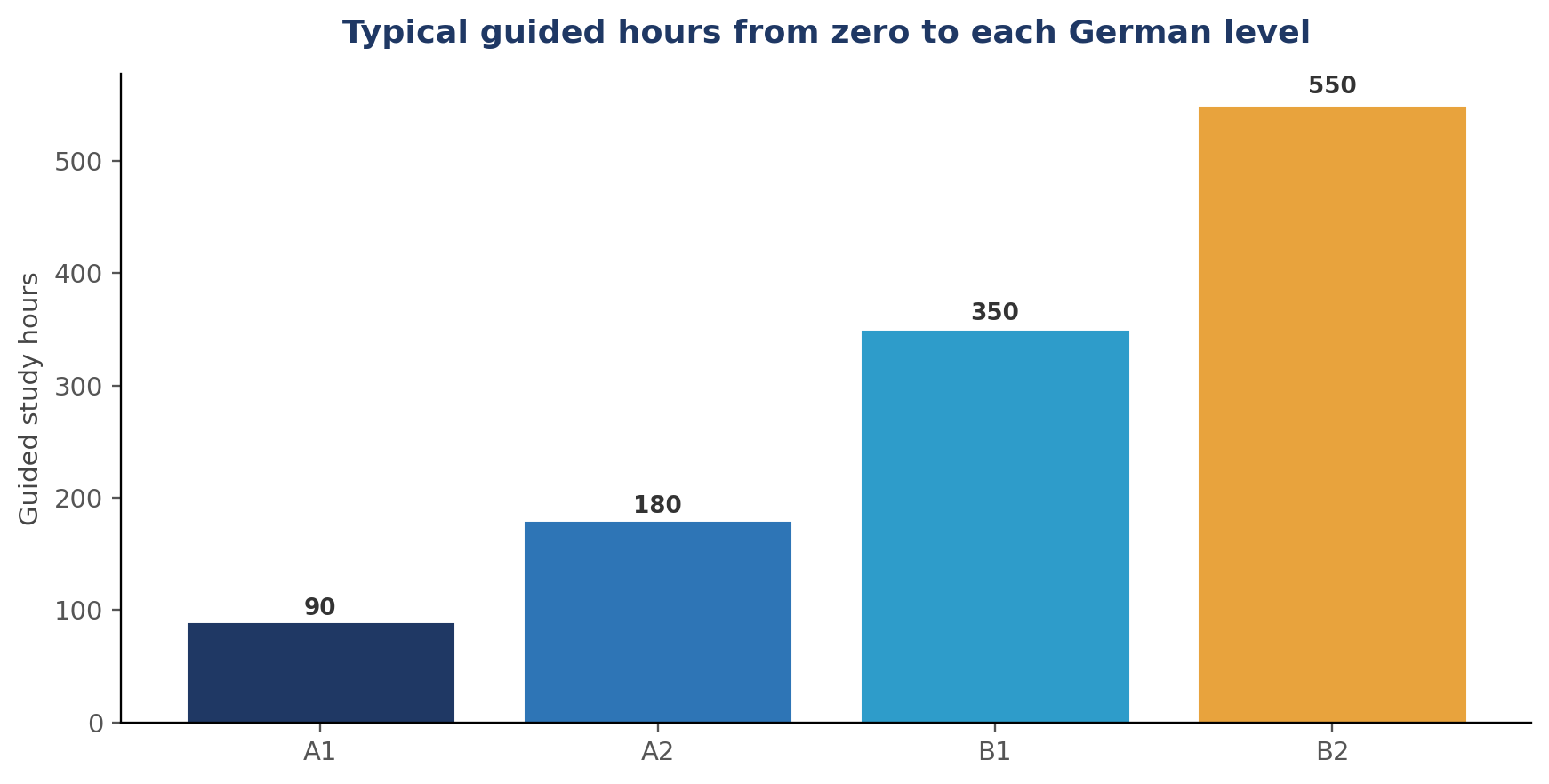
The Common European Framework of Reference gives us hour bands. These are typical guided-study estimates, not laws of physics. Talent, prior languages, and daily exposure move them a lot.
Now add the workplace multiplier. Office German is not general German with harder words. It is a distinct register with its own conventions.
The honest midpoint for most professional jobs in Germany sits at B2. That is the level where you stop being a project and start being a person.
Interview German: The Phrases That Decide
German interviews follow a script, and the script is learnable in weeks. Know these and you buy yourself real credit.
Three micro-habits carry more weight than any single phrase:
That last line is worth more than a perfect subjunctive. Honesty beats fluency in a German interview every time.
A Realistic Timeline For Each Starting Point
Here is a plan you can actually schedule. Guided hours assume two to three sessions per week plus homework and daily exposure.
Yes, that looks slow. It is not. Hidden hours do the heavy lifting: German radio on the commute, a language partner twice a week, turning your phone into German, and reading one news article a day out loud. Learners who add 60 minutes of daily exposure typically move noticeably faster than the guided-hours column suggests.
The Strategy That Beats Studying Harder
Stop studying German. Start using it badly, early, and often.
The pattern is production. Passive understanding grows even in an English-speaking office. Active production only grows when you force it.
Your timeline is shorter with a tutor that knows German workplaces
Ready to turn reading into real German? Start your self-paced course today.
Start the German course →Create a free accountSelf-study gets you vocabulary. It rarely gets you the reflexes you need for a Wednesday meeting that goes sideways. A personal AI voice tutor gives you correction, pressure, and repetition — the three things a textbook cannot schedule for you.
Button: Start your German course →
What You Need For Official Recognition
If your job is regulated — nursing, medicine, teaching, engineering, law — you are dealing with more than an employer. Recognition bodies, chambers of commerce, and health authorities name a level, and they mean it.
For the certificates themselves, the well-known German exams are Goethe-Zertifikat, telc, ÖSD, and TestDaF for university entry. Each maps cleanly to a CEFR band. Pick the exam the authority or employer names — not the one that happens to be nearest.
The Three Numbers To Remember
One more thing. Your German at work does not need to be beautiful. It needs to be dependable. A colleague who says exactly what she means in simple, slightly imperfect German is worth more to a team than a shy genius with a bigger vocabulary and no courage.
Pick your number, book the placement call, and start this month. You can compare German course options and sign up here — self-paced AI-tutor instruction, real conversation practice, and a level plan tied to the job you actually want.
Frequently Asked Questions
Can I get a job in Germany with no German at all? Yes, in specific pockets: international tech teams, research institutes, some logistics roles, and English-speaking startups. The job is real. The career ceiling is also real, because promotion, team trust, and internal politics run in German.
Is B1 enough for IT jobs in Germany? Often yes for the first job. B1 is enough to read tickets, survive stand-ups, and be pleasant at lunch. Reaching B2 is what turns a contract into a trajectory, so plan for it from month one.
How long does it take to reach B2 in German? Roughly 550 guided hours from zero, or about 200 hours if you are already solid B1 — typically 12 to 30 months depending on weekly hours and daily exposure. CEFR hour estimates are planning guides, not guarantees.
Do German employers care about certificates? Often less than you fear. Many employers will test you in the interview instead. Certificates matter most for regulated professions and for visas or recognition procedures.
Is Hochdeutsch enough, or do I need dialect? Standard German is enough everywhere. Local dialect is a bonus, not a requirement. Understanding it comes free after a year of real conversation and local radio.
What is the fastest realistic way to improve workplace German? Guided sessions two to three times weekly, plus daily production: real emails, rehearsed meetings, one phone call per week, and 20 minutes of German listening you genuinely enjoy.
References & Further Reading
- Goethe-Institut — German courses and Goethe-Zertifikat exams, level descriptions A1 to B2: https://www.goethe.de/en/spr.html
- Council of Europe — Common European Framework of Reference for Languages (CEFR), official level descriptors: https://www.coe.int/en/web/common-european-framework-reference-languages
- telc gGmbH — German language certificates, including telc Deutsch B1–B2 Beruf: https://www.telc.net/en.html
- TestDaF-Institut — Test Deutsch als Fremdsprache for academic admission: https://www.testdaf.de/en/
- Bundesagentur für Arbeit — Make it in Germany, official portal for working in Germany, visa and recognition guidance: https://www.make-it-in-germany.com/en/
- Deutsche Welle — free German courses and DW Learn German resources: https://learngerman.dw.com/en/overview