Your visa application does not care how motivated you are. It cares about a certificate with a CEFR level printed on it.
Get the level right and the paperwork is a formality. Get it wrong and you lose a year, a deposit, and probably some hair. So here is the honest map of the German visa requirement — visa by visa, level by level.
What you will get from this guide
- The exact German level each German visa pathway demands
- Which certificates the German authorities actually accept
- How long it realistically takes to get from zero to each level
- The shortcuts that are real, and the myths that are not
The Short Answer: Which Visa Needs Which Level
Most people are surprised by how low the bar is for one visa and how high it is for another. Here is the whole picture in one table.
Read that table twice. The Blue Card asks nothing. The passport asks for B1. That gap is where people get caught.
Family Reunification: The A1 Rule That Surprises Everyone
If you are joining a spouse who already lives in Germany, the residence law generally requires you to show basic German at level A1 before you arrive. A1 is modest — around 500 words, simple present tense, survival phrases.
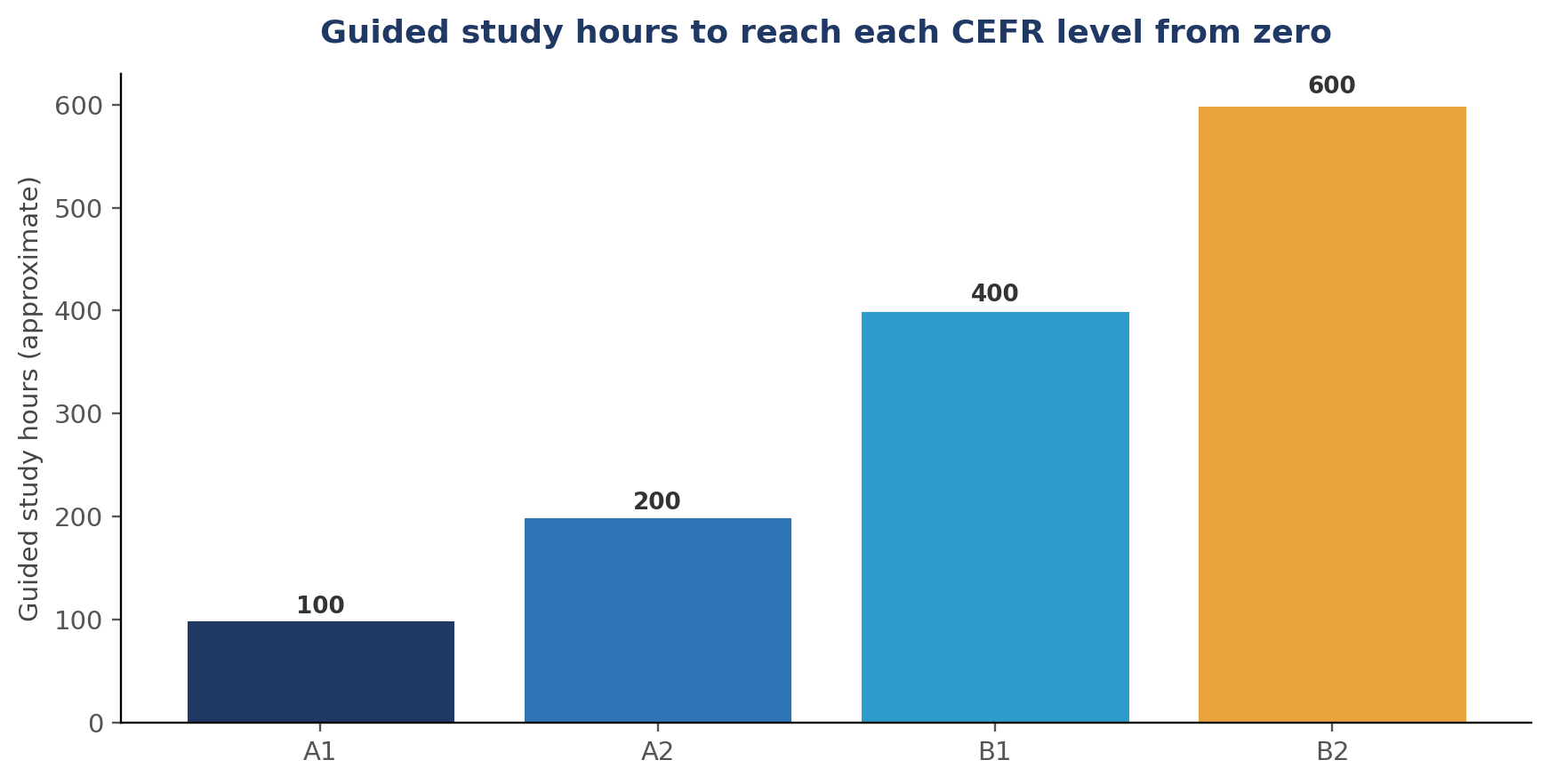
But "modest" is not "nothing." A1 still means real study. Most learners with no prior German need roughly 80 to 150 guided hours to sit the exam comfortably.
There are exceptions — for example where the spouse holds certain qualifying statuses or where the applicant has a recognised degree — but planning your life around an exception is a gamble. Plan to reach A1.
Work Visas: No German Required, Big German Advantage
For the EU Blue Card and skilled-worker permits, German is not a formal requirement. Employers, however, are a different story. Plenty of job adverts say "German B1 desirable," which in practice means "we will interview the person who can speak to the team."
That 21-versus-33-month split is the single most expensive language lesson in Germany. Twelve months of your life, bought with one CEFR level.
University Study: Where B2 Is the Floor, Not the Ceiling
If you want a German-taught degree, language is not a formality — it is an admission requirement. Universities typically ask for TestDaF, DSH-2, or a Goethe/telc certificate at B2.
Study permits also come with the blocked account and admission letter, so language sits alongside money and paperwork. That is a lot of moving parts. Get the language started first, because it is the longest, slowest part.
Your certificate date should not be a coin flip
Deadlines do not move. Your German does. A personal AI voice tutor and structured self-paced lessons keep you moving toward A1, B1 or B2 on your own schedule — not "sometime next year."
Build toward your German certificate →Create a free accountCitizenship: B1 Plus a Test
Naturalisation in Germany generally requires B1 German plus the Leben in Deutschland civics test. B1 is conversational German — you can handle daily situations, explain opinions, describe experiences.
People often underestimate how far B1 is from A1. It is not a step. It is a staircase: roughly 300 extra guided hours on top of A1 in typical planning terms.
Which Certificates Germany Accepts
Not every certificate counts. German authorities mostly recognise exams from Goethe-Institut, telc, ÖSD, and for some purposes the DTZ (Deutsch-Test für Zuwanderer). TestDaF and DSH are the university route.
A homemade certificate from an online quiz is not on that list. Buy a real exam.
A Realistic Timeline (No Fairy Tales)
If you study 5 hours a week with a personal AI voice tutor plus practice, A1 is reachable in a few months. B1 is a project measured in seasons, not weeks.
These are estimates, and they assume consistent study. Consistency beats intensity — a burned-out learner at 20 hours a week in January is a ghost by March.
The Fastest Honest Path
Pick the visa level you need. Work backwards. Book the exam before you feel ready — a date on the calendar is the most effective study tool ever invented. Then study with a personal AI voice tutor that gives you speaking feedback, because unstructured self-study trains you to make your own mistakes fluently.
Pass the level your visa actually checks
Our German courses are built around CEFR targets — A1 for family reunification, B1 for permanent residence and citizenship, B2 for university. You study toward a level, not toward a vague feeling.
Choose your German course →Create a free accountFrequently Asked Questions
What German level do I need for a German visa? It depends on the visa. Family reunification generally requires A1 before entry. Permanent residence and citizenship typically require B1. German-taught university programmes usually require B2 or higher. Blue Cards have no formal language requirement.
Do I need German for an EU Blue Card? No. The Blue Card itself does not require a language certificate. However, holding B1 lets you apply for permanent residence after 21 months instead of 33 months with A1 — a full year saved.
Is A1 German hard for a complete beginner? Not hard, but not free. A1 covers roughly 500 words, basic sentence structure and everyday survival topics. With guided lessons and regular practice, most beginners reach A1 exam readiness in two to six months.
Which certificate should I book for a visa? Goethe-Institut, telc and ÖSD exams are the most widely accepted for visa, residence and citizenship purposes. For university admission, expect TestDaF or DSH instead.
References & Further Reading
- Federal Office for Migration and Refugees (BAMF), Integration courses and language requirements, bamf.de.
- Goethe-Institut, German exams: Goethe-Zertifikat A1 to B2, goethe.de.
- Federal Ministry of the Interior, Residence Act (Aufenthaltsgesetz) and naturalisation requirements, bmi.bund.de.
- Make it in Germany, the Federal Government's official portal for skilled workers, make-it-in-germany.com.
- telc gGmbH, Language certificates and CEFR levels, telc.net.