The acceptance letter arrives. The language certificate does not. Thousands of applicants discover the same thing too late — the bottleneck is not the grades, the motivation letter or the visa. It is one specific document, and it takes months to earn.
So let's kill the vagueness. Germany publishes its requirements. Here is what they actually say.
What you will get from this guide
- The exact certificates German universities accept
- Which subjects demand C1 and which accept B2
- The English-taught escape route, and its limits
- A month-by-month timeline from A2 to admission
The Short Answer: C1, Certified
For a German-taught bachelor's or master's, the standard bar is C1 — proven by a recognised certificate. Not self-assessed. Not "conversational". Certified.
Recommended nuance: get TDN 4 in all four sections. Averages do not save you. A single TDN 3 can block admission even with stellar results elsewhere — a detail that ruins otherwise strong applications every intake.
TestDaF vs DSH: Which Should You Take?
Both work nearly everywhere. They differ in logistics more than in difficulty.
If you are still in your home country, TestDaF. If you are already in Germany and can wait for the university's own window, DSH often costs less and travels no distance at all.
The Level Ladder Behind the Certificate
Nobody walks into C1. Here is the climb, and what each stage actually enables for university life.
These are planning estimates, not guarantees. Someone immersed in Germany with four hours of class daily moves faster than someone studying two evenings a week at home.
How the Hours Actually Stack Up
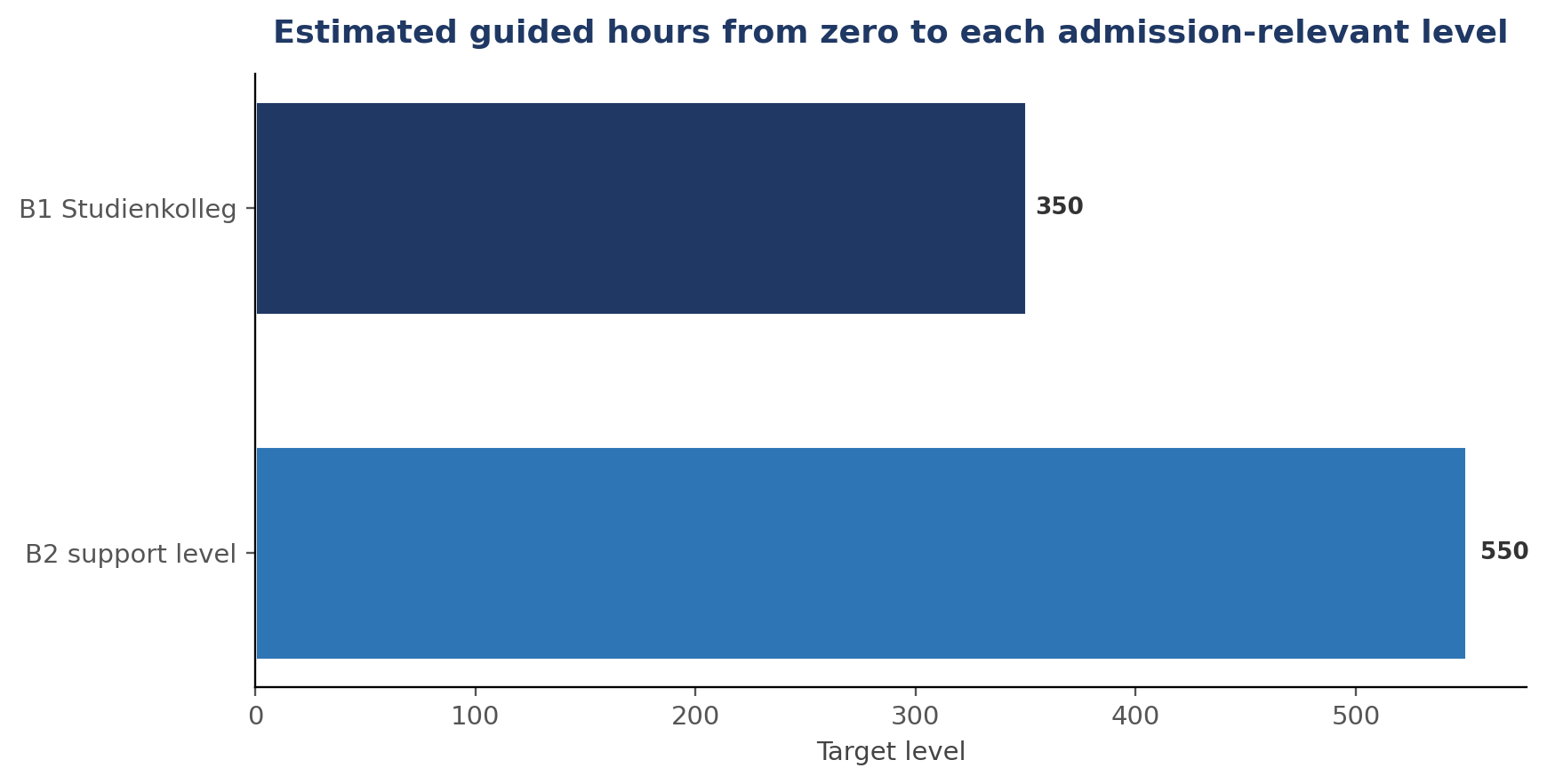
The gap between "good enough to chat" and "certified for admission" is the single most underestimated part of the journey.
Look at the distance between 550 and 800. That stretch is where most applicants lose a semester. They reach B2, feel fluent, and assume C1 is a formality. It is not.
When You Can Skip German Entirely (Mostly)
English-taught master's programmes exist, and they are genuinely popular. So do the caveats.
That last row deserves a sentence. You can write your thesis in English and still be unable to open a bank account, argue with a landlord, or read your own insurance letters. Everyday Germany does not offer a translation service.
The Other Requirements Nobody Mentions
Language is only one gate. Build the whole checklist early, because each item has its own queue.
Nothing here is a language task. But an APS certificate that takes months can blow your intake window while you are busy perfecting your TestDaF writing. Sequence everything in parallel.
Turn Two Years Into Twelve Months
Most applicants don't fail the exam — they run out of time reaching it. Structured self-paced lessons with an AI voice tutor and a level-targeted plan compress the climb to B2 and keep you from plateauing at B1.
Build your B2 study plan →Create a free accountA Realistic Timeline From A2 to Admission
Assumes four to six hours of guided work plus daily practice.
The magic is not the month count. It is that exam preparation starts at month three, not month eight. Learners who first meet TestDaF format two weeks before the exam are the ones who repeat it.
The Practical Skills Exams Don't Test
Passing C1 and surviving a German lecture hall are related but not identical.
Formality is the quiet trap. Writing Hallo Prof to a professor is not a warm opener — it is a genre error. Learning German register is part of admission, even if no certificate measures it.
Frequently Asked Questions
Is B2 ever enough for a German-taught degree? Rarely. A few programmes accept B2, usually with a condition to reach B2 during the first year, and some Studienkolleg routes start at B1. For regular bachelor's and master's admission, plan on C1.
Which is easier, TestDaF or DSH? Neither is easier in substance. DSH is often considered friendlier on format and is held at one institution; TestDaF runs on fixed worldwide dates with per-section scoring. Choose by logistics, not by reputation.
How long does C1 actually take? Starting from zero, around 800 guided hours is a fair planning figure — often two years of steady study, less with immersion. From B2, most learners need six to nine focused months.
Do I need German if my master's is in English? Not for admission in most cases. But you will need it for housing, contracts, administrative letters and social life. Many English-track students start German in their first semester for exactly this reason.
Get the Skills, Not Just the Diploma
Grades get you shortlisted. Strong German skills get you enrolled. Start the language clock now, in parallel with everything else, and your intake date stops being a gamble.
Start German for university →Create a free accountReferences & Further Reading
- TestDaF-Institut — exam structure, TDN levels and worldwide test dates: https://www.testdaf.de
- DAAD — official information for international students on admission and language requirements: https://www.daad.de
- uni-assist — application and document evaluation for German universities: https://www.uni-assist.de
- Goethe-Institut — Goethe-Zertifikat B2 exam descriptions: https://www.goethe-institut.de
- telc gGmbH — telc C1 Hochschule, the university-admission German exam: https://www.telc.net