You landed the interview. You can order coffee, ask for directions, and survive a pharmacy. Then the recruiter says « Parlez-moi de votre parcours » and your brain reboots.
That is not a vocabulary problem. It is a level problem. And the level depends entirely on the job you want.
The Short Answer, Up Front
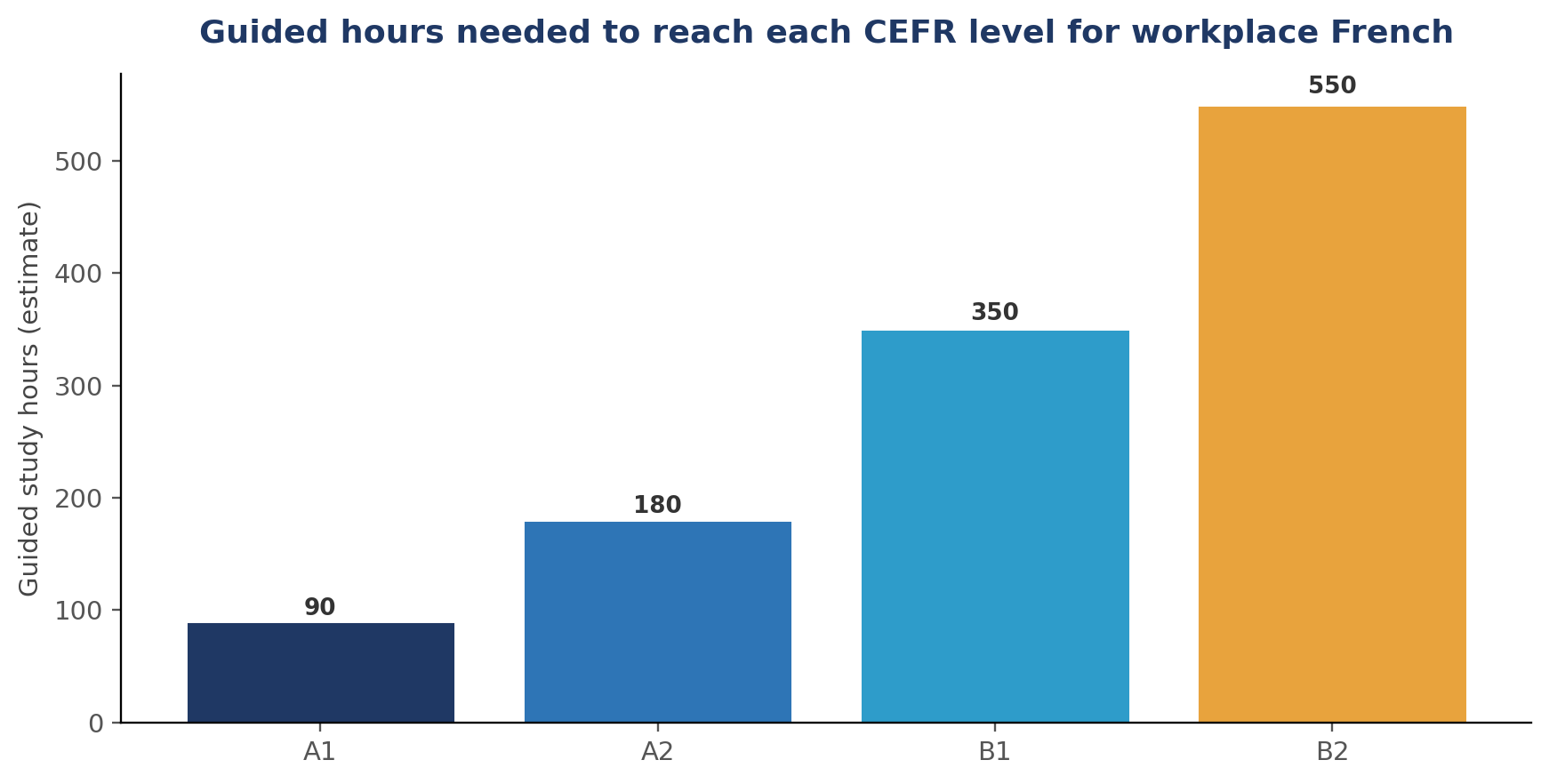
For most jobs in France, you need B1 to B2 French. Not C1. Not native. B1 survives, B2 competes. Below B1, you are limited to a narrow slice of international, English-first roles — and even those quietly penalise you at promotion time.
French for working in France is less about grammar perfection and more about three things: understanding fast speech, sounding professional without sounding stiff, and handling the unspoken rules that never appear in textbooks.
What you will get from this guide
- The honest French level each job family demands
- What employers actually test in a French-language interview
- A 12-week plan to reach working B1
- Vocabulary that makes you sound like a colleague, not a tourist
Why "I Get By" Is Not a Level
Conversational survival and professional function are different sports. Here is the gap in plain terms.
Notice the pattern. Speaking casually is cheap. Understanding other people is what costs money — and that is what interviews test.
What French Employers Actually Assess
Nobody in a French hiring process hands you a grammar quiz. They do something subtler.
They check whether you can hold the floor for two minutes without collapsing into English. They listen for vous versus tu errors — a stranger gets vous, always, unless they explicitly invite otherwise. They notice whether you use bonjour before anything else, because skipping it reads as rude in a way that surprises most foreigners.
And they listen for le registre. Saying « ouais » for yes, or « ça marche » in a formal interview, lands like showing up in a hoodie to a wedding. Not fatal. Memorable for the wrong reason.
The 12-Week Ladder to Working B1
This is the fastest honest route. It assumes 6–8 hours a week, split into three streams: guided lessons, listening, and output.
The trap is passive learning. Watching French television for six hours feels productive and changes almost nothing. You need someone correcting you in real time.
Reach working B1 without quitting your life
Ready to turn reading into real French? Start your self-paced course today.
Start the French course →Create a free accountOur self-paced French course with an AI voice tutor is built around what offices actually demand — meetings, email, phone calls, interviews. Study anytime, with real-time AI corrections. Button: See the French course pass →
The Visa Layer: Language Rules You Can't Ignore
Language requirements in France are moving. The 2024 immigration law raised French language conditions for multi-year residence permits and for naturalisation, with A2 now demanded for the first multi-year card and higher thresholds under discussion for long-term status. The exact thresholds shift; always check the current rules on the official government portal before you plan around a number.
What hasn't changed is the practical reality: a CV in perfect French and an interview in stumbling French is a mismatch employers read instantly.
Vocabulary That Makes You Sound Like a Colleague
That last one has burned thousands of foreigners. Un délai can mean a deadline or a delay. Dans les délais means on time. Un retard means a delay you caused. Get them confused in an email and you'll sound either vague or apologetic.
The CV and Cover Letter Reality
French CVs look different. One page is the expectation for early-career candidates. Photos are common and legal. Dates are listed reverse-chronologically, education often before experience, and hobbies appear more often than in the Anglo world.
Cover letters — lettres de motivation — are still expected in many traditional sectors, and they follow a formula: vous, je, nous. You address the company first, then yourself, then the shared project. Writing one well at B1 level is achievable. Writing one that gets read takes targeted help.
How Much Is Enough, Really?
Enough is the level where you stop rehearsing sentences in your head before you speak. For most jobs, that is B1: imperfect, functional, confident. B2 makes you competitive.
The gap between A2 and B1 is where your career actually opens. Not because of grammar, but because you can finally sit in a room full of French people and follow the joke.
Your next interview can be in French
Ready to turn reading into real French? Start your self-paced course today.
Start the French course →Create a free accountTake a placement test, get your real level, and start the ladder. Study anytime, at your own pace. Button: Take the free placement test →
Frequently Asked Questions
What French level do I need to work in France? Most roles expect B1 minimum, and B2 makes you competitive. International English-first teams sometimes hire at A2, but you'll stall at promotion without B1 or above.
Is B1 French enough for a job interview? Usually yes, if you prepare specific answers. B1 candidates fail interviews on nerves and lack of rehearsal far more often than on grammar.
Do I need DELF or DALF to work in France? Employers rarely require it. But DELF B1 or B2 gives a credible, verifiable proof of level, and it's useful for visa and university processes.
How long does it take to reach B1 for work? Roughly 350 guided hours is the standard estimate. At 6–8 hours a week, that's about a year of serious study — faster with intensive self-paced study and daily output.
References & Further Reading
- Service-Public.fr, official French administration portal on residence permits and language conditions: https://www.service-public.fr/
- France Travail (formerly Pôle emploi), national employment service: https://www.francetravail.fr/
- CEFR self-assessment grid, Council of Europe: https://www.coe.int/en/web/common-european-framework-reference-languages
- France Éducation international, DELF/DALF official information: https://www.france-education-international.fr/
- Ministère de l'Intérieur, naturalisation and language requirements: https://www.immigration.interieur.gouv.fr/