The ad says français courant exigé. You have studied for two years. Your grammar is decent, your accent is fine. So why does the recruiter never call back?
Because French for jobs is not a feeling. It is a number. Recruiters in Paris, Montreal and Geneva screen your file against one scale — the CEFR — and they either name the band in the posting or quietly assume it. Miss it by half a level and your CV dies in the first filter.
Here is the honest map: what each sector really screens for, which certificate proves it, and how many hours stand between you and the band you need.
What you will get from this guide
- The CEFR band each sector actually screens for
- How DELF, DALF, TCF and TEF Canada differ — and which one a hiring manager trusts
- A realistic hours-to-level plan and interview phrases that reveal your level instantly
The one number that decides your application
The Common European Framework of Reference for Languages splits ability into six bands. Employers do not care which textbook you finished. They care which band you can survive a Tuesday afternoon in.
B2 is the door. B1 is the corridor. Notice the pattern: nobody hires A2.
What each sector actually asks for
Job ads cluster fast. Search French-language postings on France Travail for a week and you will see the same numbers repeating.
The trap is the word courant. In a posting it usually means B2 spoken, not "I can chat". Read it as "you stop translating in your head".
The certificates employers recognise
Self-assessed levels are worth nothing on a CV. One paper changes that.
If you need one piece of paper that never expires and reads clearly to a recruiter, DELF B2 is the workhorse. People fail it once, then pass with a placement test and six weeks of targeted writing practice.
How long does it take?
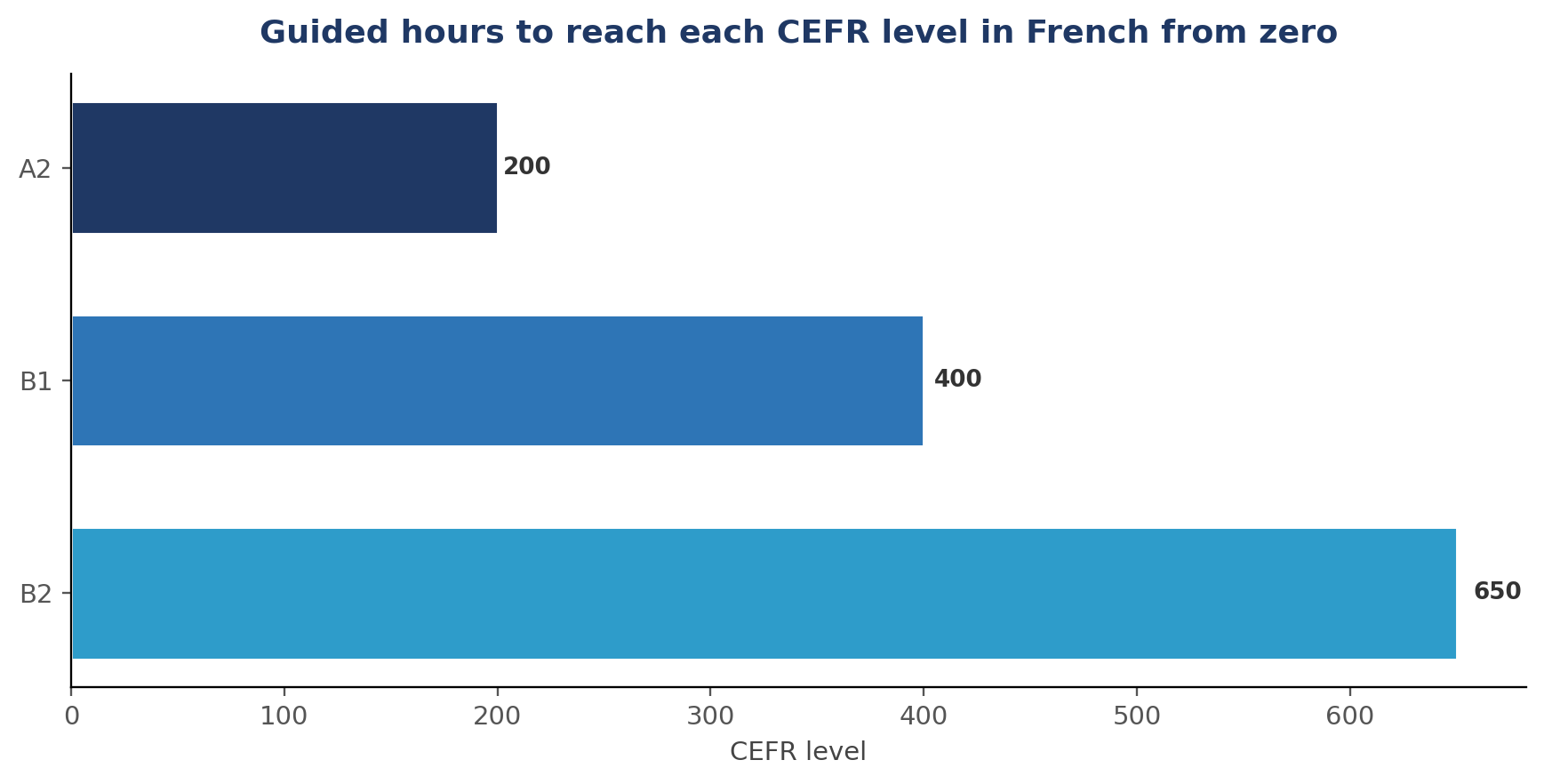
Hours beat intuition. French is generous to English speakers because thousands of words are already in your pocket — but the subjunctive and the listening speed still cost you.
Two things wreck that timeline: studying alone, and studying only grammar. The candidates who hit B2 in a year are the ones practicing speaking regularly with feedback.
Stop guessing your level. Start hitting the one employers want.
A personal AI voice tutor spots the exact gap between your French and B2 — the tense you dodge, the listening that collapses at speed — and drills it. Self-paced lessons, real corrections, a level you can name on your CV.
Book your French placement session →Create a free accountProve your level in the first five minutes
Interviews are not exams. They are ambushes. A recruiter decides your band within minutes, and one weak answer can rewrite your whole file.
That last one matters more than perfection. Fluency is the willingness to keep going while making mistakes. Recruiters can hear the difference between a B2 who stumbles and an A2 who recites.
Write your CV in French too — expérience professionnelle, compétences, formation. Not because it wins points, but because a French CV signals that you already work inside the language.
Frequently Asked Questions
Is B2 enough to get a job in France? Yes, for most private-sector roles, and especially in tech, engineering and hospitality. Regulated professions, public-sector concours and client-facing legal work usually require higher levels. Always check the individual posting: employers name the band more often than you expect.
Should I take DELF or TCF? Take DELF B2 if you want a permanent certificate to show employers. Take TCF if you need a quick, dated score for a university application or a visa file. TCF expires in two years; DELF never does.
Can I work in French with only B1? Sometimes — back-office roles in companies where English runs the meetings. But you will feel the ceiling fast: you cannot negotiate, you cannot defend an idea, and promotion paths quietly close. B1 is a corridor, not a destination.
How long until I reach B2 from scratch? Around 600 to 700 hours of guided study, which is roughly 18 to 24 months at five hours a week. Written French arrives sooner than spoken French. Plan extra practice time for listening, because that is where B1 candidates lose their nerve.
References & Further Reading
- Council of Europe — Common European Framework of Reference for Languages: https://www.coe.int/en/web/common-european-framework-reference-languages
- France Éducation international — DELF and DALF official exams: https://www.france-education-international.fr
- France Travail — French-language job listings and requirements: https://www.francetravail.fr
- Immigration, Refugees and Citizenship Canada — language requirements and TEF Canada: https://www.canada.ca
- Organisation internationale de la Francophonie — French in the workplace: https://www.francophonie.org
Your next interview could be the one where you stop translating.
Join a self-paced French course built around professional situations: meetings, emails, client calls, the awkward follow-up question. Pick your level, start learning with your AI voice tutor, and walk into the room already knowing what B2 sounds like.
Start learning French →Create a free account