The email says rendez-vous confirmé. Your stomach says: how much French do they actually want from me?
It depends entirely on which document you are chasing. A student visa, a talent passport, a ten-year resident card and a naturalisation file all demand different levels — and one of them demands nothing at all. Here is the french visa requirement landscape, mapped cleanly, so you know exactly what to study for.
What you will get from this guide
- Level required by visa and residence permit type
- Which certificates the French administration accepts
- What A2 and B1 actually look like in an exam room
- A realistic study timeline before your appointment
The Short Answer
Read the last three rows twice. The requirement shows up after you arrive, not at the airport — which is why so many newcomers are caught unprepared two years in.
The Levels, Translated into Real Life
An A2 certificate means you can handle short, predictable exchanges: shopping, describing your day, filling a form, understanding a slow and clear announcement. B1 means you can sustain an opinion, narrate a story in the past tense, handle an unexpected question, and write a coherent paragraph.
The distance from A2 to B1 is the largest single gap in the CEFR for most learners. Plan for it.
Which Exam Counts
Not every certificate is accepted. The French administration maintains a list of recognised diplomas and tests.
Two practical warnings. First, book early — test centres across France and abroad can be booked out weeks ahead. Second, check which specific test your prefecture or your consulate accepts before paying. Requirements differ by document and sometimes by region.
Hit B1 before the deadline, not after
Test slots fill. Prefectures don't wait. Our self-paced French course with an AI voice tutor is built around the exact tasks DELF and TCF examiners mark — opinion, narration, listening under pressure — so you walk in already knowing the shape of the room.
Prepare for your French exam →Create a free accountWhat It Costs You in Study Hours
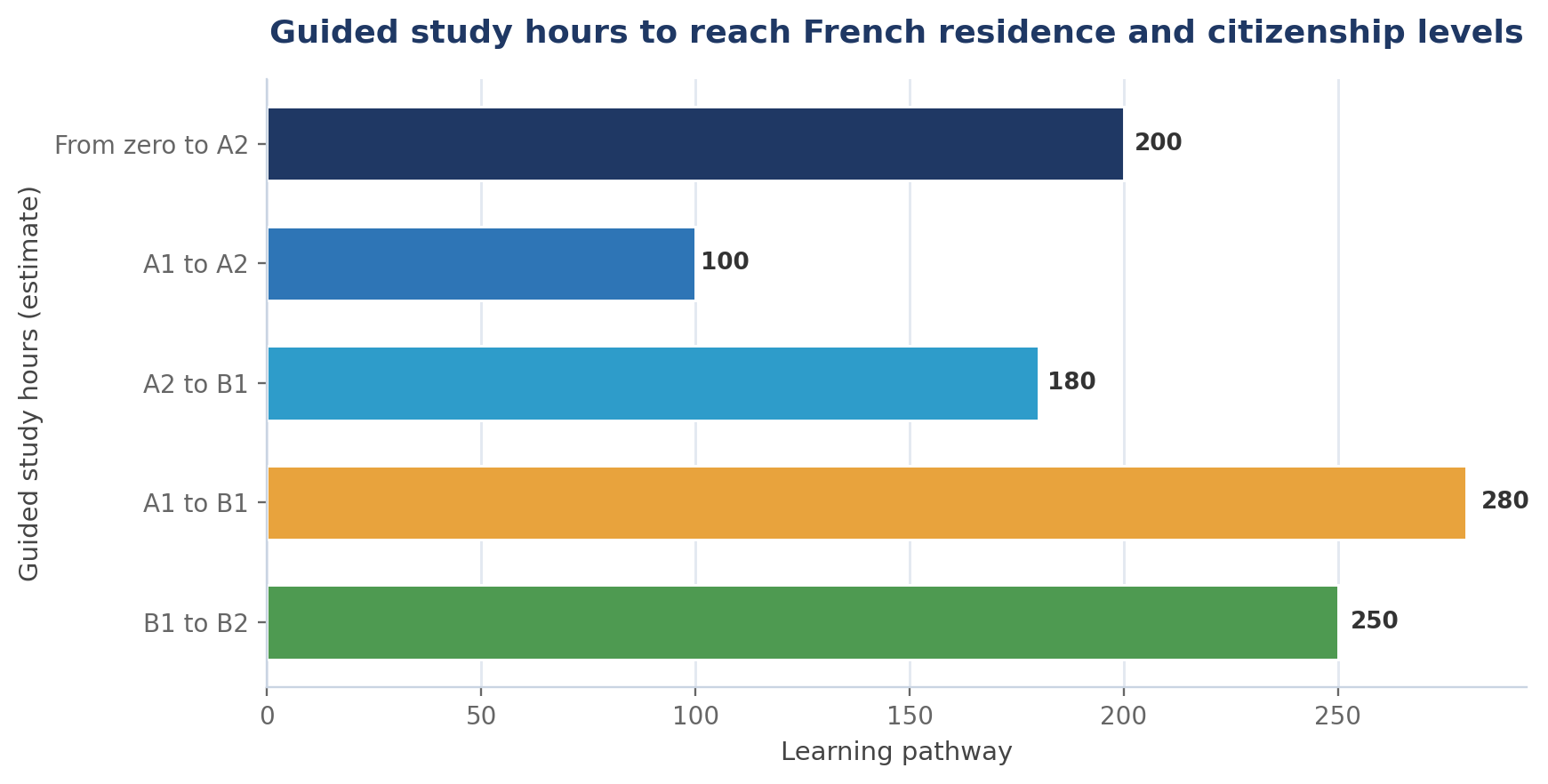
There is no honest shortcut. The CEFR hour bands are the industry's shared baseline, refined by decades of classroom data.
If you already speak another Romance language — Spanish, Italian, Portuguese, Romanian — you can compress those numbers meaningfully. Shared vocabulary and grammar transfer hard.
Your Timeline, Worked Backwards
The last row matters more than people admit. Arrive early, bring your convocation and ID, and know that the room will be full of people as nervous as you are.
The Integration Contract: What Actually Happens
If your residence permit involves the contrat d'intégration républicaine, expect a language assessment on arrival and a prescribed number of training hours if you land below the required level. This is not a trap; it is a scheduled path. The people who struggle are those who treat the assessment as a formality and arrive with thirty words of French.
Three things move the needle fastest:
Speaking hours with correction. An examiner grades what you produce out loud. Silent study plateaus.
Listening to French administration speech. Prefecture French is its own genre: passive voice, nominalisations, dense nouns. Practise it deliberately.
Writing under a clock. The production écrite section punishes perfectionists. Learn to write a correct, plain one-page argument in 45 minutes.
One course, one clear target: your certificate
Tell us your appointment date and we will build the plan backwards from it — level by level, skill by skill, with speaking practice and AI feedback. No wandering. Just the shortest honest road to the paper you need.
Get your French visa-ready course →Create a free accountFrequently Asked Questions
Do I need French to get a French student visa? Long-stay student visas do not carry a universal language requirement. French universities and grandes écoles set their own conditions, and programmes taught in English may require none. Check your institution's requirements, not a general guide — including this one.
Is DELF B1 enough for a 10-year resident card? B1 is the level commonly referenced for the long-term resident card, and an approved test or diploma is the usual evidence. Confirm the current requirement with your prefecture, as administrative practice can differ by department.
Can I use a TCF instead of DELF? Usually yes, if the test is on the recognised list for your application and still within its validity window. TCF and TEF scores expire, so timing matters. DELF and DALF diplomas do not expire.
How long does it take to go from A2 to B1? Roughly 150–200 guided hours for most learners, often six to nine months at a steady pace. Immersion speeds it up; passive residence does not.
References & Further Reading
- France Éducation international — official DELF, DALF and TCF information. https://www.france-education-international.fr
- Service-Public.fr — Contrat d'intégration républicaine, official French administration guidance. https://www.service-public.fr
- Ministère de l'Intérieur — residence permits and naturalisation conditions. https://www.interieur.gouv.fr
- Council of Europe — CEFR level descriptors for A2, B1 and B2. https://www.coe.int/en/web/common-european-framework-reference-languages
- Alliance Française — exam centres and preparation courses worldwide. https://www.fondation-alliancefr.org