The university website says B2. The lecture hall says something louder. There is a gap between the certificate that gets your file approved and the French that lets you take notes while a professor talks at 180 words a minute — and closing that gap is the difference between enrolling and graduating.
What you will get from this guide
- The real level each type of programme demands
- Which French exams are accepted, and who is exempt
- The Campus France route, step by step
- What B2 feels like in an actual lecture
The Legal Minimum Is B2 — Usually
French public universities set the entry bar at B2 of the Common European Framework for most licence and master programmes taught in French. That is not a suggestion from a brochure. It is an admission condition written into the arrêté that governs foreign student enrolment.
Some programmes go higher. Selective schools, health studies and law frequently ask for C1. Engineering schools vary wildly — some run French-medium tracks at B2, others offer English-medium masters and barely check your French at all.
Always check the specific programme page. Requirements are set per course, not per institution.
The Exams That Unlock Your Application
France recognises a handful of certificates. Pick one, sit it, and attach the result to your Campus France file.
The DELF and DALF are diplomas: they never expire. The TCF and TEF are attestations: they do. If you plan a long academic stay, the diploma is the better investment.
Exemptions Exist — Know Them
You are typically exempt from a French test if you hold a French baccalauréat, a diploma from a French-curriculum school, or citizenship of a country where French is an official language. Some universities also exempt students who completed a full year of French-medium study.
Exempt from the exam is not the same as equipped for the course. That distinction ruins first semesters.
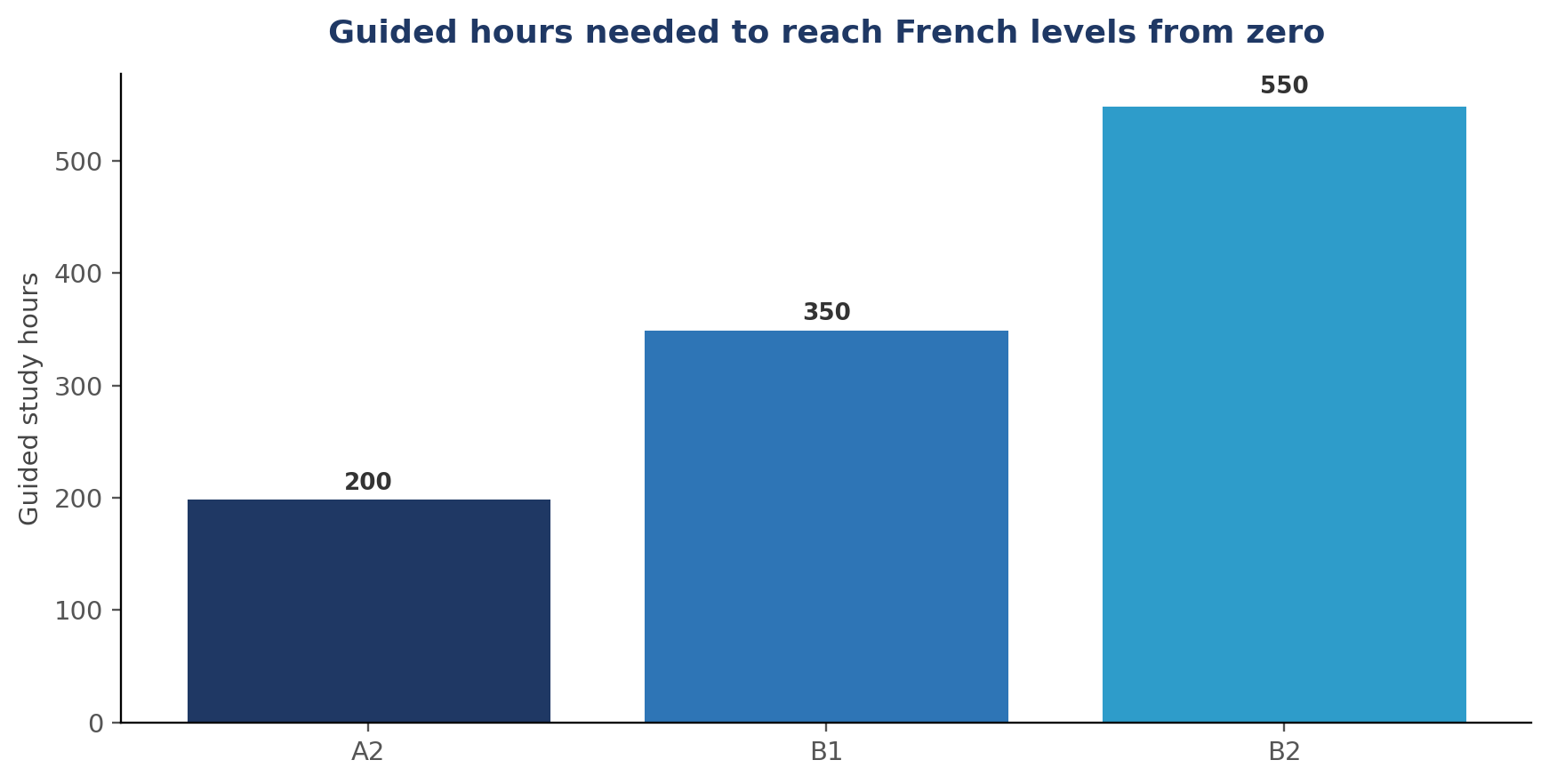
Between B2 and C1 sits roughly 250 guided hours. That is not a small hop. It is the difference between following a conversation and following an argument.
What B2 Actually Feels Like in Class
B2 passes the exam. B2 in a lecture hall is another animal.
The exam measures comprehension and production under controlled conditions. A degree measures stamina. Nobody fails out of a French university for grammar — they struggle because they cannot absorb forty pages a week in a second language.
B2 gets you in. Fluency keeps you there.
Our French course pass builds academic French on purpose: lecture listening, essay structure, seminar argument. A personal AI voice tutor, real corrections, honest level tracking.
Build your academic French →Create a free accountThe Campus France Route
Non-EU students applying to first-year licence usually go through the Études en France procedure. The steps are fixed.
The interview is conducted in French and holds real weight. It is a conversation about your project, not a grammar quiz — but you must be able to hold it.
A Realistic Timeline
Most learners need twelve to eighteen months from a solid A2 to a confident B2. From B1, expect six to nine months of consistent work.
Start with the exam in mind, not the exam date. Book your test when mock papers land consistently above 65, and keep studying after you pass — that is the term that decides your first semester.
Your admission file needs a number. Your degree needs a speaker.
Tell us your target programme and start date, and we map the months between now and your DELF B2 — speaking first, then structured practice.
Book your French placement →Create a free accountFrequently Asked Questions
Is B2 enough to study in France? It is enough to be admitted to most French-taught programmes. Many students find C1 makes the first year far calmer, especially in law, medicine and humanities.
Which French exam do universities accept? DELF B2, DALF C1, TCF, TCF DAP and TEF are the common ones. Requirements vary by programme, so check each course page and the Campus France listing.
Do DELF results expire? No. DELF and DALF are lifelong diplomas. TCF and TEF results are valid for two years, which matters if you apply later.
Can I study in France without French? Yes, if you choose an English-taught programme — but daily life, paperwork and internships still run in French. Many students arrive at B1 and keep studying alongside their degree.
References & Further Reading
- Campus France — the official portal for studying in France: https://www.campusfrance.org/en
- France Éducation international — DELF, DALF and TCF official information: https://www.france-education-international.fr/en
- Académie française — language reference and usage notes: https://www.academie-francaise.fr/
- Ministère de l'Enseignement supérieur (France) — higher education enrolment rules: https://www.enseignementsup-recherche.gouv.fr/
- LanguageSkills.net — self-paced French courses for university study: https://languageskills.net/french