Twenty minutes a day beats three hours on Sunday. Every time. That is not a motivational slogan — it is how memory works. Spanish rewards contact, not heroics.
So here is a spanish study routine you can actually keep: 25 minutes on weekdays, one longer session at the weekend, and every single minute assigned to a job.
Why daily beats weekly, in plain numbers
Your brain files language by frequency of retrieval. Meeting acostumbrarse five times across five days beats meeting it fifteen times in one evening. The forgetting curve is brutal in the first 24 hours and gentle afterwards — so the learner who returns every day pays far less in re-learning.
Less time, spread thinner, wins. Now let us spend it well.
The 25-minute weekday block
One block, four skills, fixed slots. Timer on, phone face down.
That is it. Twenty-five minutes, four tiny jobs, no rabbit holes. If you have ten extra minutes, spend them on listening — it is the skill that punishes neglect fastest.
What you will get from this guide
- A 25-minute weekday block with fixed slots
- A weekend long session that welds the week together
- The mistakes that silently kill routines, and how to fix each one
The weekend long session
Daily contact builds vocabulary. One longer session builds stamina — the ability to hold a conversation for forty minutes without your brain boiling over.
Alternate, do not stack. The variety is the point: the same routine repeated identically becomes invisible to your attention.
A routine works best with a deadline and a personal AI voice tutor.
Self-paced Spanish lessons give your week an anchor: structured sessions where the AI tutor hears your progress, fixes your pronunciation and hands you the next target. Build the habit, then let the AI tutor sharpen it.
Start self-paced Spanish lessons →Create a free accountA sample week, hour by hour
Here is what the routine looks like when it lives inside a real life.
The rest day is not laziness. Consolidation is a physical process and it needs the quiet.
The four mistakes that kill a routine
Most routines do not fail from laziness. They fail from design.
That last point has teeth. The best routine in the world dies quietly when you cannot see it working. Book a level check every two months — a real one, with the AI tutor — and watch the numbers move.
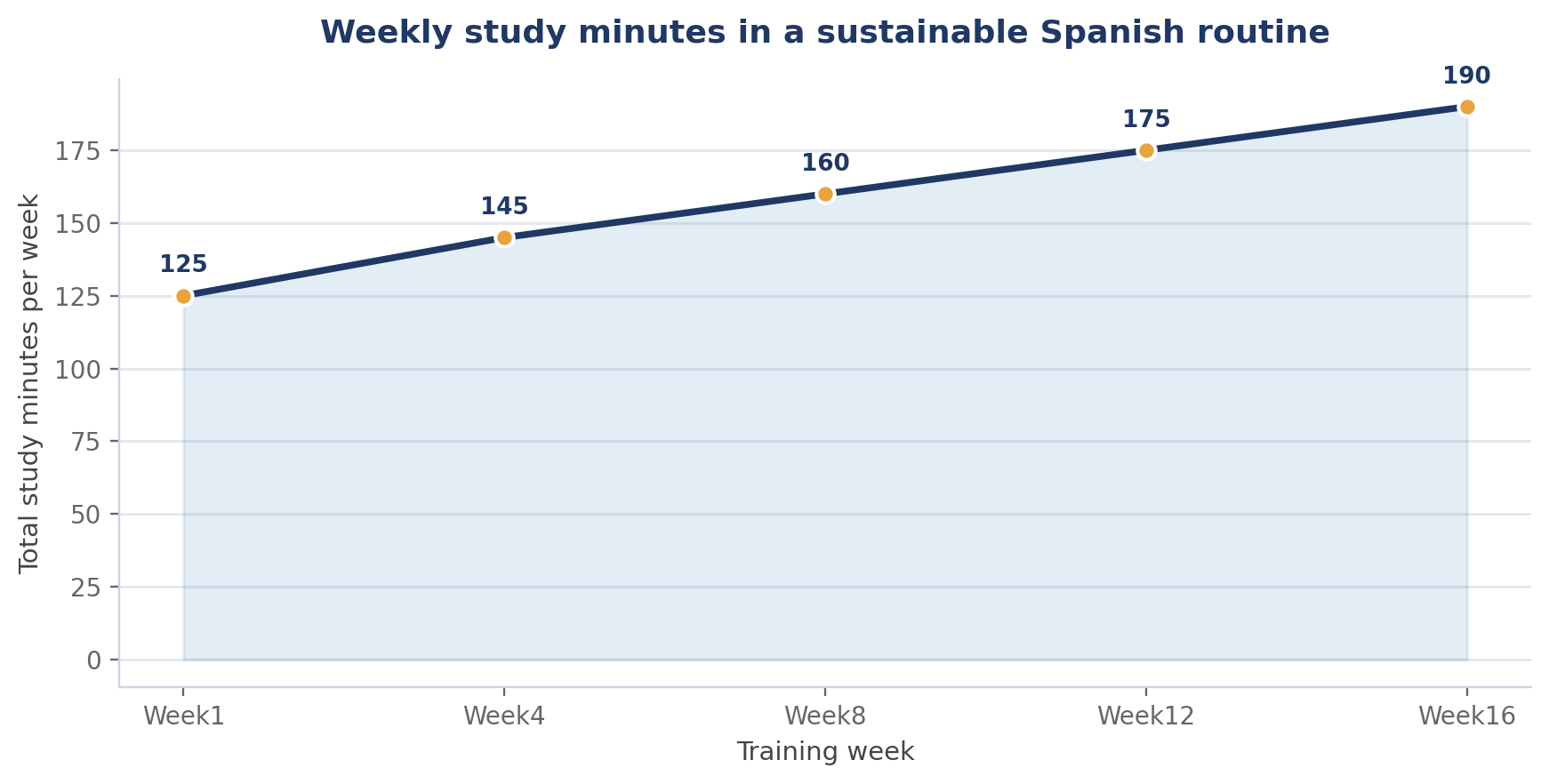
Notice the curve: it climbs gently because it never collapses. No crash weeks, no guilt resets.
How to make it stick
Attach the block to something you already do without thinking. Spanish after coffee. Spanish on the train. Spanish while the kettle boils. Habits hook onto existing habits, not onto willpower.
Track two things only: days completed this week, and one sentence you could say today but could not last month. That second line is the fuel. Progress you have felt is a habit you keep.
Frequently Asked Questions
How many minutes a day do I actually need for Spanish? Twenty-five focused minutes is enough to make visible progress, provided you keep the speaking slot. Below fifteen minutes a day, most learners plateau and drift. Above 45 minutes daily, returns flatten unless you add real conversation.
Is it better to study in the morning or at night? Whatever hour you will genuinely defend. Morning suits recall-heavy work like flashcards; evening suits relaxed input like podcasts. Consistency of time matters more than the time itself.
Can I build a routine using free resources only? You can reach a solid A2 and part of B1 with podcasts, free apps and language exchange. The bottleneck arrives at spoken accuracy — where corrections come from a person who knows what good Spanish sounds like.
How long before I can hold a conversation? With this routine, expect to manage a slow, awkward, wonderful fifteen-minute chat in three to four months. Fluency in the sense of comfort under pressure usually lands between 300 and 400 guided hours.
References & Further Reading
- Instituto Cervantes — Spanish courses and level framework: https://www.cervantes.es
- Centro Virtual Cervantes — free reading and listening materials: https://cvc.cervantes.es
- Council of Europe — CEFR level descriptors: https://www.coe.int/en/web/common-european-framework-reference-languages
- Instituto Cervantes — official DELE diploma information: https://www.cervantes.es
- FundéuRAE — practical Spanish usage and style advice: https://www.fundeu.es
You now have the routine. The last piece is the AI tutor listening.
Take the placement check, meet your personal AI voice tutor and turn 25 quiet minutes a day into real spoken Spanish. Your first free account takes under a minute.
Create your free account →Create a free account