Nobody tells you that embarazada means pregnant. So you announce to a Spanish colleague that you're embarrassed, and watch their face do something complicated.
That is a false friend. But it's not the mistake that keeps you stuck. The spanish learner mistakes that really cost you are quieter: the two-verb problem, the extra pronoun, the past tense you keep avoiding. Here are the ones that matter, and the fixes.
What you will get from this guide
- The ten errors that show up in almost every learner's speech
- Which mistakes are harmless and which mark you as a beginner
- Simple decision rules for ser/estar, por/para and the past tenses
- How to correct these without drilling yourself into boredom
Mistake One: Expecting Spanish to Sound Like English
Every letter is pronounced. Spanish is almost perfectly phonetic — once you learn the rules, you can read anything aloud. Learners who keep English vowel habits sound slow and unclear.
The five clean vowels are the foundation: a, e, i, o, u each have one sound. No diphthong drift. Say café like a flat short e, not "cafay".
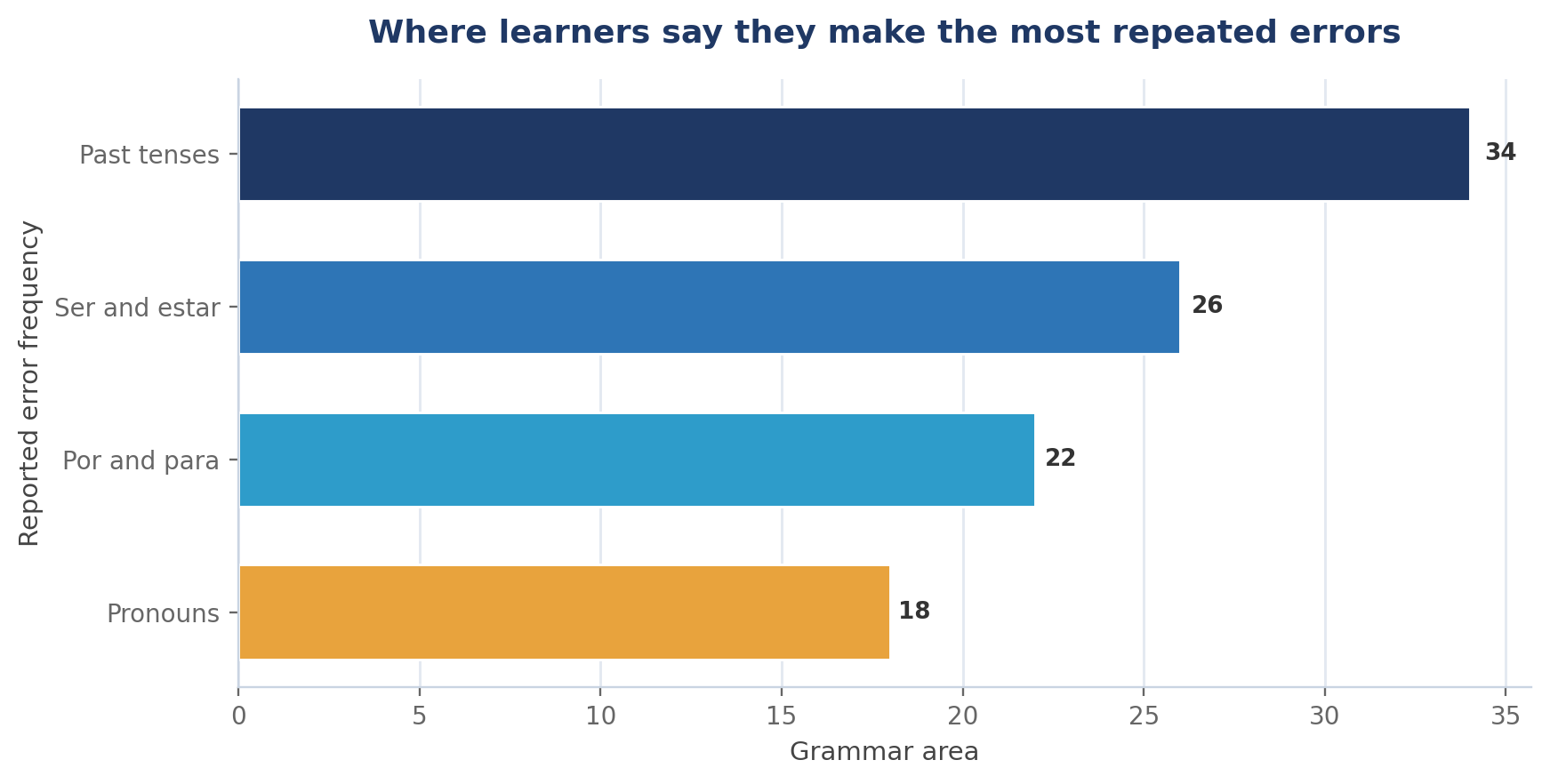
Mistake Two: Confusing Ser and Estar Beyond the Textbook
You know the rule: ser for permanent, estar for temporary. Then someone says es muy simpático about a person who is definitely not permanently anything, and the rule cracks.
The real distinction is essence versus state. Ser classifies. Estar locates and conditions.
That last pair is the one that turns a compliment into an insult. Learn the pairs, not the rule.
Mistake Three: Por and Para Never Learned Properly
Most learners get the gist of por and para and then guess forever. Stop guessing. Por is cause, exchange, movement through. Para is destination, purpose, deadline.
Mistake Four: Pronouncing Every Subject Pronoun
Yo study, tú study, él studies. Actually — no. Spanish drops subject pronouns because the verb already says who. Saying yo quiero every sentence sounds heavy, even defensive.
Use pronouns for emphasis or contrast, not by default. Yo quiero café, tú quieres té — that contrast is exactly when they belong.
Mistake Five: Avoiding the Preterite and Imperfect
This is the plateau-maker. Learners get comfortable with the present, then construct elaborate ways to talk about the past without committing to a tense.
The rule of thumb: preterite for completed events, imperfect for background and habit. Ayer fui al mercado — a finished trip. Cuando era niño, iba al mercado — an ongoing childhood habit.
If you avoid the past tense, you can't tell a story. And story-telling is where fluency lives.
Mistake Six: Escaping the Subjunctive
Espero que vengas. The subjunctive appears after expressions of wish, doubt, emotion and impersonal statements. Learners dodge it by rephrasing. That dodge is audible, and it caps you mid-B1.
You don't need to master it in a month. You need to stop treating it as optional and start using the five or six triggers you meet daily.
Mistake Seven: Silent Practice
The biggest of all. Reading, watching, listening — all comfortable. Speaking is uncomfortable, so it gets postponed. Ninety percent of plateaued learners share this single habit.
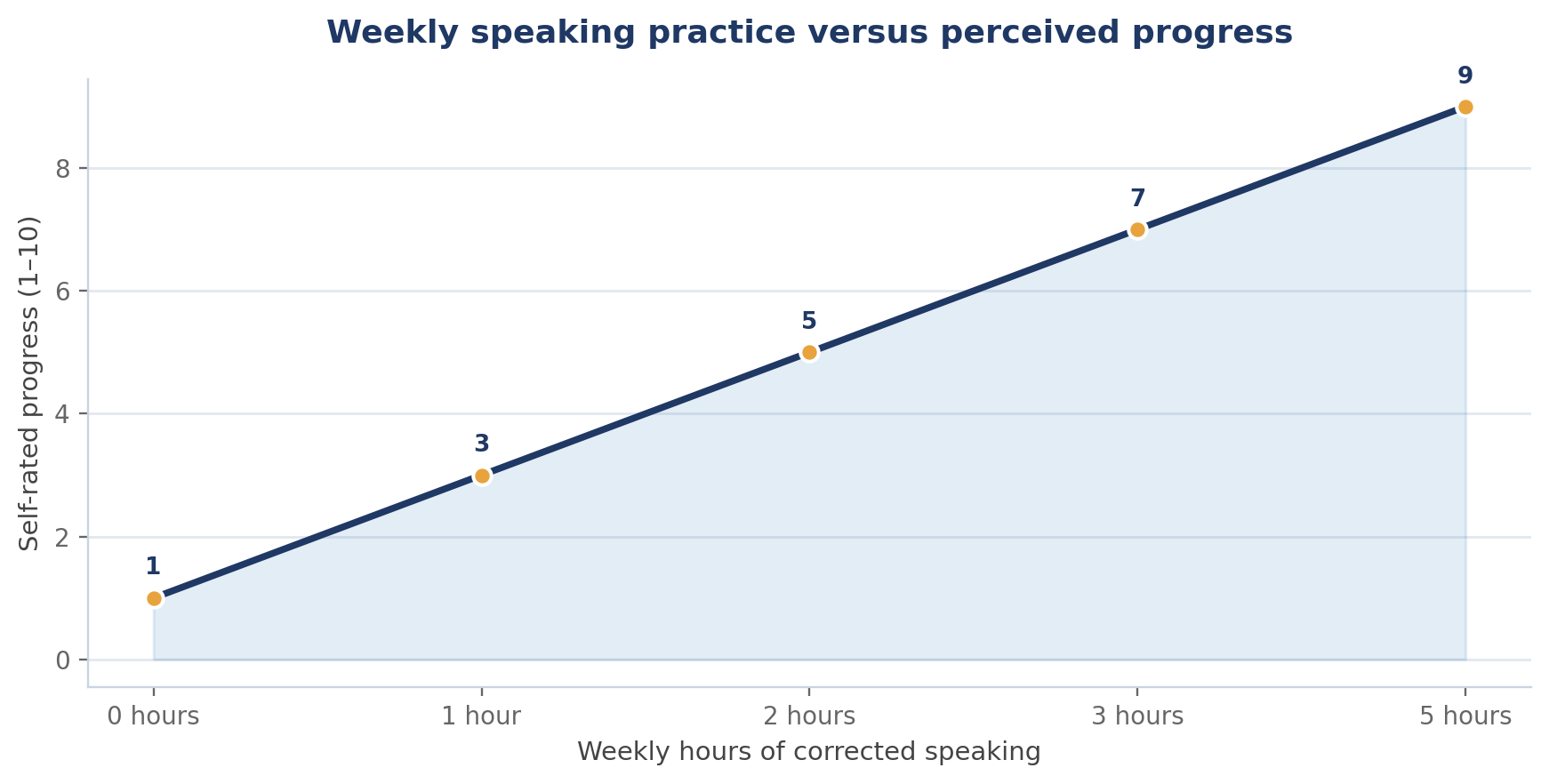
You cannot build a speaking skill by absorbing. Speaking practice with correction is the only thing that moves it. Fifteen minutes of corrected speaking practice beats two hours of passive listening for output ability.
Fix the mistakes your ear can't hear
A personal AI voice tutor catches the ser/estar slip, the missing subjunctive and the heavy pronoun in real time. That's the difference between another year of reading and a year of speaking.
Start self-paced Spanish lessons →Create a free accountThe Mistakes You Can Ignore for Now
Perfect pronunciation of rr. The full subjunctive table. Regional slang from three countries at once. Mastery of vosotros if you'll mostly speak in Latin America.
These are not errors you're overlooking — they're priorities you're sequencing. Fix the high-frequency ones first and the rare ones will arrive on their own.
Frequently Asked Questions
What is the biggest mistake Spanish learners make? Not speaking. Most learners consume endless input and postpone conversation. Speaking with correction is the single change that moves the needle fastest.
Why do learners struggle with ser and estar? Because "permanent versus temporary" is an incomplete rule. The real distinction is essence versus state — and pairs like es aburrido versus está aburrido show why it matters.
Should I learn the subjunctive early? Learn the triggers early, not the full conjugation tables. Espero que, quiero que and es importante que cover most of what you'll actually need in conversation.
Which Spanish false friends are the most dangerous? Embarazada (pregnant, not embarrassed), embarazoso (awkward), actual (current, not actual) and éxito (success, not exit) cause the most confusion.
References & Further Reading
- Real Academia Española & ASALE — Nueva gramática de la lengua española: https://rae.es
- Instituto Cervantes — Plan Curricular del Instituto Cervantes and DELE level descriptors: https://cervantes.es
- FundéuRAE — daily Spanish usage advice and common-error guidance: https://fundeu.es
- Council of Europe — Common European Framework of Reference for Languages: https://coe.int
- Instituto Cervantes — El libro del español correcto, on frequent errors in Spanish
Practise with correction at languageskills.net.