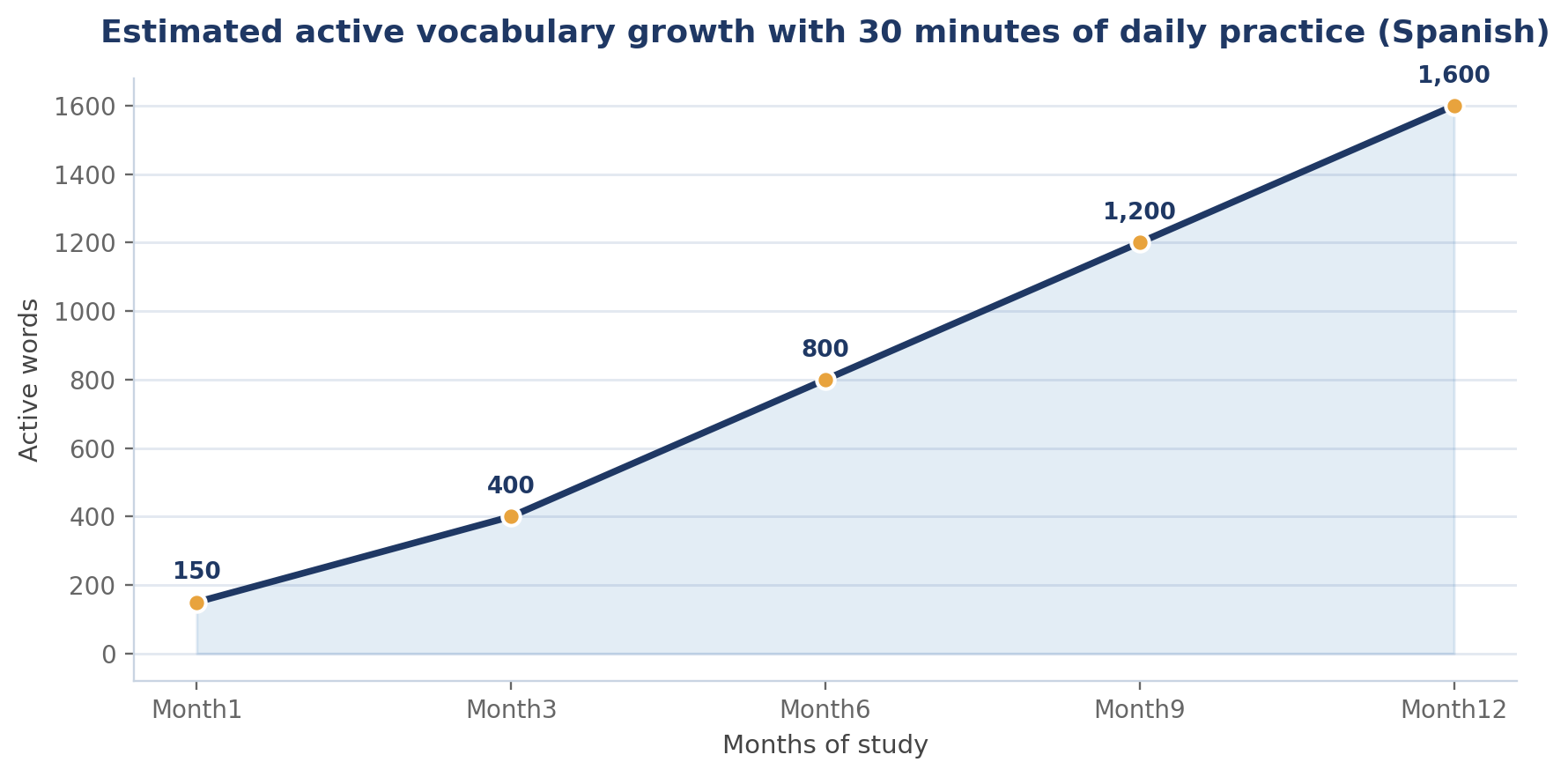
Nobody quits Spanish on day one. They quit in week seven, when the novelty is gone, the subjunctive is looming, and a waiter in Madrid answers faster than your brain can run.
Motivation is not a personality trait you were born without. It is a design problem. Build the conditions correctly and willpower barely gets involved.
What you will get from this guide
- Why motivation collapses at three predictable points
- The habit design that survives a bad week
- Milestones that prove progress when it feels invisible
- What to do when you hit the dreaded plateau
The Three Points Where Learners Quit
Every learner faces the same three ambushes. Knowing the calendar takes half the sting out of it.
The month-three dip is the crowded graveyard. It arrives exactly when the easy wins run out and the real work begins. Expect it and it stops feeling like a verdict on your talent.
Make the Habit Smaller Than Your Excuses
Deci and Ryan's self-determination theory says motivation grows from autonomy, competence and connection. Translation: you need control, visible skill growth, and other people. Tiny habits, described by BJ Fogg, supply the first two cheaply.
Notice the fourth one. A missed day is data, not a failure. Learners who restart within a day finish. Learners who wait for a fresh Monday usually do not.
Track the Right Numbers
Feelings lie. Numbers argue back.
Keep it to five numbers and review weekly for two minutes. Any tracking system you cannot face on a bad day will be abandoned by month two.
Motivation dies when nobody notices your progress
A personal AI voice tutor notices. Structured self-paced lessons give you a fixed routine, feedback that tracks your errors, and a win you can feel every single session. That structure carries you through month three.
Start a self-paced Spanish course →Create a free accountThe Milestones That Prove It Is Working
Progress in language learning is invisible for weeks and then obvious in a single moment. Collect the moments.
That last one is the real certificate. No exam beats hearing a stranger treat you as a Spanish speaker. Institutional proof has its place too, and the level descriptors on the Instituto Cervantes site make a useful target to aim at rather than a vague "fluency" wish.
When the Plateau Arrives
The plateau is not stagnation. It is consolidation. The brain is automating thousands of patterns you already recognise, and the visible curve flattens while invisible work continues.
That last row matters more than it sounds. "Learn Spanish" is a fog. "Hold a twenty-minute call with my grandmother in Medellín" is a target you can hit and celebrate.
The Social Ingredient Nobody Skips
Every learner who reaches B2 has other people in the loop. Not necessarily a class — a partner, a friend, a study group, or a conversation partner. Language is a social act, and practising it alone is like rehearsing a dance with no music.
Pick two. One alone is fragile, and three-plus becomes a calendar problem you will not keep. Ready to fix that? Start a self-paced course and check the CEFR level descriptions to choose a realistic next milestone instead of a vague ambition.
Turn willpower into a weekly appointment
You do not need more discipline. You need a routine and a tutor that keeps you going. Self-paced Spanish courses with a personal AI voice tutor give you both, plus the small wins that keep you going.
Start your Spanish course →Create a free accountFrequently Asked Questions
How long does the motivation dip usually last? The week-two dip is brief. The month-three dip can last weeks if you have no visible progress marker. Adding regular speaking practice shortens it sharply.
Are streaks useful or harmful? Useful until they become the goal. Track hours and conversations, and treat a broken streak as a restart cue rather than a defeat.
What if I am too shy to speak Spanish? Start with self-paced speaking practice. A patient AI voice tutor removes the audience, and confidence usually arrives faster than shy learners expect.
Can I stay motivated learning alone? Some learners can, with podcasts, graded readers and a strict routine. Most need at least one other person who notices when they disappear.
References & Further Reading
- Instituto Cervantes, Spanish language institution, courses and DELE exams: https://examenes.cervantes.es
- Council of Europe, CEFR level descriptions and self-assessment grids: https://www.coe.int/en/web/common-european-framework-reference-languages
- Deci, E. L. and Ryan, R. M., self-determination theory of human motivation
- Fogg, B. J., Tiny Habits, behaviour design for small consistent action
- Krashen, S., Principles and Practice in Second Language Acquisition, on comprehensible input