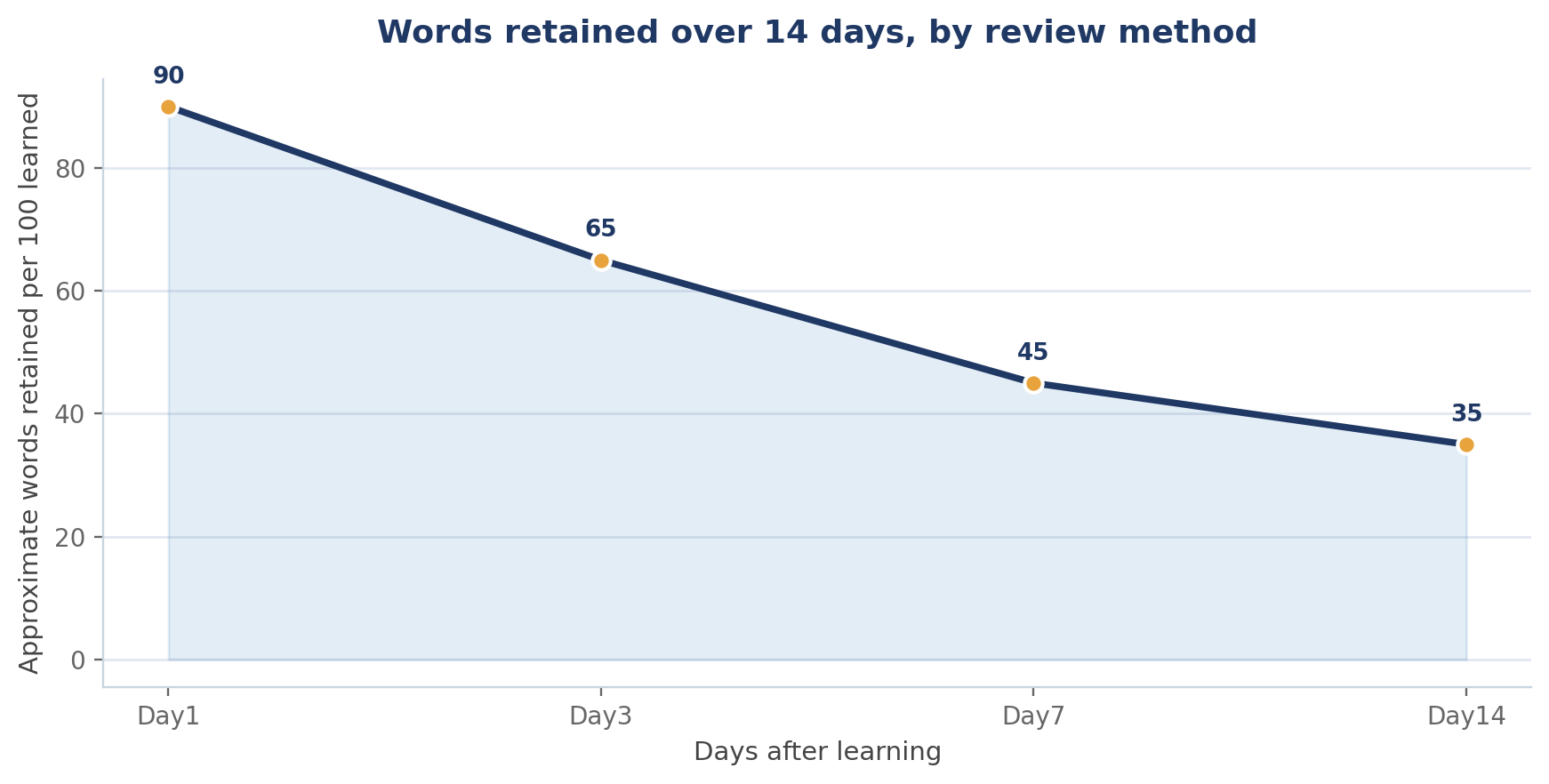
You learned la escalera on Tuesday. By Friday it was gone, and you were back to pointing at the stairs like a tourist in your own apartment. That is not a bad memory. That is a normal brain doing exactly what brains do: deleting what you never used.
So forget the fantasy of memorising a thousand words in a weekend. Here is how to recordar vocabulario en español the slow, stubborn way that keeps words for years — and why the method matters more than the effort.
What you will get from this guide
- Why the first 24 hours delete most new words
- A repetition schedule you can start tonight
- Mnemonics that survive contact with real conversation
- The habit that makes vocabulary permanent
The 24-hour cliff every word falls off
Hermann Ebbinghaus mapped this in 1885 and nobody has escaped it since. New information drops fast at first, then flattens. Miss the first day and you keep maybe a third of what you "learned".
The lie most learners believe is that repetition means rereading. Rereading feels productive because it feels easy. Easy is the enemy. Your brain files away the effort, not the page.
Recall beats review, every time
Active recall means closing the book and producing the word. Not recognising it — producing it. ¿Cómo se dice "stairs"? La escalera. That small struggle is the entire mechanism.
Do it in that direction: Spanish prompt, English answer, then flip. But also go the other way, English to Spanish, because production is the skill you actually need at a train station.
A repetition schedule you can start tonight
Spacing is the cheat code. Cramming wins the quiz; spacing wins the year.
Twenty new words a day on this schedule beats two hundred crammed on a Sunday. Every time.
Words you never use are words you lose
A personal AI voice tutor forces you to produce vocabulary out loud, then corrects the version you got wrong. That's the last review session your memory actually needs.
Explore Spanish courses →Create a free accountMnemonics that sound ridiculous and work anyway
Your brain keeps images and stories. It throws away abstractions. So give every stubborn word a picture.
Silly beats serious. The weirder the image, the longer it sits.
Where vocabulary actually dies
Not in the notebook. In the gap between learning a word and never needing it. Words that stay are words that show up in your life: your job, your kitchen, your group chat.
So build your lists by situation, not by alphabet. "At the pharmacy" beats "verbs starting with L". Ten situational sets of twenty words are worth more than one alphabetical list of two hundred.
The habit that beats every technique
Twenty minutes daily, out loud, with correction available. That's it. Technique multiplies a habit; it cannot replace one.
Write your words in a spiral notebook. Record yourself saying them on your phone and listen back on the walk to work. Once a week, tell somebody a two-minute story using the week's words. If your listener understands and fixes your accent, you have just completed the strongest review session that exists.
Twelve weeks of that is roughly 1,200 words — a solid B1 working vocabulary. Not glamorous. Just permanent.
Frequently Asked Questions
How many Spanish words can I realistically learn a day? Ten to twenty with spaced review is sustainable and sticks. Fifty a day works for about a week, then the reviews pile up and you quit.
Do flashcards really work? Yes, if you recall before flipping and space the reviews. A flashcard you glance at is a decoration. A flashcard you struggle with is a lesson.
Should I learn words in sentences? Always. El tren sale a las ocho gives you the word, the gender, the verb and the preposition in one package. A bare word is a puzzle with missing pieces.
How do I stop forgetting words I already learned? Keep them in rotation. Retirement is how vocabulary dies — pull old words into new conversations every few weeks.
References & Further Reading
- Ebbinghaus, H. (1885) — Memory: A Contribution to Experimental Psychology: https://psychclassics.yorku.ca/Ebbinghaus
- Cepeda, N. et al. (2006) — "Distributed practice in verbal recall tasks", Psychological Bulletin: https://pubmed.ncbi.nlm.nih.gov/16719566
- Murre, J. & Dros, J. (2015) — "Replication and Analysis of Ebbinghaus' Forgetting Curve", PLOS ONE: https://journals.plos.org/plosone/article?id=10.1371/journal.pone.0120644
- Nation, I.S.P. (2001) — Learning Vocabulary in Another Language, Cambridge University Press: https://www.cambridge.org
- Instituto Cervantes — Centro Virtual Cervantes reading and vocabulary resources: https://cvc.cervantes.es
Want the review partner who never lets a word slide? Meet your AI voice tutor this week.
Turn your word list into a voice
Free account, free placement check, then a self-paced lesson where you speak the vocabulary instead of staring at it. Twenty minutes a day plus one lesson a week changes everything.
Start free →Create a free account