There is no face on the other end. No lips to read, no hands to watch, no polite smile to buy you three extra seconds. Just a voice, a dial tone and a German sentence coming at you at full speed.
That is why learners who chat happily in a café freeze the moment the phone rings. German phone calls strip away every crutch you own — and then ask you to sound professional anyway.
What you will get from this guide
- The exact script every German business call follows, step by step
- Phrases for answering, holding, transferring and closing
- The formal register rules that keep you sounding competent
- A realistic timeline for phone progress at B1 and beyond
Why German Phone Calls Feel So Hard
German business calls run on a fixed script. Germans expect it. Once you know the script, the fear drops fast.
The trouble is speed. Written German gives you commas, paragraphs and a backspace key. A phone gives you one pass at full volume. Add regional accents — Bavarian, Swabian, Saxon — and even a B2 learner can miss the first twenty seconds.
Three forces hit you at once: no visual cues, compressed syntax, and formal register. Beat them one at a time and the call becomes routine.
The Anatomy of a Business Call in German
Every professional call follows the same five beats. Learn them as blocks, not as random words.
Notice the closing. Germans say Auf Wiederhören on the phone and Auf Wiedersehen only when they can see you. Mix them up and you flag yourself as a foreigner in the first ten seconds.
Answering, Holding and Transferring: The Core Toolkit
Here are the phrases that carry most calls. Drill them out loud until they leave your mouth without permission.
That last one catches people. Ausrichten means to pass a message along. Ich richte es ihm aus is the professional version. Avoid Ich sage es ihm — it sounds like gossip, not business.
Small Words That Decide How You Are Judged
German phone calls live or die on tiny particles. They carry the politeness.
B1 learners often skip these. Native speakers never do. Adding denn to a question turns interrogation into conversation: Was ist denn das Problem? beats Was ist das Problem? every time.
Spelling on the Phone: The One Skill Nobody Practises
German phone alphabets are not optional. You will need to spell your name, your email, your customer number.
Two rules matter. Say Doppel-P for a double letter, and use A wie Anton when the line crackles. German speakers also default to Ä wie Ärger and Ü wie Übung for umlauts — learn those two and your email address survives any bad connection.
Stop rehearsing alone. Practise with a personal AI voice tutor.
You can read a phrase list a hundred times and still freeze when a Swabian accent says Grüß Gott at 9 a.m. A personal AI voice tutor gives you speaking practice with feedback at your own pace, any time.
Start your German course →Create a free accountFormal vs Informal: Getting Sie Right on a Call
One wrong pronoun can end a business relationship. German splits its pronouns hard.
Default to Sie. A German colleague will almost always offer the du out loud: Wir können uns duzen. Wait for that offer. Taking it early is the fastest way to look presumptuous.
How Long Until Phone German Feels Natural?
Phone skill lags general speaking skill because it removes visual support. Expect a gap of one CEFR sub-level between your casual German and your phone German.
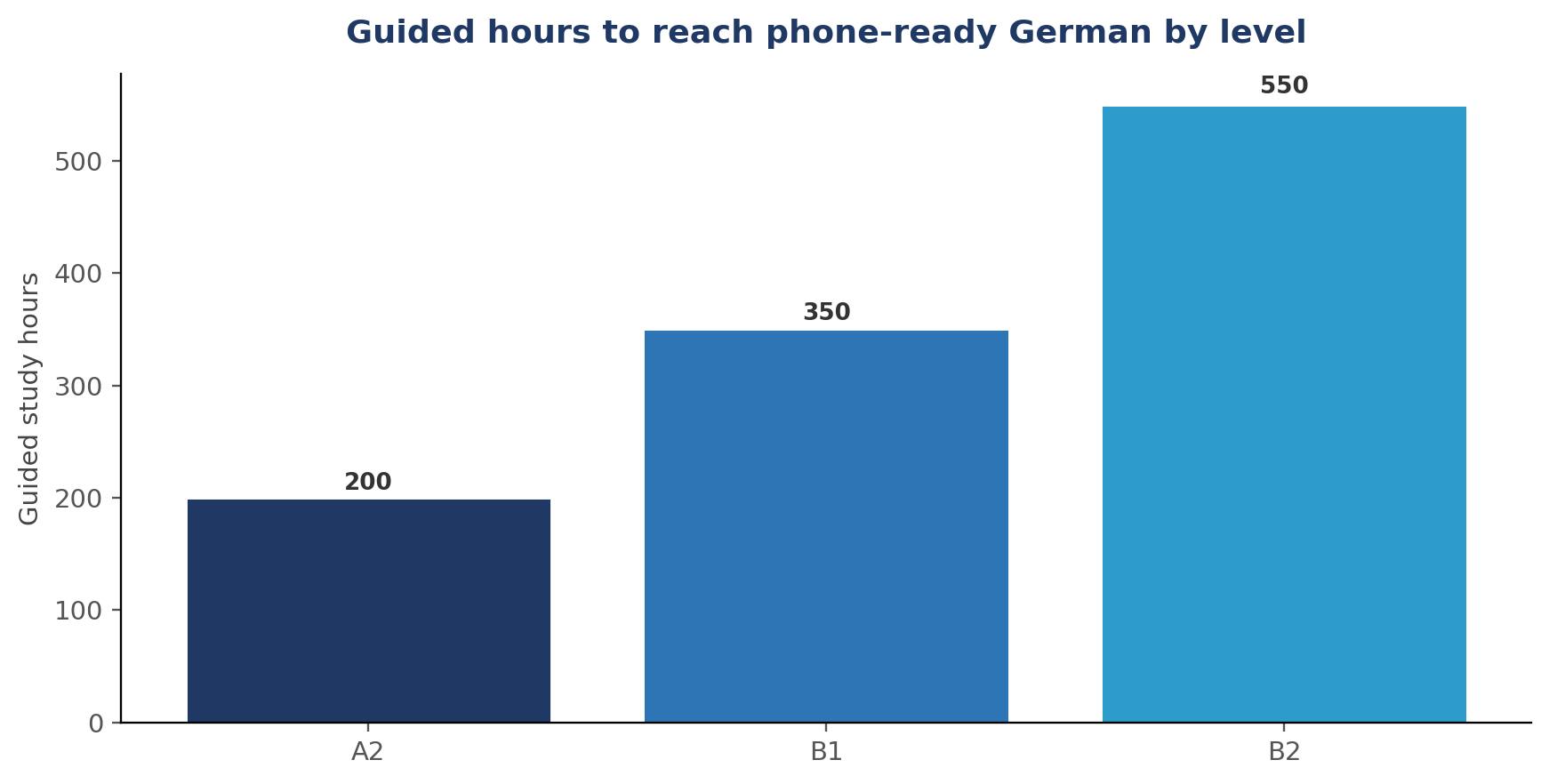
The jump from B1 (roughly 350 guided hours) to B2 is where phone work stops feeling like translation and starts feeling like talking. The trick is not more vocabulary. It is repetition of six or seven call scripts until they become muscle memory.
A Five-Minute Daily Drill That Actually Works
Record yourself. That is the whole secret.
Take one script from the tables above. Read it aloud twice while recording. Play it back and count the fillers — äh, also, halt. Rerecord until there are none. Then change one variable: the reason for the call, the name, the problem. Rerecord.
Do this five minutes a day for three weeks and your opening line becomes automatic. Automation is what kills the panic.
Turn five minutes a day into real speaking practice.
Learners who rehearse alone plateau around B1 on the phone — they need a partner who answers back at speed. Our self-paced German courses pair you with a personal AI voice tutor that gives you speaking practice and feedback on your register, your particles and your spelling, any time you study.
Start your German course →Create a free accountFrequently Asked Questions
How do I answer a German business phone? Say your company name, then your surname, then a greeting: Weber GmbH, Klein, guten Tag. Some firms reverse the order, so listen to how colleagues answer and copy them.
What is the difference between "Auf Wiederhören" and "Auf Wiedersehen"? Auf Wiederhören is for the phone — literally "until we hear each other again." Auf Wiedersehen is for when you can see the person. Using the wrong one sounds immediately amateur.
Can I get by at B1 on German phone calls? Yes, with preparation. B1 is enough for routine calls: taking orders, booking, transferring, confirming details. Complex negotiation usually needs B2.
Should I use "du" or "Sie" with a German client? Always Sie unless the client explicitly offers the du. Wir können uns duzen is the green light — nothing else is.
References & Further Reading
- Goethe-Institut: Deutsch am Arbeitsplatz — workplace German modules and register guidance.
- Deutsche Welle: Deutschtrainer — free audio lessons including telephone situations.
- Duden: Richtiges und gutes Deutsch — the standard reference on formal German usage.
- telc: telc Deutsch B1–B2 Beruf — the exam whose speaking tasks include telephone scenarios.
- CEFR Companion Volume (Council of Europe) — reference levels for spoken interaction.
Then hang up, breathe, and try again tomorrow. The phone only beats you as long as you avoid it.