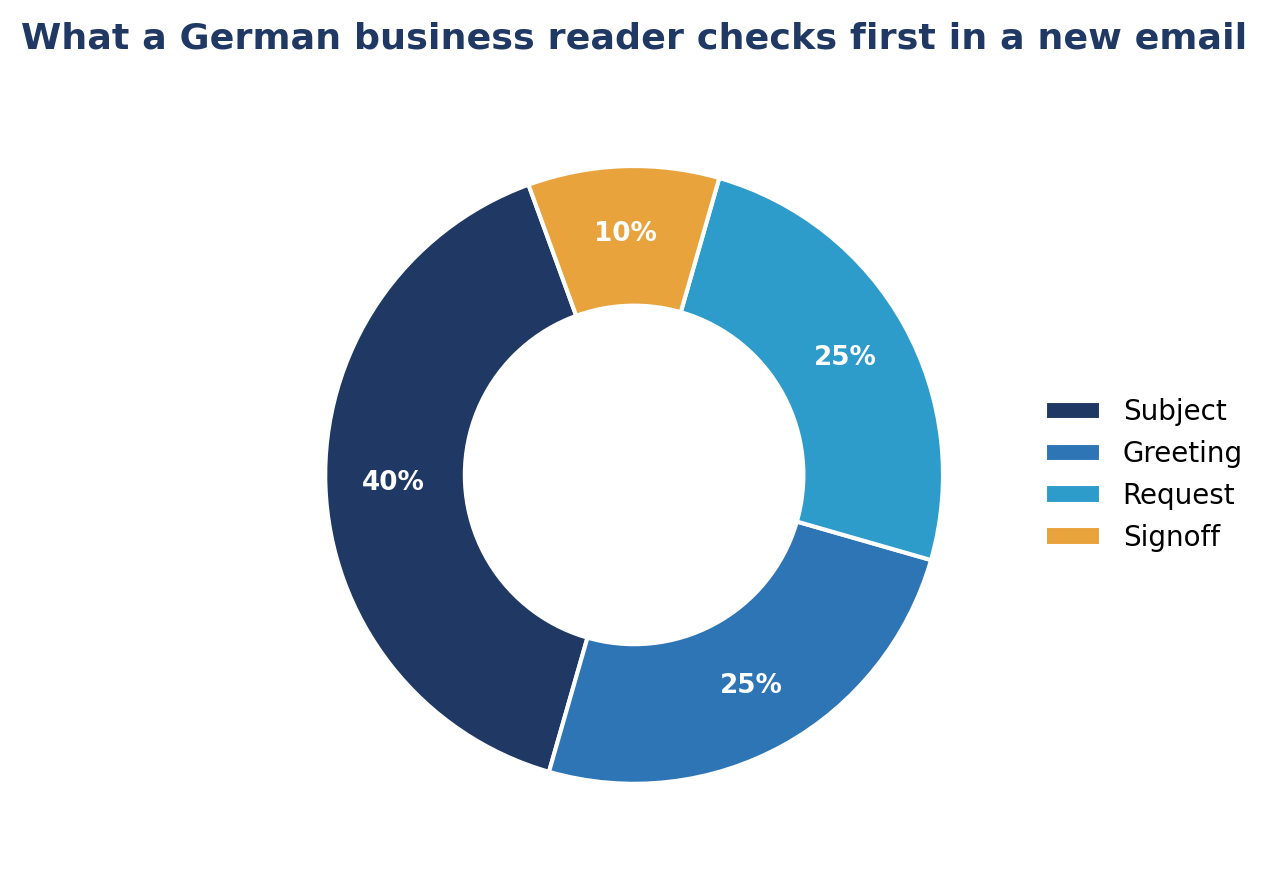
Your German is decent. You can order lunch, argue about football, and understand the news. Then an email lands in your inbox from a client in Hamburg, and you stare at the greeting line for four minutes because you cannot decide between Hallo, Guten Tag, and Sehr geehrte.
Here is the good news. German business email is the most rule-bound, most learnable writing genre in the language. The register is narrow, the formulas are stable, and once you know the skeleton you can build a hundred emails from it.
Here is the bad news. Getting the greeting and the sign-off wrong is not a small mistake. In a German-speaking office, it reads a bit like turning up to a meeting in a tracksuit.
What you will get from this guide
- The six-part structure of a German business email
- A phrase bank for openings, requests, delays, and follow-ups
- Greeting and sign-off rules, including Swiss and Austrian differences
- The mistakes that make a correct email sound rude
The Skeleton of a German Business Email
German emails are shorter and more structured than English ones. Order matters, and so does omission: German business writing values what you leave out.
That is the whole architecture. Notice how little room is left for throat-clearing.
Subject Lines: Betreff Rules
A German Betreff is not a teaser. It is a label. It should let a busy person file, prioritise, and act without opening the message.
Three habits cover almost every case: name the topic, add the reference number or date, and use a colon for the sub-topic. No exclamation marks, no all-caps, no emojis in formal threads.
Greetings: Choosing the Right Anrede
This is where learners sweat, so here is the map. Register follows relationship, not company size.
Two rules that never fail: use Sie until the other person offers du, and always put a comma after the greeting, with a lowercase letter starting the next line. That lowercase line surprises English speakers every time.
The Phrase Bank You Will Actually Use
Memorise these blocks. They cover the vast majority of working correspondence at B1 and beyond.
That last line is the German business equivalent of a firm handshake. Use it when you want to sound cooperative and finished.
Knowing the phrases is not the same as using them under pressure
Ready to turn reading into real German? Start your self-paced course today.
Start the German course →Create a free accountThe gap between recognising für Rückfragen stehe ich Ihnen gerne zur Verfügung and writing it correctly in thirty seconds is pure practice — and practice goes fastest with someone reading your drafts. LanguageSkills.net German courses drill real workplace writing with a personal AI voice tutor.
Button: Practise German writing live →
Sign-Offs: Grußformel Rules
The sign-off is short and non-negotiable. Pick by formality, and keep it consistent with your greeting.
One practical note: Mit freundlichen Grüßen is never abbreviated in formal writing. Also, no comma after the sign-off line, and your name goes on the next line.
Structure Your Body Like a German
German readers expect the point early and the detail after. Bury the request and you will get a reply asking what you actually wanted.
Six sentences. No adjectives doing overtime. No apology for existing.
The subject line does most of the heavy lifting before anyone reads your beautiful sentence about the deadline.
Five Mistakes That Make a Correct Email Sound Wrong
Vocabulary errors are forgivable. Register errors are not. These five are the ones that quietly change how people treat you.
Also avoid humour and irony with new contacts. German business writing prefers clarity so strongly that a joke can read as evasiveness.
Swiss and Austrian Variations Worth Knowing
If you write to Zurich or Vienna, small differences matter and locals notice them immediately.
When in doubt, mirror the greeting the other person used. That single habit solves most regional uncertainty.
A Template You Can Reuse Tomorrow
Fill in the brackets and you have a professional German email in under a minute.
Print it, keep it beside your keyboard for two weeks, and you will stop needing it.
Sound competent in German, not just correct
Ready to turn reading into real German? Start your self-paced course today.
Start the German course →Create a free accountCorrect grammar with the wrong register still costs you credibility. A B1-level German course focused on workplace writing fixes that fast, because the AI voice tutor gives feedback on your real emails and helps you rewrite the parts that sound off.
Button: Start your German course →
Frequently Asked Questions
Is "Hallo" acceptable in a German business email? Internally with colleagues you know, yes. With new external contacts, it reads too casual. Use Guten Tag Herr Müller or Sehr geehrte Frau Müller for a first contact, and switch to Hallo once the relationship loosens.
Should I capitalise after the greeting comma? No. After Sehr geehrte Frau Weber, the next line begins with a lowercase letter. This rule is followed strictly in professional German writing, and breaking it signals inattention.
What is the safest sign-off in German business email? Mit freundlichen Grüßen works almost everywhere and is never wrong in external correspondence. Freundliche Grüße and Beste Grüße are slightly warmer options for established contacts.
Do I need a formal opening line before getting to the point? A brief one, yes — a thank-you or a reference to a previous message. But keep it to one sentence. German readers expect the purpose of the email in the first two lines.
How do I write to someone whose gender or title I don't know? Use Sehr geehrte Damen und Herren, or write to the team or department by name. Avoid inventing a title. If you have a job title only, addressing the role with Sehr geehrte Damen und Herren is safe.
Which certificates show employers I can write professional German? telc Deutsch B1–B2 Beruf is designed specifically for workplace German, and Goethe-Zertifikat B2 also signals professional capability. Exam-style writing practice is the fastest way to close the gap — start with a level check and sign up here.
References & Further Reading
- Duden — German spelling, punctuation, and correspondence conventions including greeting and comma rules: https://www.duden.de/
- telc gGmbH — telc Deutsch B1–B2 Beruf, the workplace German certificate and its exam format: https://www.telc.net/en.html
- Goethe-Institut — Goethe-Zertifikat levels and writing assessment criteria: https://www.goethe.de/en/spr/kup/prf.html
- Beuth Verlag — DIN 5008, the German standard for business letters and correspondence layout: https://www.beuth.de/
- Bundesministerium für Wirtschaft und Klimaschutz — German business etiquette and trade information for international partners: https://www.bmwk.de/EN/Home/home.html
- Deutsche Welle — DW Learn German, business German materials and placement test: https://learngerman.dw.com/en/overview