The meeting starts in ninety seconds. Thirteen people. A table the size of a small runway. And the project you have carried for four months is on the agenda, item three, sandwiched between budget concerns and something about logistics that nobody understands.
You know this project. You could present it in your sleep. In English.
Then the chair says Wollen wir anfangen? and every prepared sentence you own evaporates like breath on a window.
Here is the good news, delivered plainly: business German is not general German with longer words. It is a closed system. A finite set of formulas, repeated so often that mastering a few dozen business german phrases will take you further than a thousand extra vocabulary cards. Meetings run on ritual, and rituals are learnable.
What this guide gives you
- The exact phrases for opening, steering and closing a German meeting
- Polite disagreement language that does not cost you the room
- The Sie and Du rules, and the moment they change at work
- A phrase table per situation, so you can prepare by scenario, not by grammar
First: The Sie and Du Minefield
German workplace culture runs on formality, and getting this wrong is the fastest way to sound either arrogant or adolescent.
The rule that saves you: never offer Du downward and never assume it upward. Wait. Somebody will say Wir können uns duzen. That sentence is your green light and it is genuinely that simple.
Opening a Meeting
The first two minutes set your ceiling for the whole hour. German meetings like structure, and they announce it.
Notice the politeness density. German business speech is courteous by default, even when the content is sharp. Never mistake directness for rudeness; it is simply less padded than English.
Steering the Agenda
Meetings drift. In German, drift is handled with slightly firmer hands.
That last one is your survival tool. Um auf die Frage zurückzukommen means "to come back to the question", and it rescues you when a discussion has wandered into a meadow.
Disagreeing Without Blowing Up the Room
This is where most B1 speakers either go silent or go nuclear. German gives you a middle lane, and it is well marked.
The pattern matters more than the vocabulary. German objections often open with a hedge, then land the point. Ich sehe das etwas anders, weil die Zahlen nicht belegen, dass… That structure lets you disagree with a director and keep your relationship intact.
Agreeing, Qualifying, Committing
Agreement in German is not just ja. It is calibrated.
Be careful with Ich kümmere mich darum. It is a commitment, not a shrug. In German work culture, saying it and not doing it is remembered far longer than in some other environments.
Learn the phrases, then use them on your own schedule
Reading a phrase table is step one. Speaking those phrases under pressure, with an AI voice tutor that gives you feedback in real time, is where they stick. Self-paced German lessons built for professional contexts, from A1 to B2.
Explore business German courses →Create a free accountPresenting and Explaining Data
If your project is on the agenda, you need these on the tip of your tongue.
Use the subjunctive würde and hätte rather than blunt imperatives. Wir müssen das ändern sounds like an order. Ich würde vorschlagen, dass wir das ändern sounds like a colleague.
Emails and Written Follow-Ups
Half of business German never leaves the keyboard. Get these right and you look far more competent than your grammar suggests.
Mit freundlichen Grüßen is the workhorse. It is correct in almost every professional email and safely neutral. Reserve the heavier closing for courts, ministries and letters that make you nervous.
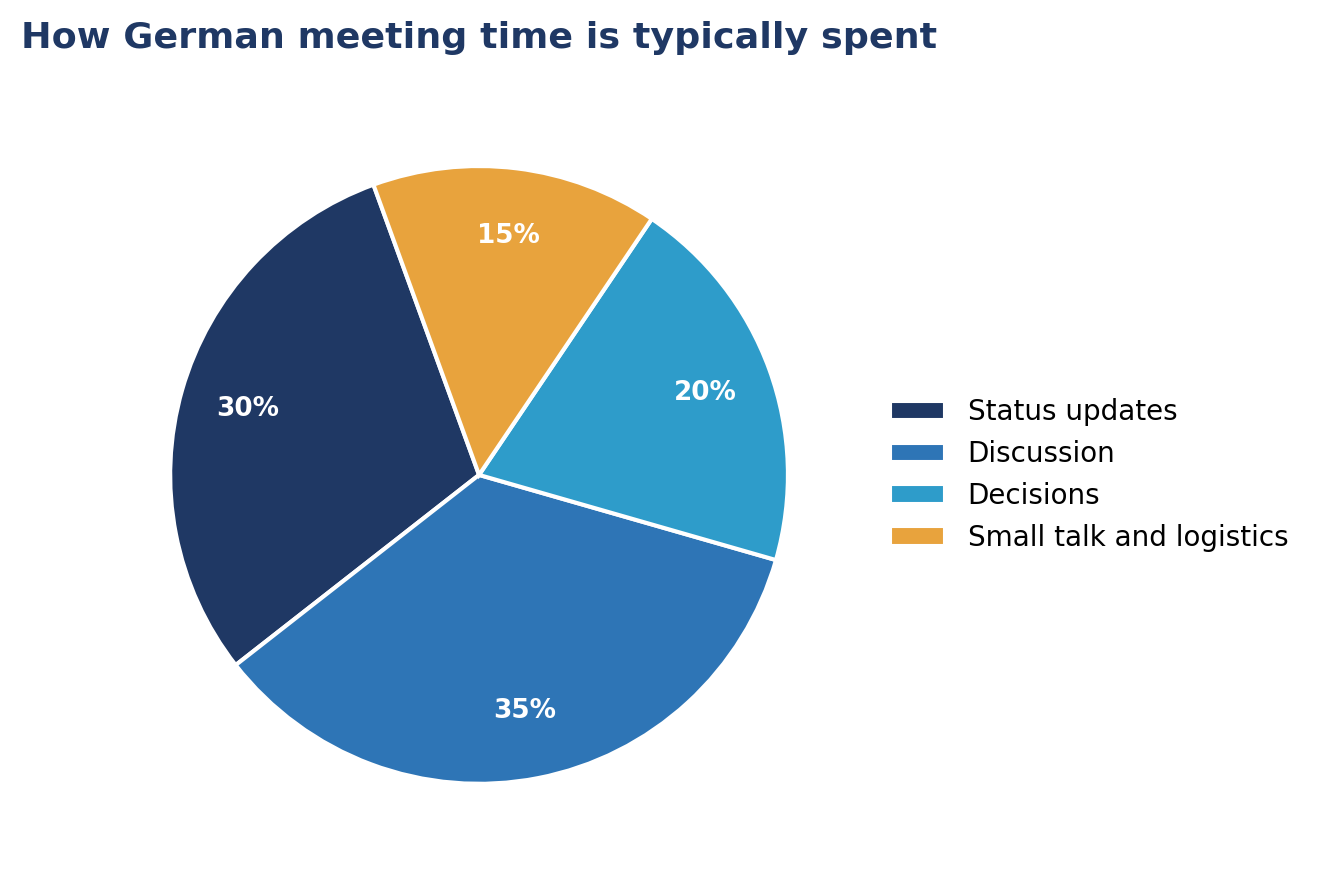
Only about a fifth of the time goes to actual decisions. Which means the phrases that matter most are the ones around negotiation, not the ones around description.
The Meeting Survival Kit
Six phrases, if you learn nothing else.
Say these six out loud until they stop feeling foreign. Fluency in meetings is not built from vocabulary. It is built from reflexes.
Preparing for Your Next German Meeting
Do this once per meeting and your performance jumps.
That is 42 minutes. It is the highest-return German study you will do all week, because it is aimed at a real event with real stakes.
Walk into the room calm
The difference between a good German meeting and a painful one is rarely grammar. It is preparation and practice. Our self-paced lessons drill exactly these workplace situations, with an AI voice tutor that makes you speak before you feel ready.
Book a placement test →Create a free accountFrequently Asked Questions
What level of German do I need for business meetings? B1 is the practical threshold. At B1 you can follow the main thread, give an update and disagree politely. Below B1, meetings are survivable with prepared scripts but exhausting without them.
Should I use Sie or Du with German colleagues? Start with Sie unless your team clearly uses Du internally. Let a German speaker offer the switch with "Wir können uns duzen", and never offer it first to someone senior to you.
How do I disagree in a German meeting without being rude? Open with a hedge, then state your reason. "Ich sehe das etwas anders, weil…" is firm, professional and completely normal in German workplaces.
Are German business emails formal? Generally more formal than English ones. "Sehr geehrte Frau…" and "Mit freundlichen Grüßen" are standard, and dropping them entirely can read as abrupt.
Which phrases are most useful for German conference calls? Repetition and clarification phrases carry the most weight: "Könnten Sie das bitte wiederholen?" and "Können Sie das genauer erläutern?" are used constantly when audio quality fails.
Is business German different from everyday German? The vocabulary overlaps heavily, but the register differs. Meetings use more nominal style, more subjunctive politeness and a fixed set of formulas you can memorise as chunks.
References & Further Reading
- Goethe-Institut — German for professional purposes and exam levels: https://www.goethe.de/en/spr/kur.html
- Duden — spelling, grammar and business letter conventions: https://www.duden.de/
- Deutsche Welle — business German and workplace learning content: https://learngerman.dw.com/en/overview
- telc gGmbH — Business German certificates and exam formats: https://www.telc.net/en/
- Germany Trade & Invest — working and doing business in Germany: https://www.gtai.de/en
- Council of Europe — CEFR level descriptors for professional language use: https://www.coe.int/en/web/common-european-framework-reference-languages