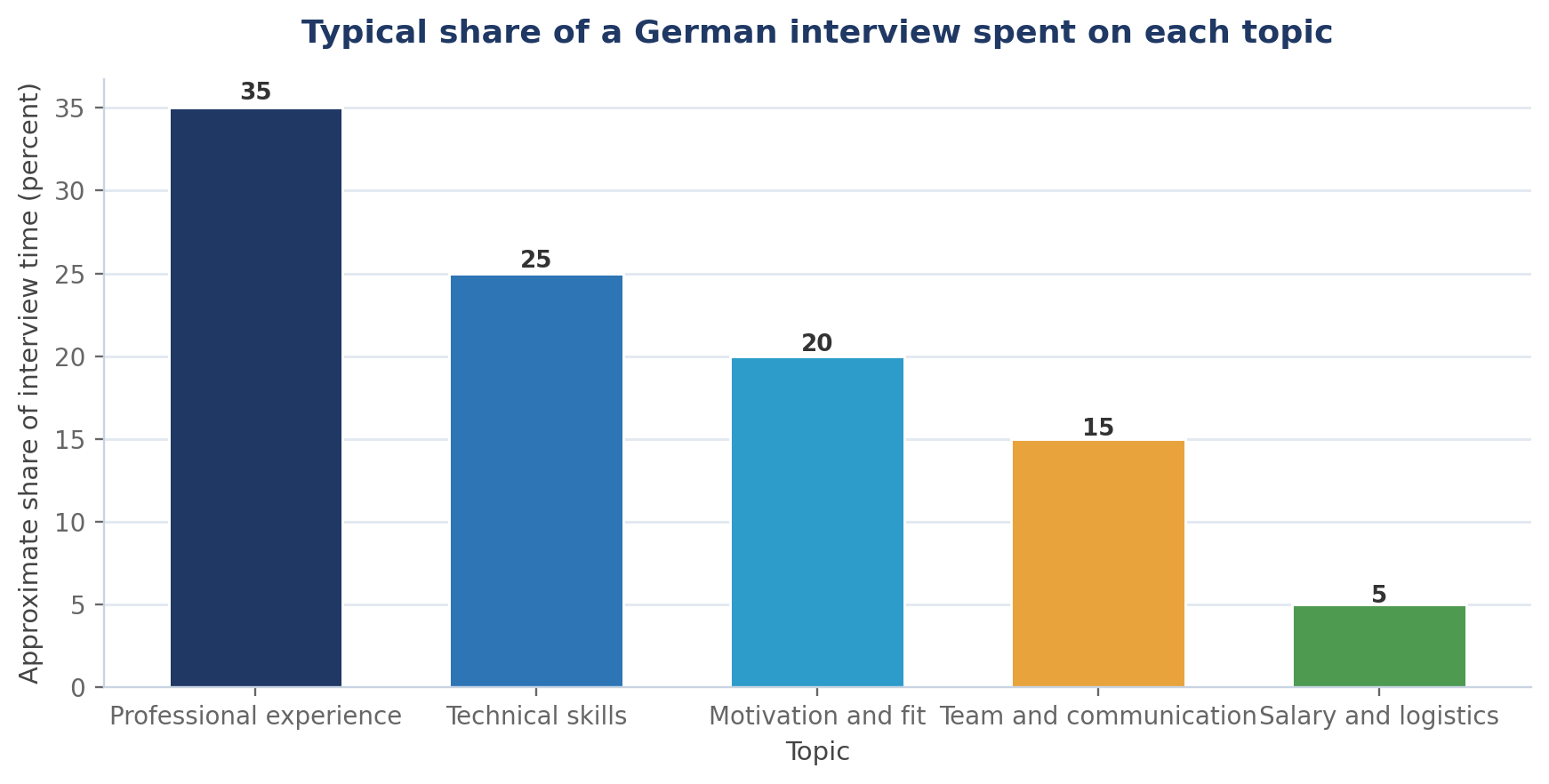
The German job interview is not a conversation. It is a structured assessment with a handshake on either end.
That is not coldness — it is clarity. German hiring runs on evidence: what you did, where, with what result, and what it cost. Bring stories, not adjectives. Here is how the German job interview actually works, and the exact language to survive it.
What you will get from this guide
- The most common German interview questions, in German
- Model answer structures you can adapt to your own history
- Etiquette rules that quietly decide outcomes
- The B2 phrases that make you sound professional, not translated
How the German Interview Differs
In many markets, interviews reward confidence and enthusiasm. In Germany, they reward Nachweis — proof. Your CV is a factual document. Your answers should match it in tone.
Do not open with jokes. Do not oversell. Open with your record.
The Core Questions — And What They Are Testing
These are the workhorses. Learn them in German, because hearing them in German first is half the battle.
Notice the word möchten. It is polite, not casual. Answer in the same register.
Model Answers You Can Adapt
Never memorise word for word — you will sound like a robot reading a script. Memorise the shape, then fill it with your own facts.
Erzählen Sie etwas über sich. Structure: present role, key achievement with a number, why this role is next. Three sentences. Then stop. "Ich arbeite seit vier Jahren als Projektmanagerin im Maschinenbau. In dieser Zeit habe ich die Lieferzeit um 20 Prozent reduziert. Jetzt suche ich eine Position mit größerer Verantwortung im internationalen Umfeld."
Warum möchten Sie hier arbeiten? Name something specific: a product line, a market, a stated value. Generic praise ("great company") is a red flag. "Ihr Unternehmen wächst stark im Bereich E-Mobilität. Genau dort habe ich in meiner letzten Position Erfahrung gesammelt."
Was sind Ihre Schwächen? Give a real weakness and the system you use to manage it. Avoid humble-bragging. "Ich neige dazu, zu viele Details zu prüfen. Deshalb setze ich klare Deadlines und hole früh Feedback ein."
The Vocabulary That Makes You Sound B2 (Not B1)
At B2 you are expected to discuss work with nuance: conditions, consequences, trade-offs. Level B1 gets you the facts across. B2 lets you argue.
Sprinkle, do not flood. Two or three of these in twenty minutes reads as fluency. Ten reads as a phrasebook exploded.
Interviews are spoken, not studied
You can know every phrase and still freeze when the room goes quiet. Our self-paced German courses with an AI voice tutor rehearse exactly this: structured speaking practice with AI feedback that helps you refine your professional register.
Get interview-ready in German →Create a free accountEtiquette: The Silent Assessment
Do not ask about vacation days in the first interview. Do not question the salary before they raise it. Both mark you as focused on the wrong thing.
Salary Questions Without Panic
German employers expect a number. Vagueness reads as unpreparedness.
Do your research first. Say a range, anchor it to your experience, and cite market data calmly. "Aufgrund meiner fünf Jahre Erfahrung liegt meine Vorstellung zwischen X und Y."
Red Flags German Employers Notice
That fourth one stings for learners. When you reach for "let's touch base" in German, you reveal that your German has no professional layer yet. Build it deliberately.
Your Three-Day Prep Plan
Day one: write your three core stories — achievement, failure survived, conflict resolved — each with a number in it. Day two: say them aloud in German, timed, until they fit ninety seconds each. Day three: rehearse the salary answer and prepare four questions about the company.
Speaking aloud is non-negotiable. Reading your answers is not rehearsal. It is memorising a document.
Walk in speaking professional German
A great CV gets you the room. Your German gets you the offer. Our B2-level courses focus on work contexts — meetings, negotiations, interviews — with an AI voice tutor and structured lessons you study at your own pace.
Prepare for your German interview →Create a free accountFrequently Asked Questions
What level of German do I need for a job interview in Germany? B1 is often the minimum for roles with English-speaking teams, but B2 is the practical threshold for German-language interviews. At B2 you can argue a point, describe results and handle unexpected questions.
Should I use du or Sie in a German job interview? Use Sie from start to finish unless the interviewer explicitly offers du. Switching too early is one of the most common mistakes international candidates make.
How do I answer "Was sind Ihre Schwächen" honestly? Name a genuine, non-critical weakness and describe how you manage it. Structure beats content: weakness, awareness, concrete countermeasure, outcome.
Is it okay to ask about salary in the first German interview? Only when they raise it. If they ask your expectation, give a researched range with a one-sentence justification rather than deflecting.
References & Further Reading
- Goethe-Institut, German for professional purposes and CEFR level descriptions, goethe.de.
- Make it in Germany, Working in Germany: applications and job interviews, make-it-in-germany.com.
- Federal Employment Agency (Bundesagentur für Arbeit), Bewerbung und Vorstellungsgespräch, arbeitsagentur.de.
- Handelsblatt and Deutsche Welle business coverage on German workplace culture, dw.com.
- BAMF, Living and working in Germany, bamf.de.