A streak of 400 days. A neat green owl telling you felicidades. Then you meet an actual Spanish speaker and your mouth locks shut.
That is the app paradox in one sentence. You did the work, you kept the habit, and the skill you wanted — talking to people — did not appear. So what is really going on?
What you will get from this guide
- What apps genuinely do well, with evidence
- Where they hit a hard ceiling, and why
- A side-by-side comparison of hours, costs and outcomes
- A hybrid plan that uses both without wasting money
The Honest Case For Apps
Apps are excellent at three things, and it is worth saying plainly.
There is real research behind this. A study by Vesselinov and Grego (2012), funded by Duolingo itself, found that roughly 34 hours of app study produced gains comparable to a first semester of university Spanish. Note who paid for it. But the direction of the finding has been echoed by independent work too: apps build vocabulary and grammar recognition effectively.
The Wall Apps Cannot Climb
Here is the uncomfortable part. An app never asks you something you did not expect.
Watch the difference in one detail. An app accepts yo quiero forever. A teacher says ¿cómo? and makes you repeat it, then asks a follow-up question you did not rehearse. That second move is the entire skill.
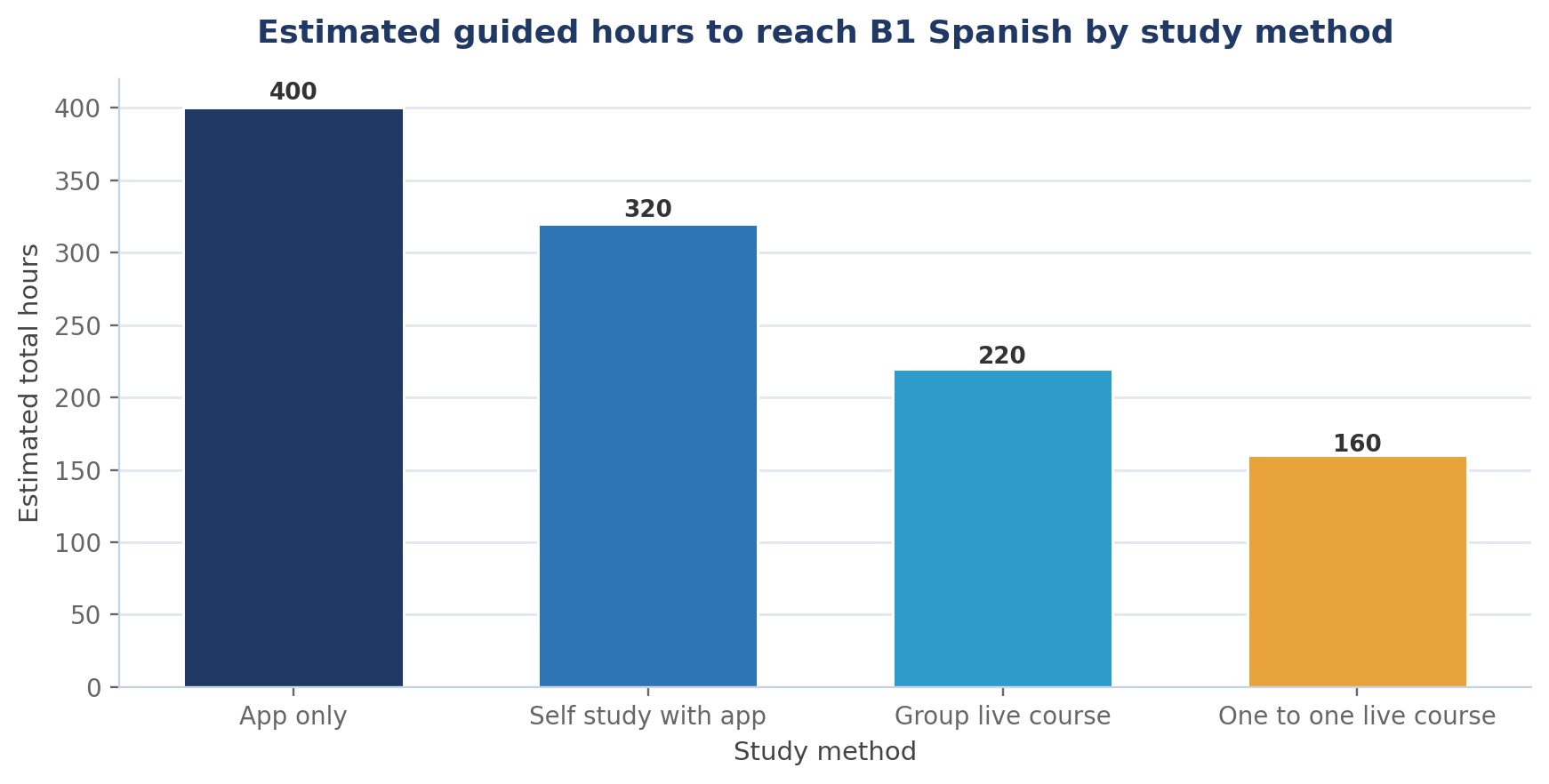
The numbers are planning estimates, not guarantees. Individual results swing widely with prior languages and intensity.
You already have the app. Add the part it cannot give you.
A personal AI voice tutor guides structured lessons and speaking practice with instant feedback, so you can study at your own pace, any time.
See Spanish courses →Create a free accountThe Money Question, Answered Plainly
Apps look cheaper because the price is visible and the outcome is not. Compare properly.
Two years of an app at a low monthly fee is not cheap if you are still at A2. Cost per level reached is the number that matters, not cost per month.
When Each Option Is the Right Call
The DELE exam is a useful reality test. The speaking paper is a live exam with an examiner, and no amount of tapping correct answers prepares you for it. Formats and level descriptors are published on the Instituto Cervantes exam pages.
The Hybrid Plan That Actually Wins
Use each tool for what it is built to do.
That mix keeps the app's greatest gift — frictionless habit — and adds the one thing it lacks: structured speaking practice with instant feedback. If you want to know where you currently stand before spending anything, take a placement assessment, and read the Council of Europe CEFR framework so you can judge any course by the level it truly targets.
How to Judge a Course Before You Pay
Ask those six questions and the marketing copy stops mattering. A course that cannot answer them is a subscription with a nicer logo.
Stop tapping. Start talking.
You do not need another app. You need structured lessons and speaking practice with instant feedback. Join a self-paced Spanish course and turn accumulated vocabulary into actual conversation.
Join a Spanish course →Create a free accountFrequently Asked Questions
Can I learn Spanish to fluency with an app alone? You can build strong vocabulary and grammar recognition, but fluency needs unscripted conversation with correction. Almost nobody reaches B2 on an app alone.
Are apps a waste of money for a complete beginner? No. For the first month or two they build habit and basic vocabulary cheaply. The mistake is staying there for years.
How many hours per week do I need to progress? Two sessions of 60 to 90 minutes, plus daily listening, moves most learners steadily. Consistency beats long occasional sessions.
Is a self-paced course as good as one-to-one? One-to-one is faster and more targeted. Self-paced courses are cheaper, let you study any time, and often keep motivation higher.
References & Further Reading
- Council of Europe, Common European Framework of Reference for Languages, including level descriptors: https://www.coe.int/en/web/common-european-framework-reference-languages
- Instituto Cervantes, official DELE exam formats, levels and dates: https://examenes.cervantes.es
- Vesselinov, R. and Grego, J. (2012), Duolingo Effectiveness Study, commissioned research on app-based learning outcomes
- Loewen, S. et al. (2019), study of mobile-assisted language learning with Duolingo, Foreign Language Annals
- Instituto Cervantes, El español en el mundo yearbook, annual report on Spanish worldwide: https://www.cervantes.es