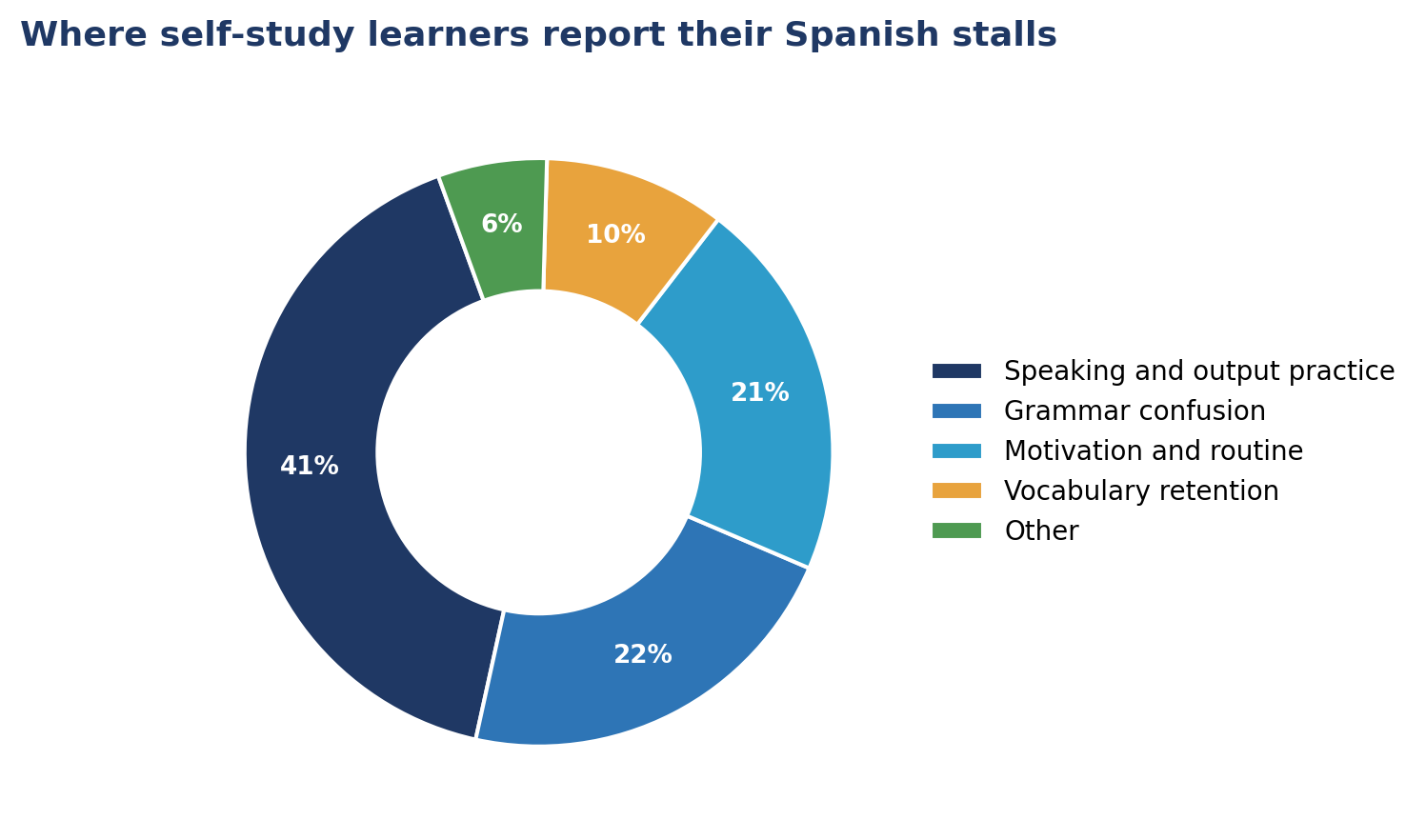
Apps are free. Tutors are not. So the question sounds like a budget problem — and it is not. It is a completion problem. Most self-study Spanish learners do not quit because they run out of money. They quit because nothing and nobody notices when they stop.
What you will get from this guide
- Where self-study genuinely wins, and where it quietly fails
- A real cost comparison per hour of speaking
- The dropout numbers and what causes them
- A hybrid plan that uses both, properly
The Case for Self-Study — It Is Real
Be fair to the free option. Self-study beats a course in three specific situations, and pretending otherwise is dishonest.
If your goal is to read Spanish — literature, news, research — self-study with a solid grammar book and endless input is a genuinely excellent route. Nobody needs a classroom to learn to read.
Where Self-Study Quietly Collapses
Now the other half. Self-study fails in predictable, documented ways.
The plateau is the big one. Thousands of learners sit at a comfortable B1 for a decade because they never force output. Input alone does not produce speakers.
The Numbers That Decide It
It is tempting to compare sticker prices. Compare hours of live speaking instead — that is the variable that actually predicts fluency.
The free route is not cheap. It is expensive in the currency that matters: years.
What a Guided Course Actually Buys You
You are not buying information. The internet gave information away decades ago. You are buying four things that self-study cannot manufacture.
The AI voice tutor also does something subtler: it raises the bar in real time. When the tutor keeps talking at natural speed and you have to keep up, your brain stops translating and starts listening.
Now, the guided route's honest weaknesses.
The Dropout Question
Here is the uncomfortable comparison. Self-study dropout rates in language learning are widely reported to be very high — most app users abandon within weeks. Guided learners with structured lessons and a paid commitment stick around far longer, mostly because there is a system expecting them.
That is the whole argument in one table, and it has nothing to do with which method is "better". It has to do with which one survives a bad week.
You have already tried the free route
Be honest — how many apps have you deleted? A guided Spanish course gives you the one thing apps cannot: a personal AI voice tutor that teaches structured lessons and gives speaking feedback, any time you study.
Start your guided Spanish course →Create a free accountThe Hybrid That Actually Wins
The best learners do not choose. They run both tracks and let each do what it is good at.
AI tutor speaking practice forces production and correction. Solo hours build the volume of input that makes the speaking practice easier. Each track feeds the other, and neither one carries the whole load.
What About the DELE?
If you have an exam in view, the guided route earns its fee. The DELE comprensión auditiva and expresión oral papers punish learners who only ever heard textbook audio and never spoke under pressure.
Above B1, exam technique and timed speaking practice matter as much as vocabulary. That is exam-prep territory, which this product does not provide.
Bring your self-study habits. Add a voice.
Keep your podcasts and your flashcards. Add a personal AI voice tutor that corrects you as you study, at your own pace, and build toward B1.
Start your Spanish course →Create a free accountFrequently Asked Questions
Can I reach fluency with self-study only? Reading fluency, yes. Comfortable spontaneous speaking, rarely. Output needs a listener, and most solo learners avoid the discomfort of speaking until it becomes a barrier.
Is a guided course worth the money? If your goal is speaking, often yes — a self-paced AI voice tutor gives you structured speaking practice at a low cost, and you can study any time.
Which method is faster? A guided course with regular practice can reach B1 on a self-paced timeline. Self-study reaches B1 on a highly variable timeline that often stretches past two years.
What if I cannot afford classes? Combine free input with language exchanges for output, and add a self-paced AI voice tutor for structured speaking feedback. Even a little regular feedback changes the trajectory.
References & Further Reading
- Instituto Cervantes — Spanish courses and DELE certification worldwide: https://www.cervantes.es/
- Instituto Cervantes — official DELE exam information and model papers: https://examenes.cervantes.es/
- Council of Europe — CEFR level descriptors for planning progress: https://www.coe.int/en/web/common-european-framework-reference-languages
- RTVE — free authentic Spanish audio and video for input hours: https://www.rtve.es/
- LanguageSkills.net — self-paced Spanish courses (A1–B2) with a personal AI voice tutor: https://languageskills.net/spanish