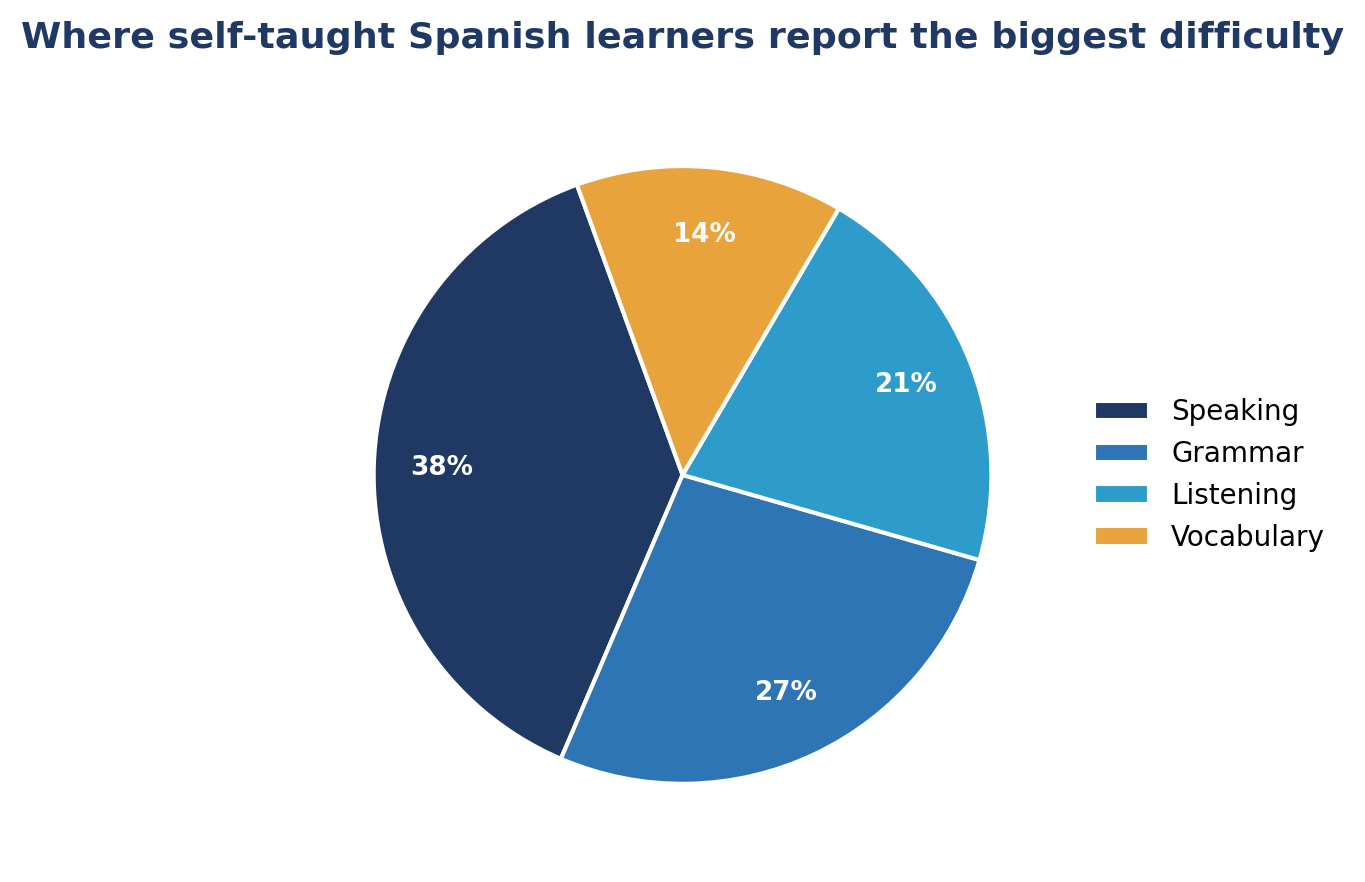
Free Spanish resources are genuinely excellent. That is not a marketing concession — it's a fact. Duolingo, YouTube, podcasts, news sites, library books, tandem partners. You can build real Spanish from zero without paying a euro.
So why do so many learners plateau at A2 and stay there for three years? Because free resources solve the easy half of the problem: input. They don't solve output, correction, or a reason to show up on Tuesday.
What you will get from this guide
- What free Spanish resources genuinely do well
- The three failure points that free options rarely fix
- A cost-per-level comparison you can actually plan around
- How to hybridise both so you stop wasting months
What Free Gets You Right
Free is unbeatable for volume. You can hear native Spanish for two hours a day, follow news, read, and grind vocabulary without spending anything. Apps gamify the boredom. YouTube has a lecture for every grammar point that ever confused you.
Where Free Quietly Breaks
Three things collapse.
First, correction. You cannot hear your own accent or catch your own ser versus estar slip in real time. You need another human ear.
Second, accountability. Free costs nothing, so skipping costs nothing. A week off becomes a month.
Third, the A2 wall. This is where the language stops being a game of nouns and starts being a system of tenses — preterite against imperfect, subjunctive triggers, clitic pronouns. Apps give you sentences. They rarely give you the map.
What Paid Buys You That Free Can't
A paid course buys three things: a sequence, a deadline and structured feedback.
The feedback is the big one. An AI voice tutor hears your rr, catches your por versus para confusion, and tells you when you're being over-formal with a friend. That feedback loop is what free content structurally cannot provide.
The sequence matters more than learners expect. Courses exist so you don't spend four months learning the future tense when the preterite is what every conversation needs.
The deadline is unglamorous and decisive. Paying for something changes attendance rates — this is true of gyms and it's true of Spanish.
The Honest Cost Comparison
Free is not free if you count time. Three years of drifting app use at two hours a week is roughly 300 hours — and if it leaves you at A2, that's a lot of invested hours for a plateau. Paid speed can be cheaper per level, even at a real price.
Numbers are planning estimates. Nobody's timeline is identical, but the shape holds: free is slower, paid is faster, and the gap widens past A2.
Stop paying in years instead of euros
Every month of drifting is a month of Spanish you don't have. Our self-paced Spanish courses give you a set sequence, structured AI feedback and lessons you can study any time.
Compare Spanish courses →Create a free accountThe Hybrid That Beats Both
The strongest Spanish learners don't pick a side. They use free for volume and paid for structure.
Free gives you listening hours: podcasts, series, radio, music. Paid gives you the class where you speak, get corrected and get pushed. That combination moves faster than either alone, and it's what most successful B2 learners actually do.
Three Questions Before You Spend Anything
Ask what level it takes you to — not what features it advertises. Ask how often you'll be corrected by a human. Ask what happens when you miss a week.
If a paid option can't answer those three plainly, free is genuinely the better choice for you right now. If it can, the free-versus-paid question stops being about money and becomes about whether you want Spanish this year or someday.
Try self-paced Spanish with an AI voice tutor
Structured lessons at every level from A1 to B2, and a placement check so you start exactly where you are — not where a quiz guessed.
Create your free account →Create a free accountFrequently Asked Questions
Can I learn Spanish for free to fluency? People have, but it's rare and slow. Free resources handle input well and output badly. Most self-taught learners plateau around A2–B1 without human correction.
Are paid Spanish apps worth it? They're slightly better than free apps, mostly because payment creates habit. They still can't correct your speaking, so they work best alongside a course with structured speaking feedback.
How much should a Spanish course cost? It varies widely by format and hours. Compare cost per level rather than cost per month — a cheap course you abandon is more expensive than a pricier one you finish.
What's the fastest way to learn Spanish? Combination: high-volume free listening plus structured self-paced lessons with AI speaking feedback, 3–6 hours of study time a week. Most learners reach B1 in around a year at that pace.
References & Further Reading
- Instituto Cervantes — DELE levels and the official A1 to B2 framework: https://cervantes.es
- Council of Europe — Common European Framework of Reference for Languages: https://coe.int
- Instituto Cervantes — Plan Curricular del Instituto Cervantes, the reference syllabus for Spanish levels
- Real Academia Española — Diccionario de la lengua española: https://rae.es
- Fundación del Español Urgente (FundéuRAE) — daily usage guidance for learners: https://fundeu.es
Explore self-paced options at languageskills.net.