A free app taught you hola. It taught you nothing you could say to a landlord, a hiring manager, or a doctor at 2 a.m. So the honest question in 2026 is simple: ¿vale la pena un curso de español — is a Spanish course worth it, or are you paying for something a podcast already gives away?
Short answer: it depends on your destination. For the tapas menu, free wins. For a job, a degree, or a life in Spanish, free hits a wall — usually around A2. Below is exactly where that wall stands, what a paid course really buys, and when you should keep your money in your pocket.
What you will get from this guide
- Real 2026 price ranges for every route into Spanish
- The CEFR hour bands that explain why you feel stuck
- A short checklist for judging any paid course
- Honest cases where you should not pay a cent
What learning Spanish actually costs in 2026
Every route has a price, even the "free" ones — paid in time. Here is the landscape, with figures that are planning estimates rather than quotes.
Notice what changes as the price rises: not the vocabulary, but the feedback. Cheap routes hand you input. Expensive routes hand you a human who tells you what you just said wrong.
¿Vale la pena un curso de español? Three questions that decide it
Answer these honestly and the decision makes itself.
Do you need to be understood by a stranger? Ordering food needs 200 words. Explaining why you missed a deadline needs grammar you have to own without thinking. Paid courses exist for the second situation.
Do you have a deadline? A move to Mexico City in eight months, a DELE B2 certificate for a university application, a client call in April. Deadlines convert optional study into a guided plan with someone checking your progress.
Do you quit when it gets boring? Most people do, and that is the quiet reason people pay. Accountability is not a soft benefit; it is the product.
The wall that free tools hit
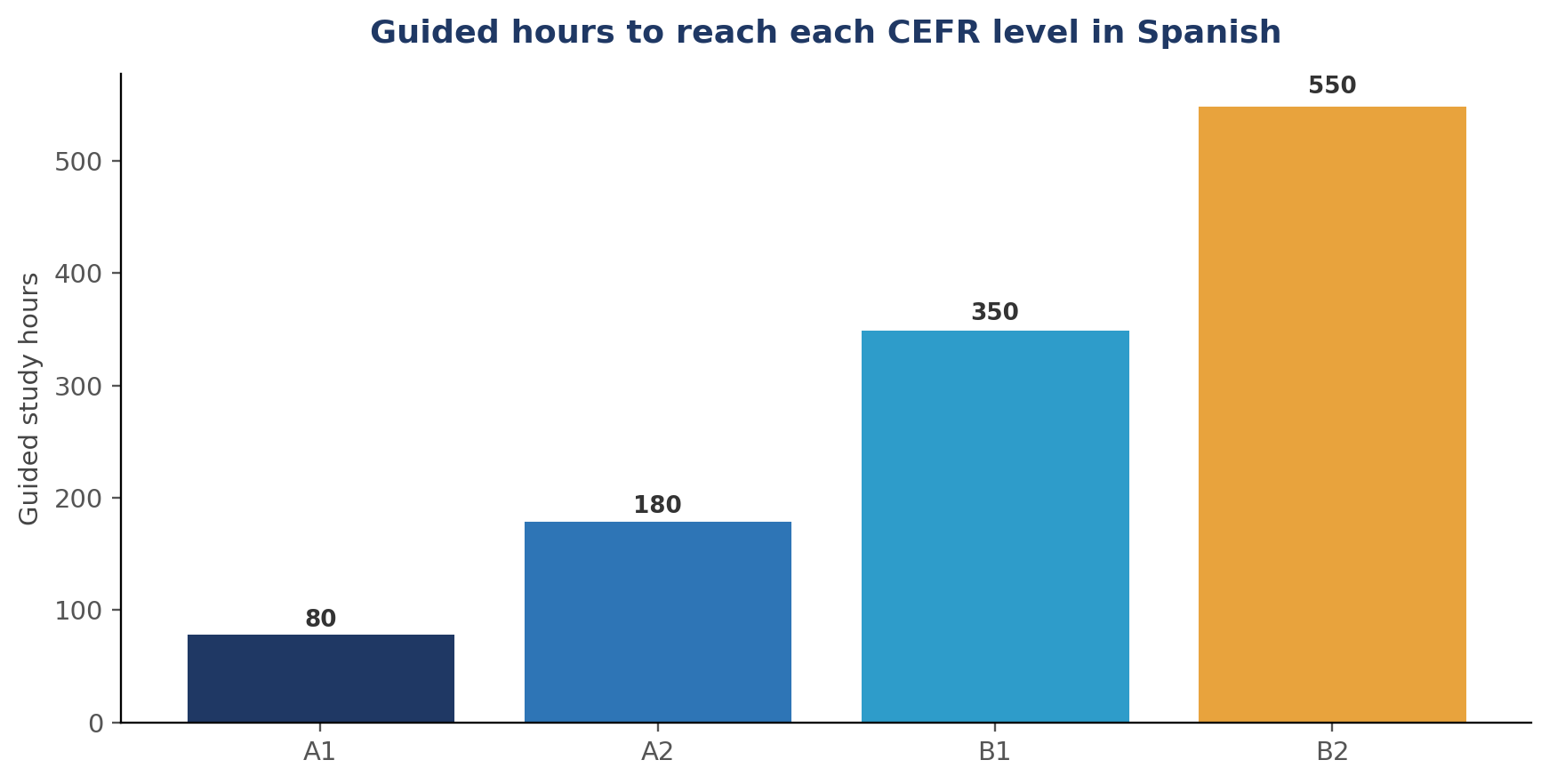
The Common European Framework doesn't measure vibes. It measures the hours and the type of practice behind them.
Free tools are brilliant at the first 80 hours and terrible after them. Why? Because A2 to B1 is not more words. It is past tense versus imperfect, subjunctive triggers, and knowing when por is right and para is wrong. Nobody corrects you on a video. Errors calcify. You arrive at B1 politely fluent in your own mistakes.
Stop rehearsing your mistakes
A personal AI voice tutor hears the error you stopped noticing and gives you feedback the same session. Guided lessons, speaking practice with AI feedback, and a level plan from A1 to B2 that you follow at your own pace.
See Spanish courses →Create a free accountWhat a paid course must include (or you are wasting money)
Price is not the test. Structure is. Hold any course against this table before you pay.
Six ticks. If a course misses three, walk away.
When you should not pay
Skip the checkout if you are three weeks from a holiday, if you have never finished a self-study course, or if you genuinely only want to read menus and ask for the bill. A course is a commitment device; if you won't show up, the price is just a donation.
How to compare courses without getting fooled
Two of those answers are usually enough to spot the difference between a school and a shop.
Frequently Asked Questions
Is a Spanish course worth it if apps are free? Yes, once you need to speak to real people about real things. Apps deliver input; they rarely deliver correction. The moment your goal is a job, an exam, or living abroad, guided hours with feedback become cheaper than years of drifting.
How much should a good Spanish course cost in 2026? Self-paced AI-tutor courses typically run 0–100 per year, while live online group courses run 300–1,200 per level and private tutoring 20–50 per hour. Anything far below that usually removes structure; anything far above it should come with small groups and named instructors.
How long until I'm conversational? Around 350 guided hours to B1, doubled for the self-taught because they repeat their own errors. Add real conversation practice and the clock moves faster.
Can I pass DELE B2 with a course alone? A well-structured course gets you the language; exam practice gets you the score. Choose a provider whose syllabus names DELE or SIELE, then book practice papers. Note that LanguageSkills.net does not provide practice exercises or exam guarantees.
Ready to stop guessing at grammar? Start with a free account, meet your AI voice tutor, and hear the difference in one lesson.
Your first corrected sentence is one click away
Create a free account, take a quick placement check, and start your first guided lesson with your AI voice tutor this week. If it isn't for you, you've lost nothing but an hour.
Create your free account →Create a free accountReferences & Further Reading
- Council of Europe — Common European Framework of Reference for Languages: https://www.coe.int/en/web/common-european-framework-reference-languages
- Instituto Cervantes — DELE diplomas and level descriptions: https://examenes.cervantes.es
- Instituto Cervantes — Centro Virtual Cervantes learning resources: https://cvc.cervantes.es
- Instituto Cervantes — El español en el mundo annual report: https://www.cervantes.es
- Instituto Nacional de Estadística (Spain) — language and population statistics: https://www.ine.es