Germany has more free German learning material than any learner in history could finish. Apps, YouTube channels, public broadcaster courses, library audiobooks. All free. All genuinely good.
So why do millions of people still pay? Because free content answers "what is German?" and paid teaching answers "why do you keep getting it wrong?" Those are not the same question. Here is the honest maths on whether a German course is worth it in 2026.
What you will get from this guide
- A real cost comparison: free vs. paid German learning
- The four hidden costs of self-study nobody warns you about
- Who should pay, and who genuinely should not
- A decision table you can run in sixty seconds
The Free German Learning Stack Is Genuinely Excellent
Let us not pretend otherwise. Duolingo is free. Deutsche Welle's Nicos Weg covers A1 to B1 at no cost. YouTube has grammar channels that rival a first-year university course.
If money is genuinely tight, that stack will carry you a long way. Use it.
The Four Hidden Costs of Free Learning
Free learning is not free. It trades money for something scarcer.
The correction problem is the big one. Nobody can hear their own mistakes. You will happily say "ich habe gegangen" for six months, feeling fast and fluent, until someone winces.
What a Paid German Course Actually Costs
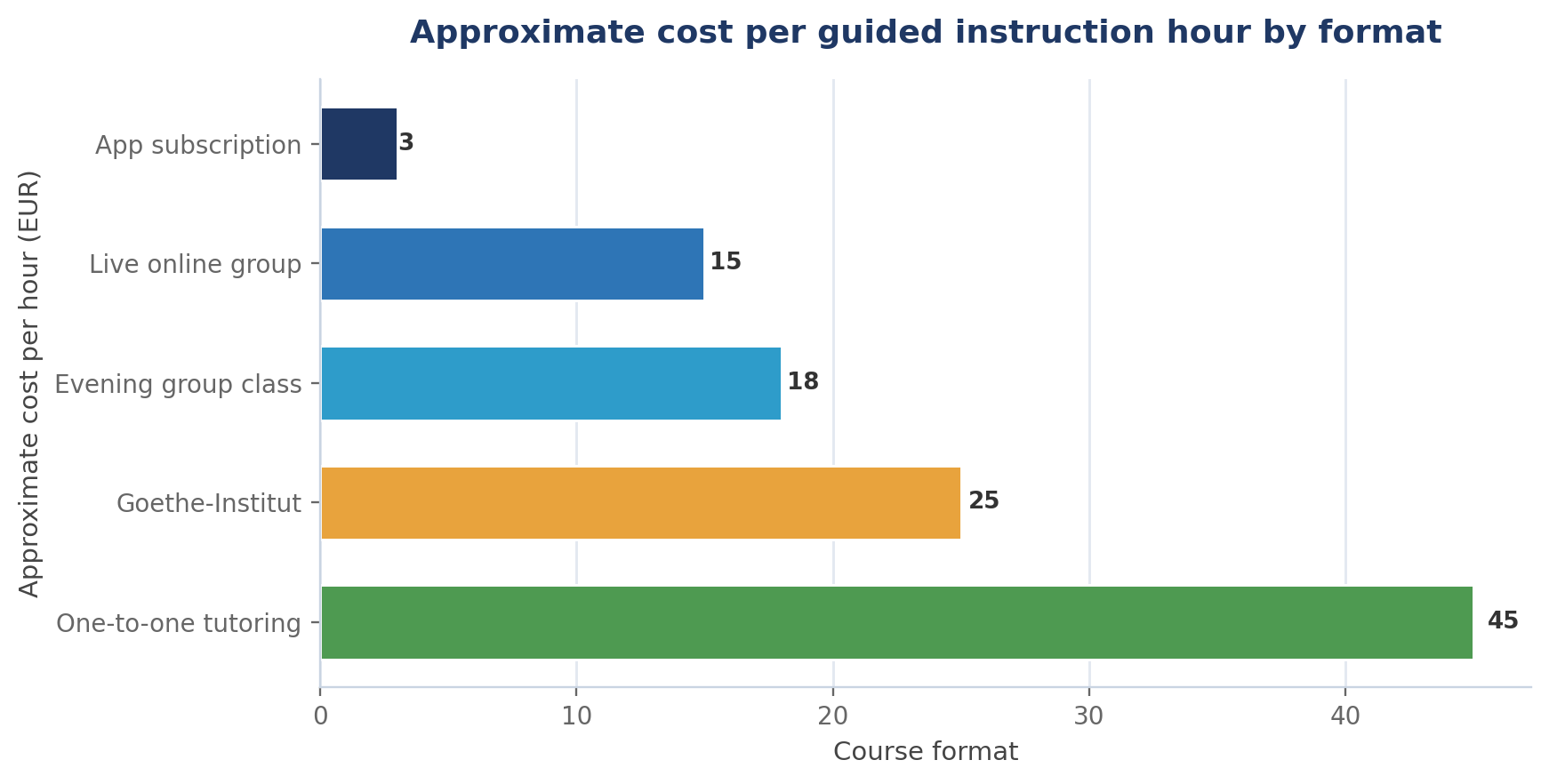
Prices vary wildly. Here is an honest band for the mainstream options, in typical 2026 ranges.
Per hour of real instruction, group courses are almost always the best value. One-to-one is the fastest but you pay for the privilege.
Free vs. Paid: A Direct Comparison
Notice the pattern. Free wins on price. Paid wins on the one variable that matters most: whether you actually finish.
The difference is feedback you can actually hear
Feedback is the one thing an app cannot sell you cheaply. Our self-paced German courses pair you with a personal AI voice tutor that corrects the errors you cannot hear and keeps your pace honest — any time, at your own speed.
See our German courses →Create a free accountThe Actual Maths: Is a German Course Worth It?
Here is the calculation most people never run. Divide cost by hours of genuine progress. A €400 course over 40 contact hours is €10 per hour — cheaper than two coffees.
Then run the second calculation: what is one year of your life worth? If a paid course gets you to B1 a year faster, and B1 unlocks a job, a visa, or a relationship, the course is not an expense. It is the cheapest ticket in the room.
Who Should Absolutely Not Pay
Be honest with yourself here. Do not pay if you have quit three courses already and the problem is not the material. Do not pay if you want a certificate with no intention of speaking — some exams are genuinely self-studyable. And do not pay for a brand name when what you need is contact hours.
Pay when the bottleneck is feedback, accountability, or speed. Those three are what you are buying.
What to Look For Before You Pay
Recorded-only "courses" are just video libraries with a payment page. Fine as a supplement, poor as your main engine.
The Verdict
Paying for a German course is worth it when you buy feedback and accountability, not content. Content is free and abundant. Correction is rare and expensive. In 2026, that is still the whole story.
Stop paying in years to save in euros
The most expensive German course is the free one you never finish. Our self-paced German courses give you a level target (A1 to B2), structured lessons, and an AI voice tutor that keeps your progress honest.
Start your German course →Create a free accountFrequently Asked Questions
Is a German course worth it if I can learn for free? Yes — when your bottleneck is correction, accountability or speed. Free resources cover content brilliantly but offer almost no personalised feedback, which is exactly where most learners stall.
How much should I expect to pay for a good German course? Group courses typically run €150–€600 per term, Goethe-Institut courses €400–€1,200, and one-to-one tutoring €25–€60 per hour. Live online self-paced lessons usually offer the best balance of cost and instructor contact.
Can I reach B1 with free resources alone? It is possible, but typically much slower and only with strong self-discipline. Most learners who reach B1 efficiently combine free material for practice with paid instruction for feedback.
What is the biggest sign a paid German course is not worth it? If it is recorded video with no live instruction or feedback, you are buying content you could find free. Walk away unless the price reflects that.
References & Further Reading
- Goethe-Institut, German courses and prices, goethe.de.
- Deutsche Welle, Nicos Weg free German course, dw.com/deutschlernen.
- Council of Europe, Common European Framework of Reference for Languages (CEFR), coe.int.
- European Commission, Erasmus+ and language learning resources, ec.europa.eu.
- BAMF, Integration course structure and costs, bamf.de.