Four hundred and twelve days. That is the streak glowing on your phone screen, a number you protect like a houseplant. And yet last Tuesday, at a bakery in Kreuzberg, a woman asked you a perfectly ordinary question and your mouth produced nothing but a small, polite sound of panic.
You are not lazy. You are not untalented. You have simply been sold a tool and told it was a road.
So let us settle this honestly: what is the best way to learn german app or course? The short answer is that apps are superb at some jobs and hopeless at others, and a live course does the opposite. The long answer involves a table, a chart, and a decision you can make this week.
What you will get from this guide
- A clear-eyed split of what apps genuinely do well and where they break down
- Real CEFR hour bands, so you can stop guessing how long German takes
- A cost comparison that puts €8 a month next to €15 a session without flinching
- A week-by-week hybrid plan you can start on Monday
First, the Myth That Needs to Die
Apps do not teach you German. They teach you to recognise German. Those are cousins, not twins.
Recognition means you see der Bahnhof on a screen and feel a warm glow of familiarity. Production means a train conductor asks you something at speed and you have to build a sentence from scratch, under pressure, with your heart going. Apps train the first skill relentlessly. They barely touch the second.
Here is the trap in numbers, and yes, these are planning estimates rather than gospel:
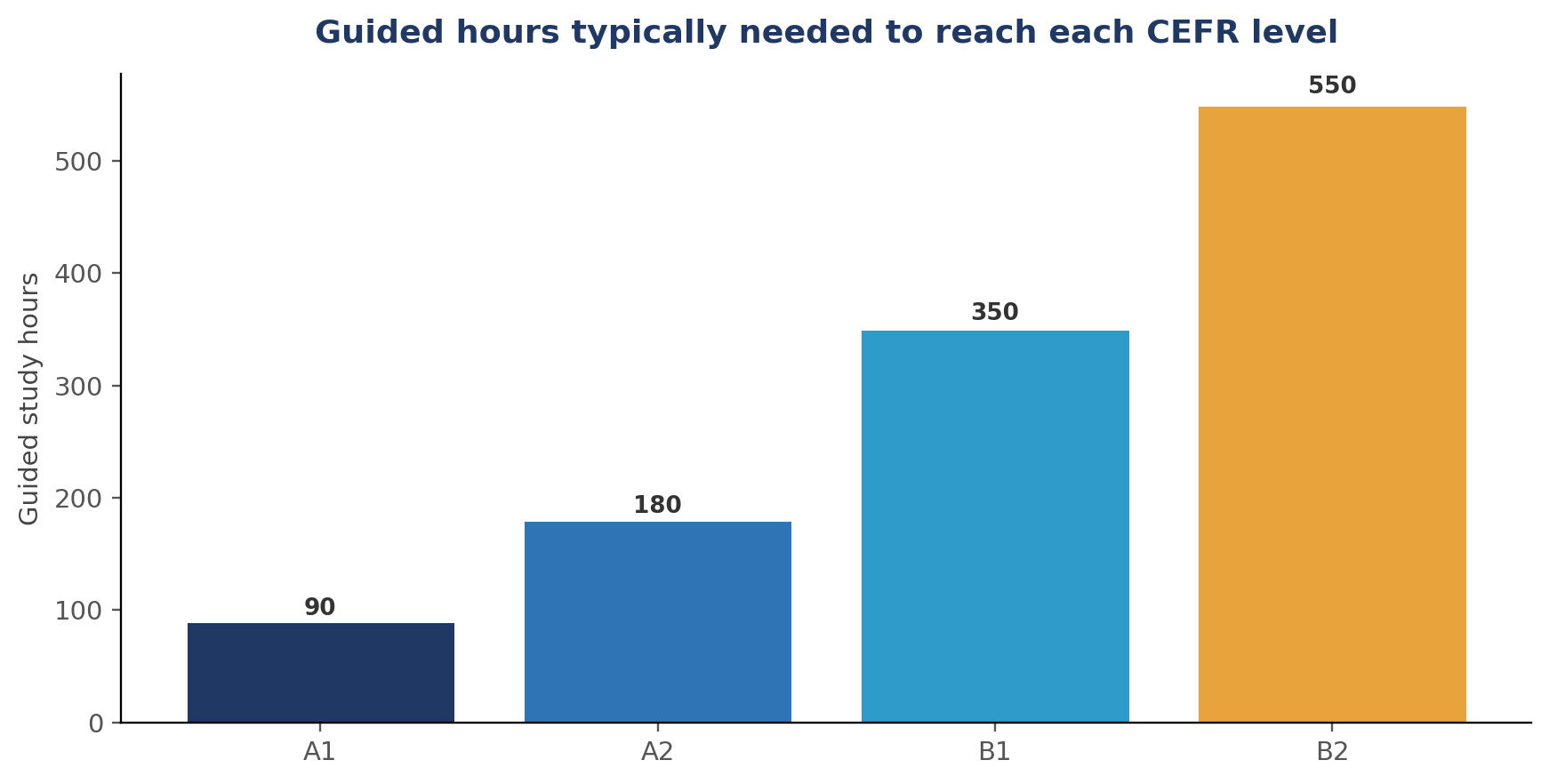
Notice where the curve bends. Getting to A1 is a weekend hobby. Getting to B1, the level where real conversations stop being combat, takes roughly four times the effort of A2. Apps are magnificent engines for the first 90 hours. After that, they start charging you attention without paying out progress.
Where Apps Genuinely Win
Let us be fair, because laziness in the other direction is just as expensive. Apps are not useless. They are unbeaten at three specific jobs.
That last row matters more than the price tag suggests. German is a language where Du and Sie can change a job interview, and no green owl will ever explain that to you.
Where a Live Course Takes Over
Here is what happens in a real class that cannot happen in an app: someone hears you, and then they correct you.
Your teacher notices you are defaulting to the nominative because it is safe. Your teacher hears that you say ich habe gegangen and stops you, kindly, the third time. Your teacher makes you reorder a sentence in front of witnesses until the verb-second rule stops being a rule and becomes a reflex.
The honest conclusion is not "apps bad". It is that apps are a gym membership and a course is a coach. You need both, but only one of them watches your form.
Your first real German conversation is closer than you think
You have built the vocabulary. Now you need someone to talk to, someone who will catch the mistake before it becomes a habit. Self-paced German lessons with an AI voice tutor give you exactly that, at your level, any time that fits your busy week.
See live German courses →Create a free accountHow Long Does It Take? Let Us Do the Maths Honestly
The German government's own benchmarks and the Goethe-Institut's course descriptions both work from CEFR bands. The commonly cited planning figures look like this:
Now the uncomfortable part. A learner doing 15 minutes of app tapping per day accumulates about 91 hours a year. A learner doing two 60-minute self-paced lessons a week plus 20 minutes of daily practice accumulates about 225 hours a year.
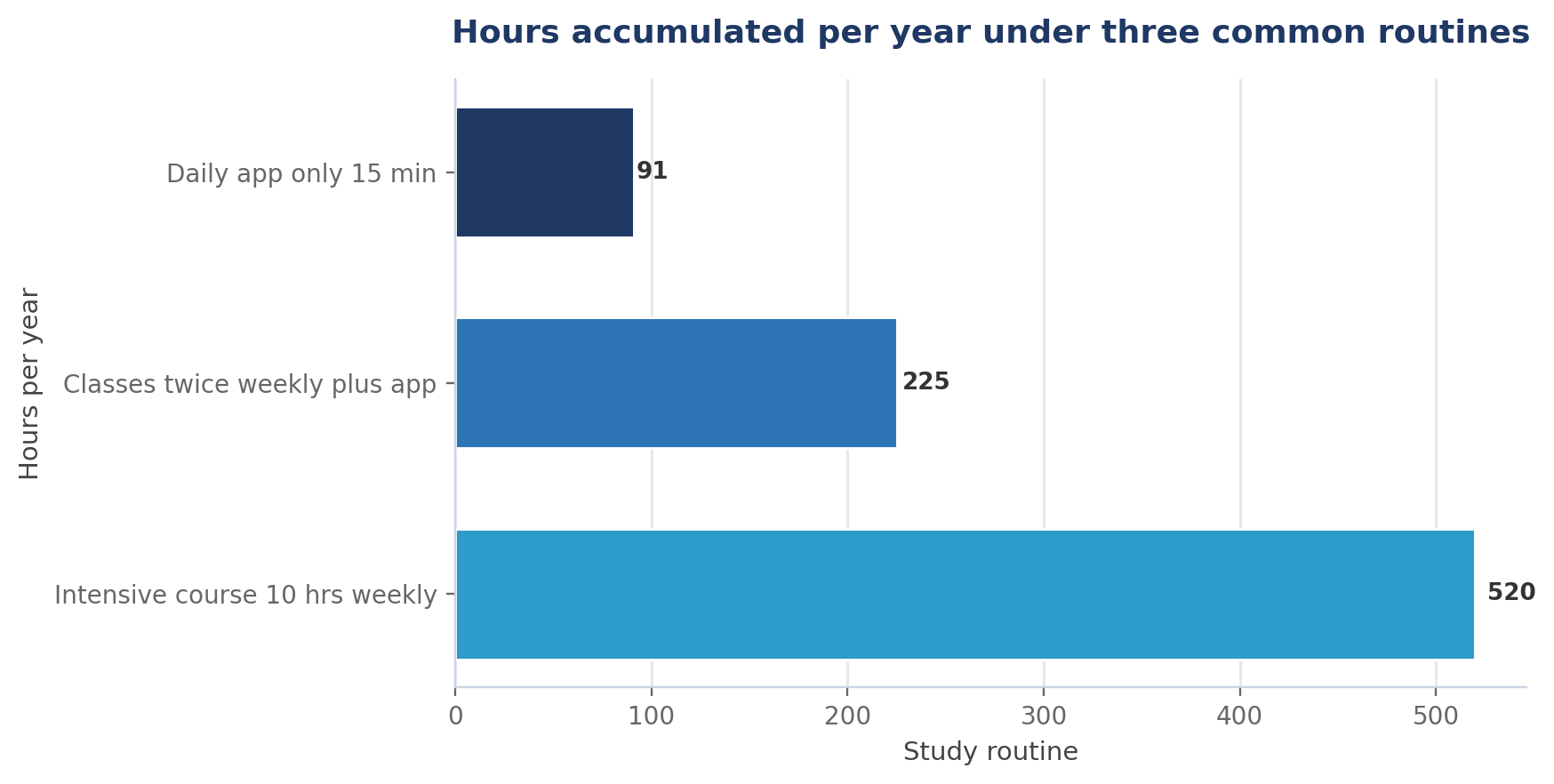
Same person. Same brain. Same enthusiasm on day one. Wildly different destination on day 365.
The Real Cost, Without the Marketing Gloss
Money is the argument everyone reaches for first, so let us handle it properly.
Read that table twice. The gap between a paid app and a group course is frequently smaller than one skipped takeaway per week. What you are buying for that money is not information. Information is free everywhere. You are buying correction, accountability and the terrifying, wonderful pressure of being expected to speak.
The Hybrid Plan That Beats Both
You do not have to choose. In fact, choosing is how people lose. Here is a week that works for most adult learners at A2 to B1.
Sunday is not filler. Rest is part of the plan, because the learners who burn bright for three weeks and vanish are more common than the ones who find German hard.
Red Flags When You Are Choosing
A few signals that should make you walk away, from either side of this debate.
Do not buy another tool. Buy a teacher.
You already know the vocabulary is not the problem. The problem is that nobody has ever made you produce a sentence out loud and then fixed it. Our self-paced AI voice tutor courses come with a placement test, structured lessons, and speaking practice with AI feedback.
Start with a placement test →Create a free accountWhat the Evidence Actually Says
Language acquisition research is unglamorous and consistent. Comprehensible input matters enormously, which is why apps and podcasts help. Interaction matters enormously too, which is why learners who only consume plateau. The Goethe-Institut describes its levels in exactly these hour bands, and exam bodies such as telc and ÖSD build their speaking components around spontaneous production, not recognition.
The pattern repeats everywhere: input builds the reservoir, output builds the tap.
Your Decision, in One Paragraph
If you are at zero, start with an app and free media this week. Cost: nothing, risk: none. If you are at A2 and have been circling for a year, stop optimising your flashcard deck and book a self-paced lesson. That is where the plateau breaks.
You have already proved you can show up 412 days in a row. That discipline is not the scarce resource. Direction is.
Frequently Asked Questions
Can an app alone get me to fluent German? Almost never. Apps can carry you comfortably to A2 through vocabulary and reading, but fluency requires spontaneous production with a human who corrects you, which no current app replicates.
Is a live German course worth the extra money? For most learners past A2, yes. The cost per guided hour in a group course is often €10 to €20, which is comparable to streaming subscriptions you have already forgotten you pay for.
How many hours a week should I study German? Four to six hours weekly is a realistic floor for steady progress at A2 to B1. Below three hours a week, progress stalls so slowly that motivation collapses before results appear.
Do I need to learn grammar rules if an app teaches by pattern? You need the rules eventually, for the same reason you need a map after walking a city for a month. Pattern recognition gets you through familiar streets; rules get you through new ones.
What is the fastest legal route to B1 German? An intensive course of 15 to 20 hours weekly for three to four months, combined with daily app practice. That is roughly 350 guided hours, which matches the CEFR band for B1.
Should I learn German with an app or a course if I only have 20 minutes a day? Use an app, but add one 60-minute self-paced lesson weekly if you possibly can. Twenty minutes of daily input plus one hour of real speaking beats forty minutes of input and no speaking at all.
References & Further Reading
- Goethe-Institut — German courses and CEFR level descriptions: https://www.goethe.de/en/spr/kur.html
- Council of Europe — Common European Framework of Reference for Languages: https://www.coe.int/en/web/common-european-framework-reference-languages
- Deutsche Welle — free German learning resources and Nicos Weg: https://learngerman.dw.com/en/overview
- telc gGmbH — language examinations and level frameworks: https://www.telc.net/en/
- Duden — the standard reference dictionary of German: https://www.duden.de/
- TestDaF-Institut — university admission German exam: https://www.testdaf.de/