You can learn German for zero euros. That sentence is true, and it is also the reason thousands of learners stall at A2 with a 400-day Duolingo streak and no ability to hold a conversation.
Free is not worthless. Free is unaccountable. Understanding exactly where free stops and paid begins is the difference between a hobby and a certificate.
What you will get from this guide
- What free German resources genuinely deliver well
- The three points where free reliably breaks
- Fair prices for paid options, and what overcharging looks like
- A hybrid plan that spends money only where it buys speed
What Free Actually Gives You
Free German content is genuinely excellent. This is not a marketing exercise — some of the best material in the world costs nothing.
Notice the pattern. Free is superb at input and information. It is nearly silent on feedback.
Where Free Breaks: The Three Failure Points
Three problems appear in almost every self-taught German story, and all three are accountability problems rather than content problems.
The second one is the expensive one. Fossilised errors cost three times as much to fix at B2 as they cost to prevent at A2. Free tools will happily let you repeat Ich habe gegangen ten thousand times.
What You Are Actually Buying When You Pay
Paid courses are not selling information. Information is everywhere and free. You are buying four specific things.
Rank them in that order and your spending decisions become obvious.
The Real Cost of Slow
Money is not the only currency. Time is the one nobody refunds.
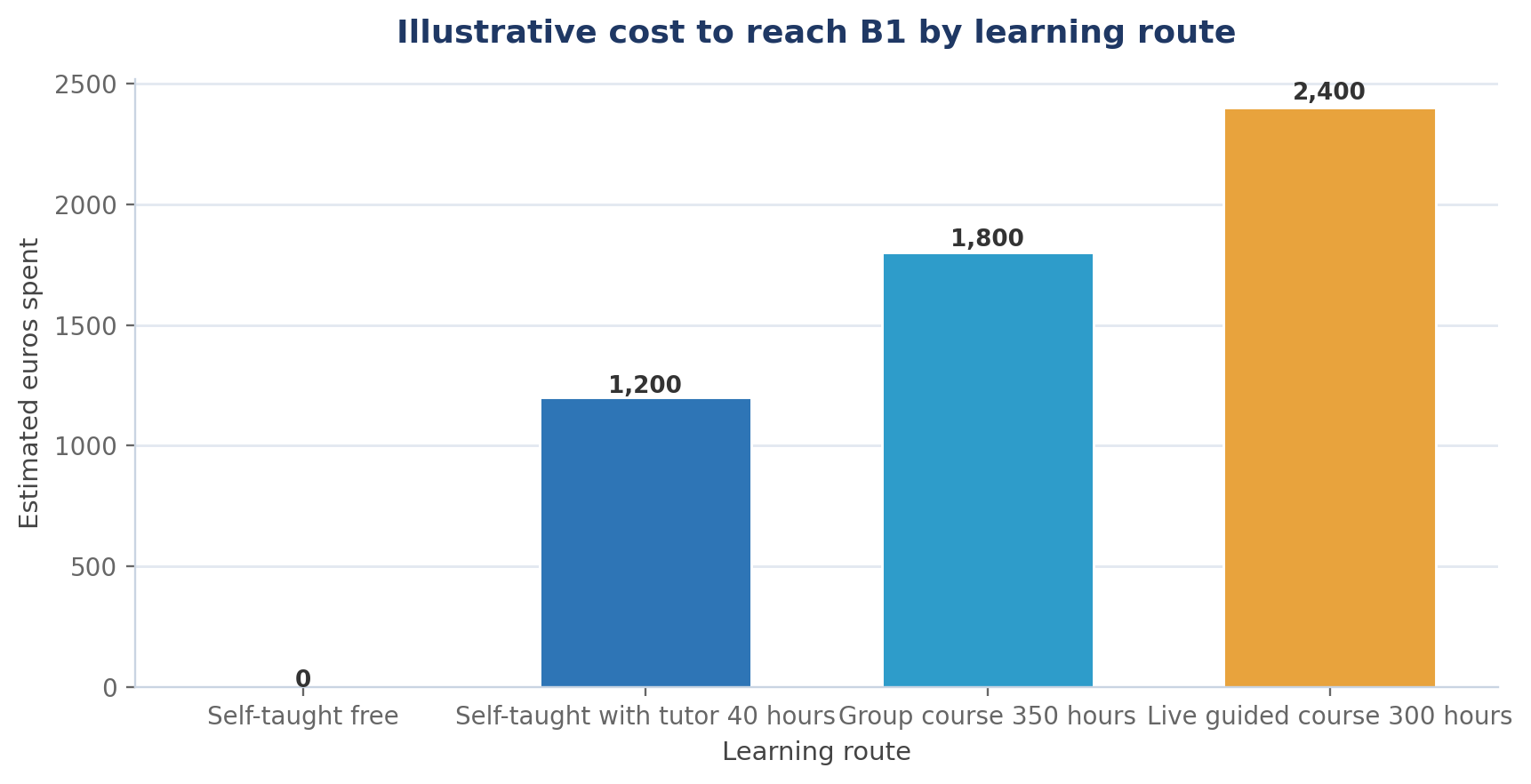
The free bar looks unbeatable. Then add the axis nobody plots: calendar months to B1. Free self-study commonly takes 24–36 months of inconsistent effort. A guided route often lands in 12–18. Two extra years of not speaking German has a cost too — it just does not appear on a receipt.
The Fair-Price Ladder
Paid German comes in tiers. Here is what each tier honestly offers.
Volkshochschule is the most underrated option in German learning: public, affordable, and taught by an AI tutor. It is the honest middle ground between free apps and premium tutoring.
Best Value: A Hybrid Plan
You do not need to choose sides. Spend where feedback lives, save where it doesn't.
Around 80 percent of your study hours can run on free material without hurting results. The remaining 20 percent — the correction and speaking hours — is where paid options earn their entire price.
Spend Only Where It Buys Speed
Keep your free resources. Add the one thing they cannot provide: a teacher who hears your German and tells you exactly what is wrong before it hardens into habit.
Compare live German courses →Create a free accountRed Flags When You Are Paying
Price is not quality. Judge a paid course by these signals, not by its logo or its promises.
That last row is worth more than any price comparison. If you never speak during class, you are paying for a podcast with attendance.
When Free Is Genuinely the Right Answer
Do not pay yet if any of these describe you.
The exam and visa rows are not upselling. Admission offices and employers do not accept streaks, screenshots or self-assessment. They accept a certificate from a recognised exam, and no free app issues one.
Frequently Asked Questions
Can I reach fluency with free resources alone? Some learners do, especially with immersion through living in a German-speaking country. They are the exception, and almost all of them had a human correcting them somewhere — a partner, a colleague, a patient friend. Free content rarely supplies correction on its own.
Is Duolingo a waste of time? Not at all. It builds the habit and the first few hundred words faster than most methods. It simply cannot take you to B2, because it does not teach you to produce unprompted speech.
How much should a good German course cost? Local self-paced lessons at a Volkshochschule are typically the cheapest structured option. Live online group courses sit in the middle. One-to-one tutoring costs the most per hour. Judge by correction and speaking minutes per euro, not sticker price.
Do paid courses guarantee I will learn? No, and any provider promising that is selling a fantasy. What a good course guarantees is structure, correction and accountability. Attendance and practice still belong to you.
Free Content Taught You. Who Corrects You?
That is the whole gap. Live instructors hear your errors, fix them in the moment, and keep the plan pointed at a real goal — an exam, a job, a move.
Take a live German class →Create a free accountReferences & Further Reading
- Deutsche Welle — free structured German courses such as Nicos Weg: https://learngerman.dw.com
- Goethe-Institut — official courses, exams and free practice materials: https://www.goethe-institut.de
- Deutscher Volkshochschul-Verband — overview of local adult education provision: https://www.volkshochschule.de
- Council of Europe — CEFR level descriptors to judge any course's claims: https://www.coe.int/en/web/common-european-framework-reference-languages
- Bundesagentur für Arbeit — guidance on recognising language qualifications for work in Germany: https://www.arbeitsagentur.de