Your textbook taught you cela me convient parfaitement. Then your French friend texts ça me va, nickel and you spend ten minutes in a dictionary that has never heard of nickel.
Textbook French is real French — it is the French of written reports, formal letters and exams. But it is one register out of four. This guide hands you the other three, tells you exactly who you can use them with, and keeps you out of the embarrassing corners of french slang.
What you will get from this guide
- The four registers of French and who each one is for
- Verlan decoded — how it works and how the meaning shifts
- 40+ expressions you will actually hear this week
- Age and region warnings so you don't sound absurd
The Four Registers (and Why Nobody Told You)
The classic beginner error is not slang at all: it is using soutenu with a barista and sounding like a tax audit. Matching register matters more than fancy vocabulary.
Verlan: French, Backwards
Verlan reverses syllables. L'envers becomes verlan. It started as street code and became mainstream youth speech — some words are now so common that the original has faded.
Rule of thumb: the top half of that table is safe with friends in their twenties and thirties. The bottom half depends entirely on the room.
Expressions That Make You Sound French
Function words matter more than rare nouns. Get these and conversations stop stalling.
Learn the French people actually speak
Slang dies fast and registers shift monthly. A personal AI voice tutor guides you through structured lessons at your own pace, any time, and shows you which words still land, which now sound like your dad, and which will get you a strange look.
Learn real French with your AI voice tutor →Create a free accountSlang Ages Faster Than You Think
Borrowed memes. Dead memes. This is the lifecycle of French slang, and it is unforgiving.
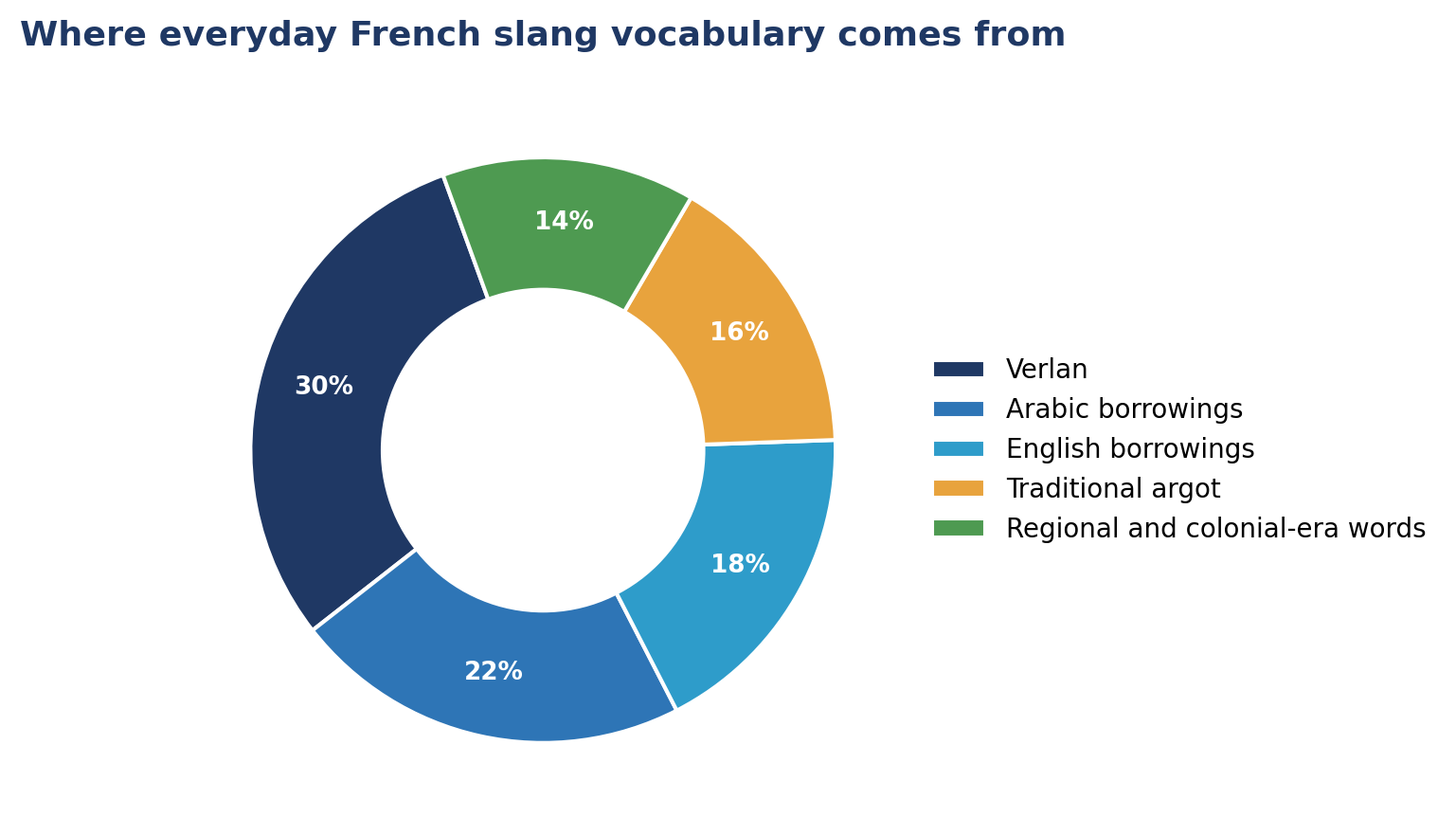
That Arabic-origin slice is significant and often invisible to learners: kiffer (to love), bled (town, village), chouia (a little), zéro (nothing at all), miskine (poor thing). These are everyday words in most French cities.
Regional Slang: One Language, Many Dialects
Travellers who learn ten regional words get treated differently. Locals open up instantly.
When Slang Is Outright Dangerous
Three situations where argot costs you.
Code-switching is the real skill. Fluency is not "knowing slang" — it is knowing when to shut it off.
Your Practical Learning Plan
Comprehension first. Production later, and only after confirmation.
Watch. French YouTube and French rap are the densest sources. Turn on French subtitles — catching chelou in the wild beats memorising a list.
Collect. Keep a note titled "heard it, unsure." When three different people use the same word, it is real.
Test small. Use one new expression per week with someone who will gently correct you. Ask directly: ça se dit ? (do people say that?) — French speakers love answering this.
Fluency is register, not vocabulary size
You can know 8,000 words and still sound like a grammar exercise. Learn French with a personal AI voice tutor that gives you the words, the tone and the timing — so you can text like a friend and write like a professional in the same afternoon.
Start speaking real French →Create a free accountFrequently Asked Questions
Is it rude to use French slang as a learner? Not if it fits the register and the company. Slang with friends reads as friendly; the same word with a stranger, a teacher or an official reads as careless. Copy people around you rather than inventing your own mix.
Should I learn verlan? Learn to understand it — it appears constantly in music, film and group chats. Use it sparingly until you have heard it validated by native peers. Some verlan words like ouf and meuf are fully normal; others are dated.
What's the difference between argot, verlan and français familier? Argot is slang vocabulary, historically tied to specific trades or criminal milieux. Verlan is a word-formation trick (reversed syllables) that produces much modern slang. Français familier is simply everyday relaxed French, and it is what most textbooks leave out.
Where can I hear real French slang safely? Scripted series with French subtitles, French-language YouTube, and conversation with native speakers. The Alliance Française network also runs cultural events in French where informal speech is completely normal.
References & Further Reading
- Académie française — Dictionnaire de l'Académie française (9th edition), register labels. https://www.dictionnaire-academie.fr
- Le Robert — Le Petit Robert de la langue française, entries marked familier, argotique, verlan. https://www.lerobert.com
- TV5Monde — Langue française resources on registers and regional variation. https://www.tv5monde.com
- Alliance Française — cultural and language programmes worldwide. https://www.fondation-alliancefr.org
- Office québécois de la langue française — Québec-specific usage and vocabulary guidance. https://www.oqlf.gouv.qc.ca