You land in Paris with a decent phrasebook and a confident smile. You ask a shop assistant a question without saying bonjour first. The temperature drops ten degrees. That is not rudeness — you broke a rule nobody ever told you about.
What you will get from this guide
- The greeting ritual that opens every French interaction
- Meal times, ordering, and how the bill actually works
- Tipping, transport and the queues nobody respects
- Five sentences that will change how you are treated
The One Rule That Beats All Others
Say bonjour. Say it first. Say it every time you enter a shop, a bakery, a waiting room, a bus, a lift.
This is not a suggestion. It is the entry fee for a normal human interaction in France. Skip it and you get clipped, efficient, faintly disdainful service. Say it and the same person becomes warm.
And use vous with everyone you do not know, including people younger than you. Tu is an intimacy you earn, not a default.
Meal Times Will Rewrite Your Day
France runs on a different clock, and it does not apologise for it.
Restaurant kitchens stop serving between roughly 14:30 and 19:00. Arrive at 15:00 in a restaurant town and you will find the doors shut and a lone barman polishing glasses. Bakeries close one day a week — often Monday — and many shut for weeks in August.
The Restaurant Code
Menus are structured, and reading them correctly is half the experience.
Bread is free and lands on the table without asking. Tap water is free too — ask for une carafe d'eau and you will not be judged. The bill does not arrive until you ask: l'addition, s'il vous plaît.
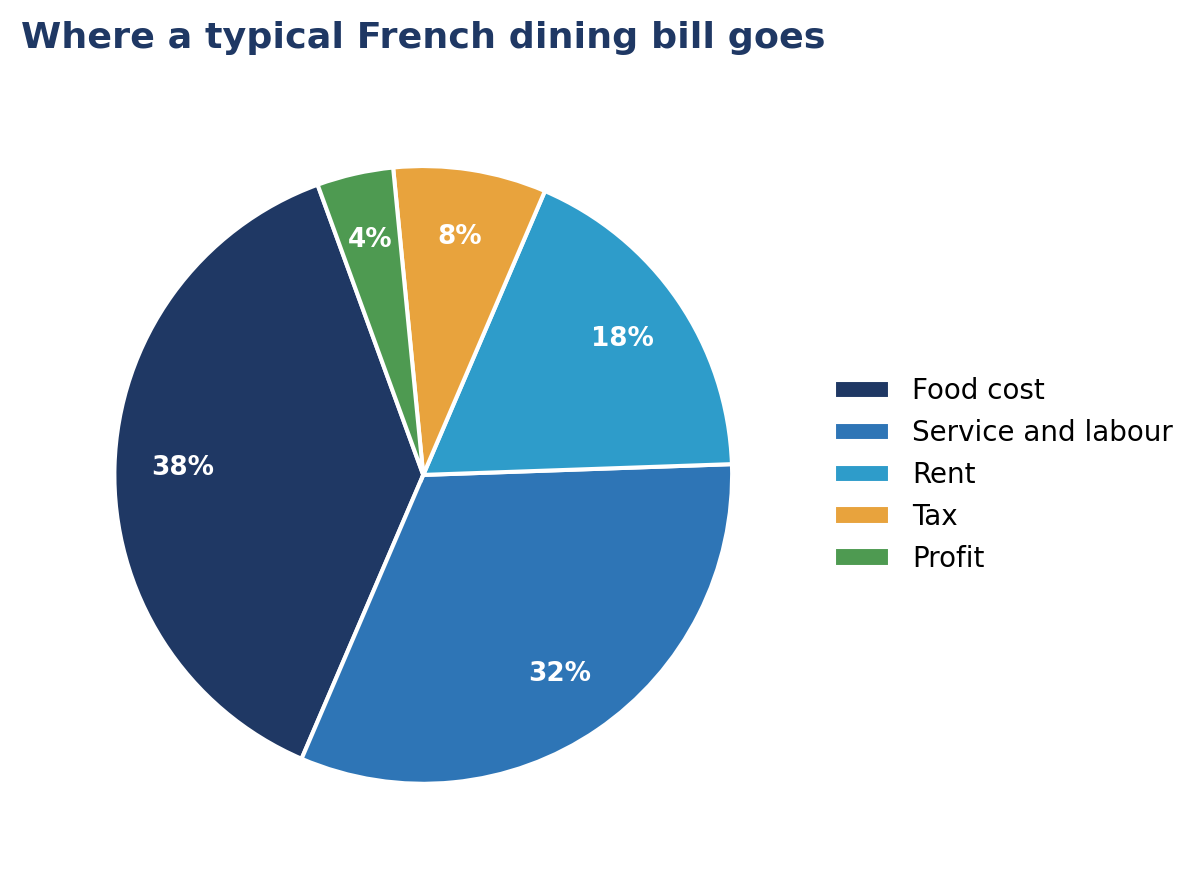
That labour slice explains the tipping culture. Service is already included by law — service compris — so the tip is a small round-up, not an obligation.
Over-tipping does not buy better treatment. It just marks you as a visitor.
A greetings-and-orders toolkit, before you fly
Twenty minutes a day with a personal AI voice tutor and you land knowing exactly what to say in the bakery, the bar, the ticket hall. French manners are learnable grammar, not mysterious magic.
Start French for travel →Create a free accountTransport, Queues and Personal Space
Parisians do not queue at the bakery — they ask qui est le dernier? ("who's last?") and remember the name. The file d'attente exists for buses, tickets and post offices, and cutting it is a genuine offence.
On public transport, keep your voice low and your phone quieter. A loud phone call in a carriage draws looks that will make you want to evaporate.
Five Sentences Worth Memorising
Learn these and 80 percent of daily friction disappears.
A gesture counts too. Merci spoken while walking out, or a small nod to the waiter, does more than any amount of over-apologising in English.
What This Means for Your Trip
France rewards preparation with real warmth. The country is not cold — it is formal, and formality has rules that can be learned in an afternoon.
Get the greetings right, respect the meal clock, tip like a local, and you will spend your trip being treated as a guest rather than a stranger. That is the whole secret, and it fits in a pocket.
Travel better with fifty words of real French
Most bad travel moments in France come from missing a politeness cue. A few weeks of self-paced practice with an AI voice tutor puts those cues on autopilot.
Start French for travel →Create a free accountFrequently Asked Questions
Should I tip in France? Service is included by law, so a small round-up or one or two euros is plenty. A fixed service charge already appears on your bill.
Is Paris really as rude as people say? Parisians match your energy closely. Open with bonjour and a smile and the famous frost often turns out to be a myth.
Do I need to speak French to visit? No, but ten sentences carry an enormous amount of goodwill. Attempting French is treated as a courtesy, not a test.
What should I avoid wearing or doing? Nothing dramatic. Dress a little smarter than you would at home, keep your voice conversational indoors, and never enter a shop without greeting.
References & Further Reading
- Institut français — French language and cultural courses worldwide: https://www.institut-francais.fr/
- Atout France — official French tourism information and practical guides: https://www.atout-france.fr/
- France Diplomatie — practical visitor information and entry guidance: https://www.diplomatie.gouv.fr/en/
- Ministry of Culture (France) — French heritage and museum access information: https://www.culture.gouv.fr/
- LanguageSkills.net — French courses for travel and conversation (A1 to B2): https://languageskills.net/french