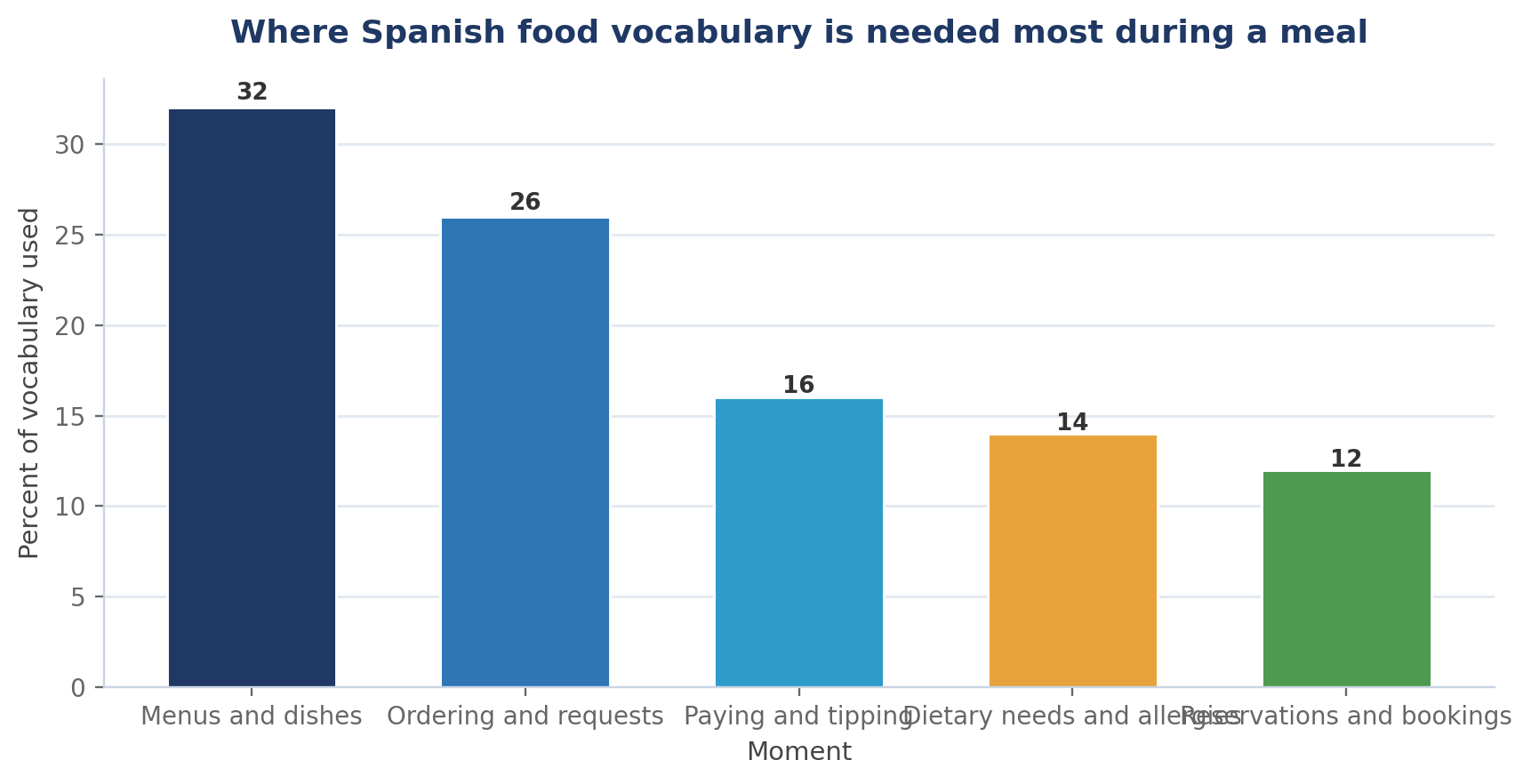
Restaurants are the friendliest place in the world to practise Spanish. The script is predictable, the stakes are low, and the person in front of you wants you to succeed. It is also the place where a beginner's vocabulary earns the fastest visible reward.
About forty words will get you through almost any meal in Spain or Latin America, from a bakery counter to a full dinner for four. This guide groups them by the moment you will need them, and every entry comes with an example sentence so the word arrives with a sound and a shape, not as a flashcard.
Reading the Menu
Menus are full of structural words that repeat everywhere. Learn these first and the dishes themselves become guessable.
The menú del día is the single most useful phrase on a Spanish menu. It is a fixed-price lunch with several courses, it is usually excellent value, and asking for it marks you as someone who knows what they are doing.
Ordering and Asking
¿Qué me recomienda? is the highest-value question in this article. It turns a menu into a conversation, gets you the dish the kitchen is proud of, and — usefully — invites the server to speak to you slowly and clearly.
Drinks
Regional notes matter here: in Spain the small beer is a caña and the juice is zumo, while in much of Latin America you will hear cerveza and jugo. Both are understood, but using the local word is always warmer.
Dietary Needs and Allergies
This is where vocabulary stops being a game. If you have a genuine allergy, learn the sentence, not just the word — and use soy alérgico or soy alérgica to match your gender.
¿Lleva…? is the most flexible allergy question in Spanish — it means "does it contain…" and works with any ingredient you can name.
Paying
Por favor pulls its weight here. In Spain the bill is not brought until you ask, and la cuenta, por favor is a complete, polite request on its own.
When Something Is Wrong
Saying disculpe rather than waving is both friendlier and more likely to work. Spanish-speaking service culture is warm, and a small apology-and-request formula opens doors that a demanding tone closes.
Five Sentences That Handle Almost Everything
Five sentences, and you can eat well anywhere in the Spanish-speaking world. Everything else in this article is refinement.
Hear these words at real speed before you travel
Restaurant vocabulary is easy to read and surprisingly hard to catch. Our Spanish Course Pass adds guided listening practice so you recognise the words when the waiter says them. Explore the Spanish Course Pass →
Start the Spanish course →Create a free accountMaking It Stick Before Your Trip
The role-play day is worth the embarrassment. Ordering a full meal to an empty room rehearses the sequence — table, drinks, starter, main, dessert, bill — which is exactly the sequence a real meal will follow.
Eight days of preparation, a lifetime of easier meals
From a bakery counter to a full dinner, the Course Pass gives you a personal AI voice tutor who rehearses the exact situations you will meet — and gives you feedback before you travel. Start your Spanish Course Pass →
Start the Spanish course →Create a free accountFrequently Asked Questions
How do I order food in Spanish politely? Start with quisiera or me pone rather than quiero, add por favor, and end with gracias. Asking ¿Qué me recomienda? is both polite and practically useful.
What is the menú del día? It is a fixed-price set lunch, common across Spain, usually with two courses, bread, a drink and dessert. It is typically the best value on any menu.
How do I say I am allergic to something in Spanish? Say Soy alérgico a… or Soy alérgica a… followed by the ingredient, and ask ¿Lleva…? to check whether a dish contains it.
Is tap water free in Spanish restaurants? In Spain you can usually ask for agua del grifo free of charge, though many places bring bottled water by default, which is charged.
References
- Instituto Cervantes — Spanish language resources
- Real Academia Española — dictionary and usage
- Spanish Agency for Food Safety and Nutrition
- Instituto Cervantes — DELE examination levels
- UNESCO — Mediterranean diet cultural heritage