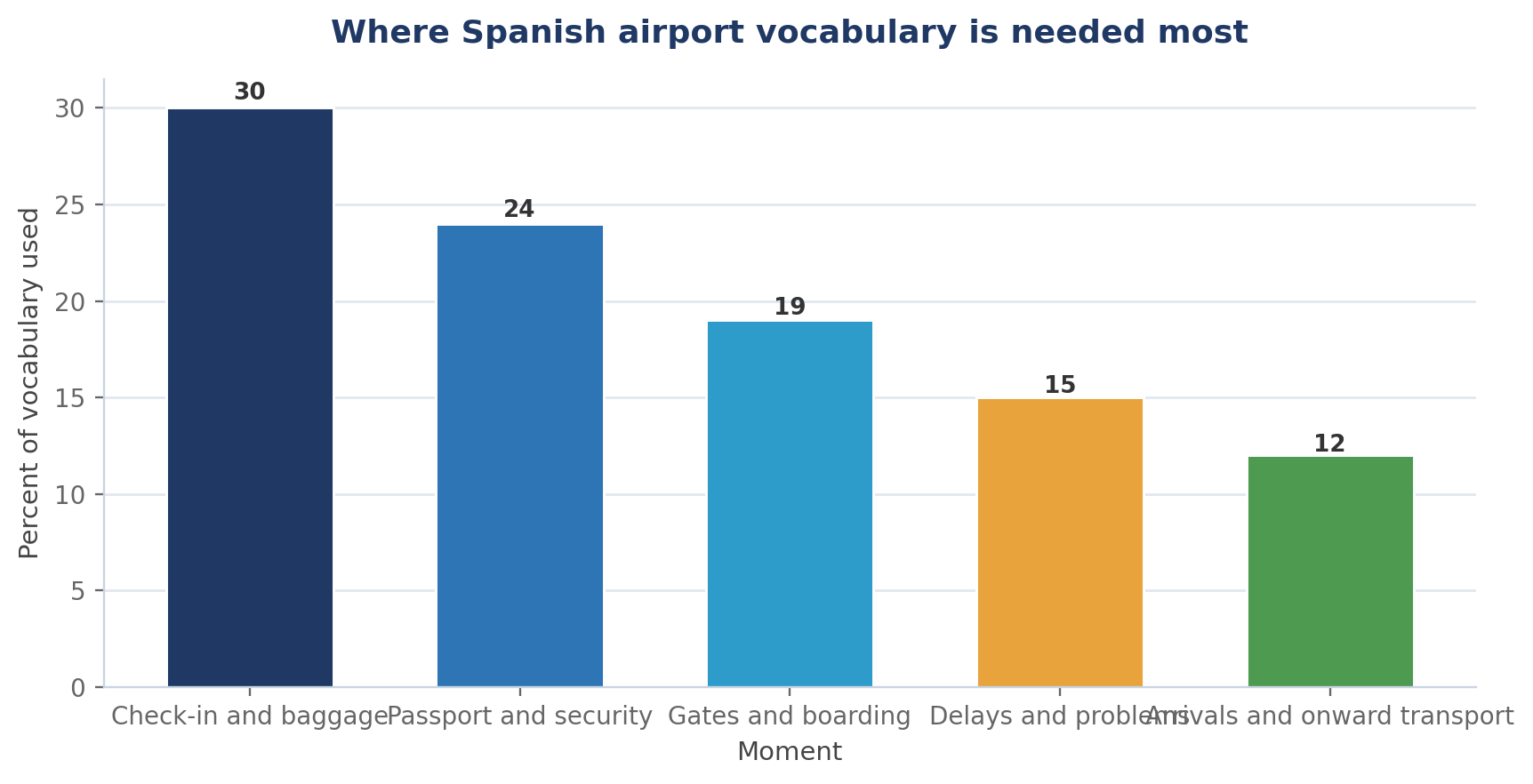
Airports are where language pressure peaks. Announcements arrive at speed over a bad speaker, staff are busy, the queue is moving, and the information you need is often a single word — a gate number, a delay, a bag that has not arrived.
That is exactly why airport vocabulary is worth learning as a block. The situations repeat across every trip, the phrases are short, and a small set of words covers almost everything. This guide groups them by the moment you will need them, with an example sentence for each so the word arrives with a sound attached.
Around fifty words will carry you from the departure hall to the arrivals curb.
The Airport Itself
¿Cuál es la puerta? and ¿En qué terminal está? are the two questions you will ask most often, and both fit in one breath.
Check-in and Baggage
Note the difference between maleta and equipaje. A maleta is one suitcase; equipaje is the collective term for everything you are travelling with. Using them interchangeably is understandable but slightly odd to a native ear.
Security and Passport Control
No tengo nada que declarar is worth memorising as one unit. It is the standard answer at customs and it ends the interaction cleanly.
At the Gate and Boarding
Announcements are the hardest part of airport Spanish, because they are fast and distorted. Two words will save you repeatedly: retraso and cancelado. Recognise those two and you know whether your day has changed.
When Something Goes Wrong
Mi maleta no llegó is the sentence no traveller wants to use and every traveller should know. Add ¿Dónde está la oficina de equipaje perdido? and you can solve the problem without switching to English.
Arrivals and Getting Out
The word cinta catches learners out, because it also means ribbon or tape. At an airport it is always the baggage belt, and the flight number is usually displayed above it.
Ten Sentences That Cover the Whole Journey
Hear airport Spanish at the speed it is really spoken
Announcements are fast and distorted, and reading a list will not train your ear for them. Our Spanish Course Pass adds guided listening and speaking practice with an AI voice tutor, so you catch the words that matter on the day. Explore the Spanish Course Pass →
Start the Spanish course →Create a free accountHow to Practise Before You Fly
The announcements day is the one that pays off. Ten minutes of real airport audio teaches you the vocabulary that no list can, because it contains exactly the distortions you will meet — clipped numbers, background noise and a speaker system from 1985.
Six days of preparation for a smoother journey
From the check-in desk to the baggage belt, our Course Pass gives you a personal AI voice tutor and structured lessons so you can rehearse the exact airport conversations you will have, at your own pace. Start your Spanish Course Pass →
Start the Spanish course →Create a free accountFrequently Asked Questions
How do I ask for an aisle seat in Spanish? Say Un asiento de pasillo, por favor, or Quisiera un asiento de pasillo to be more formal. A window seat is un asiento de ventanilla.
What does retraso mean at the airport? It means a delay. If you hear el vuelo tiene un retraso, your flight is late; cancelado means it has been cancelled.
How do I report lost luggage in Spanish? Say Mi maleta no llegó and ask for la oficina de equipaje perdido. Then request una reclamación to start the formal claim.
Is Spanish airport vocabulary different in Latin America? Most of it is identical. A few words differ, such as boleto for ticket in much of Latin America versus billete in Spain.
References
- AENA — Spanish airports and passenger information
- Instituto Cervantes — Spanish language resources
- Real Academia Española — dictionary and usage
- Spanish Ministry of Transport — travel information
- Instituto Cervantes — DELE examination levels