← Back to the blog
SpanishVocabulary & Phrases

Essential Spanish Vocabulary: Directions & Getting Around (with Examples)

LanguageSkills Team · 6 October 2026

Essential Spanish Vocabulary: Directions & Getting Around (with Examples)

Asking for directions in Spanish is easy. Understanding the answer is the hard part.

The question is a fixed sentence you can rehearse in a minute. The reply arrives at natural speed and contains exactly the words you have not learned yet — siga, gire, cuadras, a la altura de. And it comes with gestures that point somewhere you cannot see.

This guide solves both halves: the questions that get you a clear answer, and the vocabulary that lets you follow it. Around forty-five words will carry you from a train station to an address in an unfamiliar city.

The Questions That Work

SpanishEnglishWhen to use it
¿Dónde está…?Where is…?Any place
¿Cómo llego a…?How do I get to…?Needing a route
¿Está lejos?Is it far?Deciding to walk
¿Está cerca?Is it near?Confirming
¿Puede repetir más despacio?Can you repeat more slowly?After a fast answer
¿Me lo puede escribir?Could you write it down?Addresses and names
¿Está por aquí?Is it around here?Nearly there

¿Me lo puede escribir? is the sentence learners underuse most. It converts a stream of spoken instructions into a written address you can read at your own pace, and it politely signals that you are trying.

Understanding the Answer

SpanishEnglishNote
a la derechato the rightTurn or side
a la izquierdato the leftTurn or side
todo recto / derechostraight onVery common
gire / dobleturnFormal / informal
sigacontinueFormal instruction
crucecrossStreets and crossings
la esquinathe cornerLandmark
la cuadrathe blockLatin America
la manzanathe blockSpain and some regions
el semáforotraffic lightsLandmark
la plazasquareVery common landmark
al lado denext toPosition
enfrente deoppositePosition
detrás debehindPosition

Note the cuadra versus manzana split. In most of Latin America distance is counted in cuadras; in Spain the manzana is the block. Both are understood widely, and using the local one earns you a small smile.

Landmarks and Places

SpanishEnglishExample
la callestreet¿En qué calle está?
la avenidaavenueVive en la avenida principal.
la acerapavementCamina por la acera.
el crucejunctionGire en el cruce.
la rotondaroundaboutTome la segunda salida.
el puentebridgeCruce el puente.
la iglesiachurchEstá junto a la iglesia.
el mercadomarketDetrás del mercado.
la estaciónstationLa estación está cerca.
el centrocentreVoy al centro.

Local landmarks are more useful than street names, because locals navigate by them. Asking for the bank on the corner will get you a clearer answer than asking for a street you cannot pronounce.

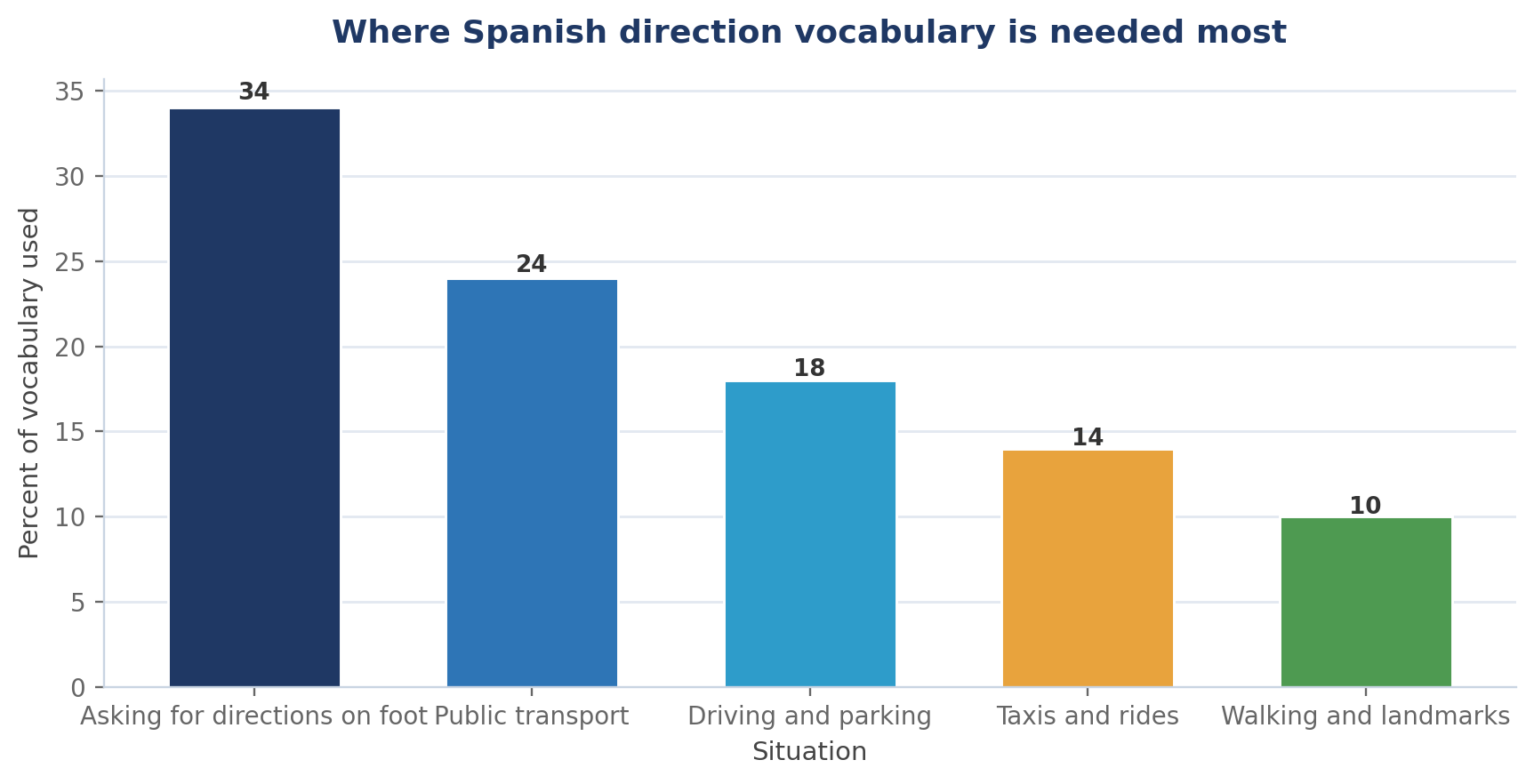
Where Spanish direction vocabulary is needed most
Figure 1: Where Spanish direction vocabulary is needed most · Source: Languageskills.net review of learner navigation conversations, 2025

Buses, Trains and Metro

SpanishEnglishExample
el billeteticketUn billete a Valencia, por favor.
el boletoticketLatin America variant
ida y vueltareturnIda y vuelta, por favor.
solo idaone waySolo ida.
el andénplatform¿En qué andén?
la paradastopLa parada está allí.
la línealineCoja la línea tres.
el horariotimetable¿Tiene el horario?
la estación de trentrain station¿Dónde está la estación de tren?
el metroundergroundEl metro es más rápido.
transbordochangeHaga transbordo en la próxima.

The two sentence shapes that matter here are ¿En qué andén? and Coja la línea…. Between them they cover almost every station interaction in the Spanish-speaking world.

Taxis and Driving

SpanishEnglishExample
el taxitaxi¿Dónde puedo tomar un taxi?
lléveme atake me toLléveme a esta dirección.
la tarifafare¿Cuánto es la tarifa?
el conductordriverEl conductor fue muy amable.
el aparcamientoparking¿Hay aparcamiento cerca?
aparcarto parkNo puedo aparcar aquí.
el peajetollHay un peaje en la autopista.
la gasolinerapetrol station¿Dónde está la gasolinera?
la multafineMe pusieron una multa.
el atascotraffic jamHay mucho atasco.

Lléveme a esta dirección plus a phone screen is the most reliable taxi sentence available. It removes pronunciation from the equation entirely.

Ten Phrases That Solve Any Journey

PhraseMeaning
Perdón, ¿dónde está…?Excuse me, where is…?
¿Cómo llego al centro?How do I get to the centre?
¿Está lejos de aquí?Is it far from here?
¿Puede repetir más despacio?Could you repeat more slowly?
¿Me lo puede escribir?Could you write it down?
Un billete de ida y vuelta.A return ticket.
¿En qué andén sale?Which platform does it leave from?
¿A qué hora sale el próximo?What time is the next one?
Lléveme a esta dirección.Take me to this address.
¿Estoy en el camino correcto?Am I on the right road?

Understand the answer, not just the question

Asking is easy; following a fast reply is the real challenge. Our Spanish Course Pass adds guided listening so directions stop sounding like a blur. Explore the Spanish Course Pass →

Start the Spanish course →Create a free account

A Practice Routine Before You Travel

DayFocusTask
1Question formsSay all seven questions aloud
2Left, right, straightTen direction sentences
3LandmarksName ten landmarks in Spanish
4TransportRehearse a ticket purchase
5ListeningHear real directions, no text
6Role-playAsk, listen, repeat back
7Full rehearsalRoute from hotel to station

Day six contains the most useful habit in this whole article: repeat back what you heard. Saying entonces, a la derecha y luego todo recto confirms your understanding and, if you got it wrong, gives the other person a chance to correct you before you walk away.

Three Cultural Notes

SituationWhat to expect
Asking a strangerPeople are usually willing and generous with detail
Being unsureThey may walk you part of the way
Physical guidancePointing and touching the arm are normal
Directions versus distancesTwenty minutes walking may be described as cerca
Being lateCerca is relative, so ask for a time estimate

That last row saves real time. Cerca often means "less than half an hour on foot". Ask ¿cuántos minutos a pie? and you will get a number you can plan around.

Travel with the words already in your mouth

Direction vocabulary is short and highly reusable. Our Course Pass gives you a personal AI voice tutor and guided speaking practice so you can rehearse exactly these situations before you go. Start your Spanish Course Pass →

Start the Spanish course →Create a free account

Frequently Asked Questions

How do I ask for directions in Spanish? Use ¿Dónde está…? for a place or ¿Cómo llego a…? for a route. Adding perdón at the start is polite and gets attention.

What does todo recto mean? It means straight on. You may also hear todo derecho, which means the same thing, especially in Latin America.

How do I say left and right in Spanish? A la izquierda is to the left and a la derecha is to the right. Gire or doble means turn.

What if I don't understand the answer? Ask ¿Puede repetir más despacio? and then ¿Me lo puede escribir? Writing removes speed and accent from the problem entirely.

References

Ready to start speaking?

Put this into practice — self-paced, in the language of your choice.

Start your course
LanguageSkills.net is an educational preparation tool aligned with the published syllabus of each listed examination. We do not guarantee any individual exam result and accept no liability for pass or fail outcomes.