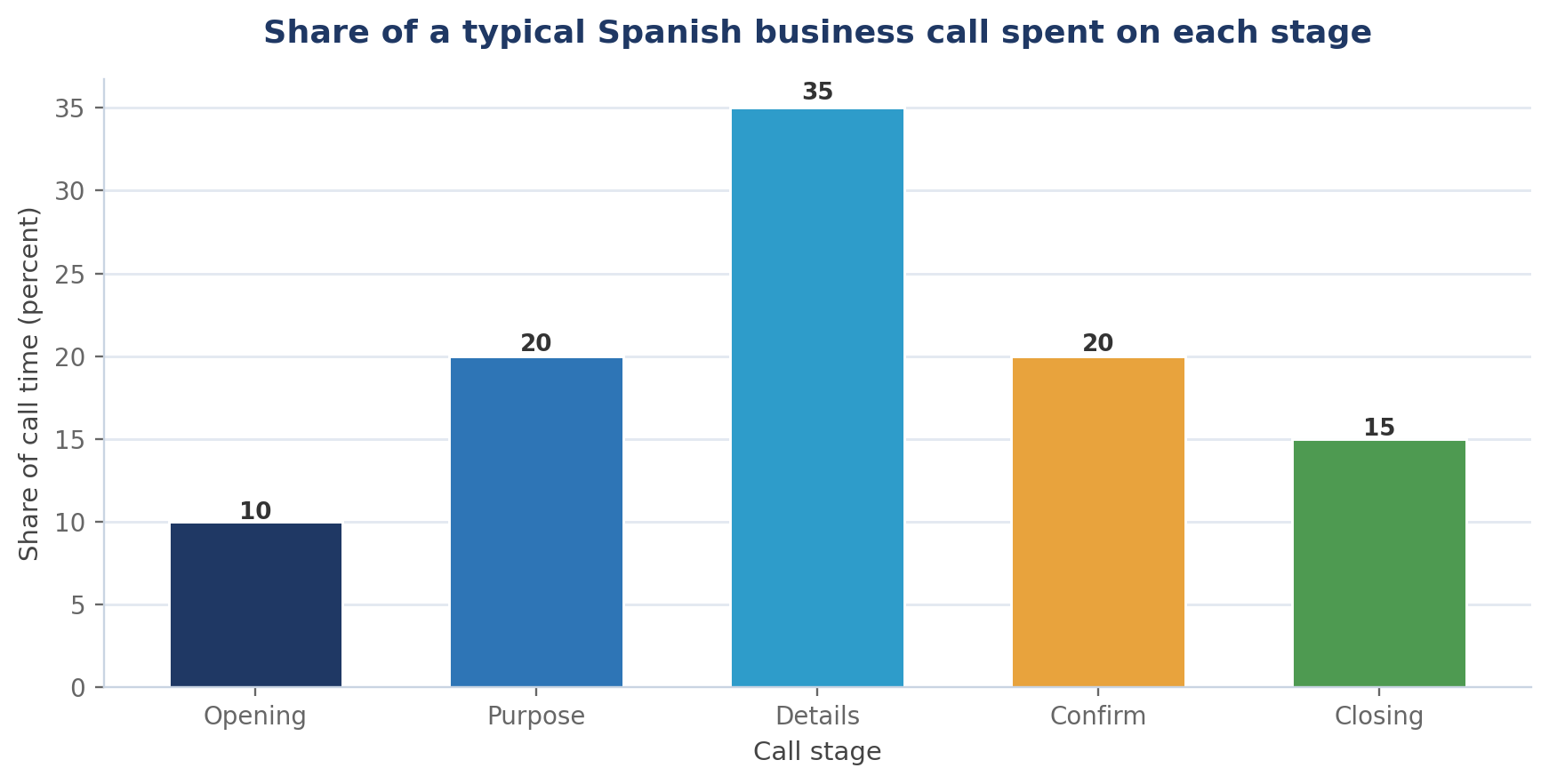
Spanish on the phone is not the same Spanish you learned in class. There are no lips to read, no gestures, no face saying wait, repeat that. Just a compressed voice and the terrifying ¿dígame?
The good news: business spanish phone calls run on a small, fixed script. Learn roughly thirty phrases and you can handle almost any call — booking, chasing, apologising, closing.
What you will get from this guide
- The full call arc, from picking up to signing off politely
- Formal phrases for clients, plus the tú forms for colleagues
- Spelling your name, taking a message and surviving bad lines
- A reusable script you can keep beside your laptop
Picking Up: Never Say "Hola"
Answer with ¿Dígame? or ¿Sí, dígame? — literally "tell me", and the standard Spanish phone answer. Say hola alone and you sound like you're calling a friend.
When you're the caller, the opening formula is fixed: greet, identify yourself, state your purpose.
Always ask ¿Es buen momento? — it's polite, it buys you a second to breathe, and it prevents launching a pitch into someone's lunch break.
Asking for Someone and Surviving the Switchboard
Quisiera hablar con… is the soft, professional way to ask for a person. ¿Me pone con…? means "could you put me through?" and works everywhere.
Holding, Transferring and the Awkward Pause
The Spanish hold phrase is no cuelgue, por favor — don't hang up. Transferring gets announced with le paso con….
Silence on a Spanish call is uncomfortable, so fill it. Perdón, un momento que busco el archivo keeps the line alive and buys you time.
Spelling, Numbers and Confirmation
Names break phone calls. Spanish uses ¿cómo se escribe? and letters are named, not sounded out — eme for M, efe for F. Numbers get read in pairs, so make them repeat back.
The Business Vocabulary That Carries the Call
Closing the Call Properly
Spanish calls end with a thank-you and an action commitment. Never just hang up after "OK, thanks".
Quedo a la espera de su respuesta — "I await your reply" — is the workhorse closing of Spanish business email and phone alike. Learn it once, use it forever.
Stop rehearsing the call in the shower
Self-paced Spanish courses with a personal AI voice tutor, built for real workplace calls — ordering, chasing, apologising, closing. Speaking practice with AI feedback helps you fix your register before your client does.
Take business Spanish with an AI voice tutor →Create a free accountThe Register Question: Usted or Tú?
Spanish workplaces have loosened. Many offices use tú immediately. But the phone is more formal than email, and clients are more formal than colleagues.
The safe rule: start with usted with anyone external, follow their lead, and let them offer tutéame before you switch. If they say puedes tutearme, switch immediately — refusing is a small snub.
A Script You Can Keep Open During the Call
Screenshot this and keep it beside your screen.
Practise it aloud five times before the call. Not mentally — aloud. Your mouth needs the reps more than your brain does.
Walk into your next call prepared
Self-paced levels from A1 to B2 and a business track that drills exactly these phrases until they come out without thinking.
Create your free account and get started →Create a free accountFrequently Asked Questions
How do you answer the phone in Spanish? Say ¿Dígame? or ¿Sí, dígame? — never just hola. If you're answering for a company, add the company name: LogiTrans, ¿dígame?
How do I ask someone to repeat something politely? Use ¿Puede repetir más despacio, por favor? followed by A ver si le he entendido bien… to confirm. This sounds attentive rather than confused.
Should I use usted or tú on a business call? Start with usted for external calls and clients. Switch to tú only when they invite you to (puedes tutearme), or when you already know each other well.
How do I spell my name over the phone in Spanish? Ask ¿Me lo deletrea? if you're receiving, and read letters by their Spanish names — eme for M, jota for J, eñe for Ñ. Repeat numbers in pairs and ask them to read the number back.
References & Further Reading
- Instituto Cervantes — Plan Curricular del Instituto Cervantes, including the reference inventory of telephone functions and formulas: https://cervantes.es
- Real Academia Española & ASALE — Nueva gramática de la lengua española, on pronouns of address: https://rae.es
- Instituto Cervantes — DELE exam descriptors, including B1 and B2 spoken interaction tasks: https://cervantes.es
- FundéuRAE — guidance on greetings, closings and business correspondence in Spanish: https://fundeu.es
- Cámara de Comercio de España — resources on Spanish business communication practice
Level up your workplace Spanish at languageskills.net.