You know the grammar. You passed B1. Then the meeting starts and someone says "vamos a ir al grano" and your brain goes blank.
The gap is not vocabulary size. It is that meetings run on a small, repeatable set of ritual phrases — and nobody teaches them in Chapter 7 of a textbook.
What you will get from this guide
- The phrases Spanish-speaking colleagues actually expect in meetings
- A table-by-table script for opening, interrupting, disagreeing and closing
- Register rules: when tú gets you in trouble and usted saves you
- How many guided hours a B1 speaker needs to sound meeting-ready
Why Business Spanish Phrases Beat Perfect Grammar
Spanish business culture tolerates an accent. It does not tolerate silence. A person who speaks slowly but leads with "Tengo una propuesta concreta" reads as competent. A person who says nothing reads as absent.
The Instituto Cervantes draws the line clearly in its CEFR-aligned curriculum: at B1 you manage everyday professional transactions; at B2 you defend positions and negotiate nuance. Most international teams live in that muddy middle. Here is the shortcut through it.
The Opening Move: Take the Floor Politely
Notice the pattern: Spanish meetings name the topic, name the goal, then move. Vagueness is not politeness here — it is noise.
Interrupting Without Starting a War
Interruptions in Spanish are normal, even warm. The trick is the softener before the cut.
The magic word is perdona (or perdone with clients). It buys you three seconds of attention.
Disagreeing: The Diplomatic Ladder
Spanish disagreement is rarely blunt in a formal room. You climb a ladder from warm to firm, and you choose the rung by consequences.
Rung four is fine with peers. Rung five is for budgets and lawyers.
Stop rehearsing phrases you will never say
Ready to turn reading into real Spanish? Start your self-paced course today.
Start the Spanish course →Create a free accountOur self-paced Spanish course drills exactly these meeting scripts with a personal AI voice tutor until they come out without thinking. A1 to B2, structured lessons, speaking practice with AI feedback.
Button: Build your meeting Spanish →
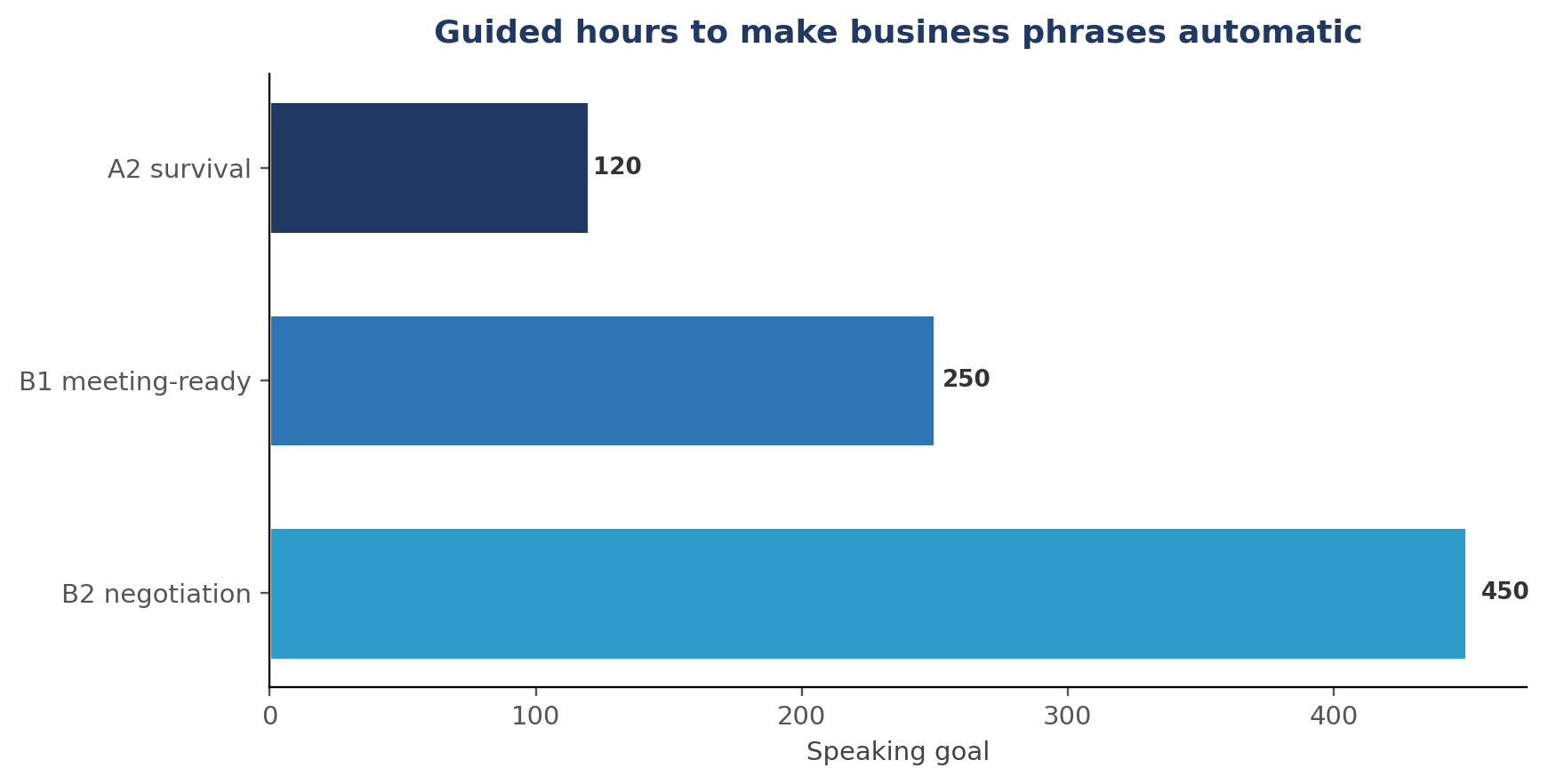
How Long Until These Phrases Feel Automatic?
Guided hours are the honest currency. Doubling your time does not double your output — but it does move you from decoding to landing.
Numbers matter less than consistency. Thirty minutes of speaking a day beats four hours on Sunday.
Written Business Spanish Phrases That Get Replies
Meetings are half the job. Email is the other half, and the tone rules are stricter.
For clients in Latin America, ustedes replaces vosotros, and Quedo atento a su respuesta is the safer sign-off. Small adjustment, big credibility.
Tú, Usted and the Room You Are In
When unsure, start formal. Most Spanish speakers will invite you to tutear within a call — and that invitation is itself a small win.
Cultural Moves That Signal Fluency
Business Spanish phrases are only half the code. The other half:
That last one is universal. Speed of follow-up beats elegance of phrasing every time.
Practising Without a Spanish Office
You need reps, not theory. Three moves that work:
Explaining your own job in Spanish is brutally effective. You cannot hide behind textbook topics.
Your next meeting is in Spanish
Ready to turn reading into real Spanish? Start your self-paced course today.
Start the Spanish course →Create a free accountStudy at your own pace with a personal AI voice tutor and rehearse the exact phrases above until they arrive on cue. Guided lessons, speaking practice with AI feedback, and printable study materials included.
Button: Start speaking Spanish at work →
Frequently Asked Questions
How many business Spanish phrases do I actually need?
Around 60 to 90 cover most meetings: openers, interruptions, agreement, disagreement, clarification and closing. Depth beats breadth — a mastered 70 beats a half-learned 400.
Is business Spanish different from everyday Spanish?
The grammar is identical. The register shifts: more conditionals, more usted, fewer slangy verbs. Learning 40 formal connectors instantly raises how professional you sound.
Can I reach B1 business Spanish in three months?
With 6 to 8 guided hours a week plus daily practice, a motivated A2 learner can reach a working B1 for meetings. Reaching B2 negotiation level usually takes longer — see the hour estimates above.
Do I need to learn both Spanish and Latin American usage?
Learn one deeply, then adjust. Replace vosotros with ustedes, note vocabulary differences (ordenador versus computadora), and keep your core phrases unchanged. The etiquette travels.
References & Further Reading
- Instituto Cervantes — Plan curricular del Instituto Cervantes: Niveles de referencia para el español, the standard CEFR-mapped syllabus for Spanish.
- Council of Europe — Common European Framework of Reference for Languages: Companion Volume, the source for B1 and B2 descriptors.
- Real Academia Española — Diccionario panhispánico de dudas, for regional and register questions.
- Instituto Cervantes — El español en el mundo (yearbook), on Spanish in professional and international settings.
- Fundación del Español Urgente (FundéuRAE) — daily guidance on modern written Spanish, excellent for email style.