A customer calls. She is angry, she is fast, and she is not repeating herself. Your Spanish is decent — in a classroom. On the phone, with no lips to read and no pause button, decent evaporates in four seconds.
Good spanish customer service is not fluency. It is a small, bulletproof set of scripts you can fire under pressure, plus enough listening to catch the one word that matters.
The phrases you will use every single day
Learn these cold. Not recognise — produce, without thinking, at speed.
Six scripts, repeated a thousand times, will carry you through most days. That is the whole secret.
Usted, tú and the fast way to lose trust
Spanish has two ways to say "you", and customer service lives almost entirely in usted. Switch to tú without permission and a formal caller hears disrespect. Stay in usted with a friendly one and nothing breaks.
Verb forms follow: puede becomes puedes, tiene becomes tienes, dígame becomes dime. Practise both columns out loud until the switch is automatic, because fumbling it mid-call sounds worse than staying formal.
What you will get from this guide
- The core scripts every agent needs at B1
- How to handle anger, silence and escalations in Spanish
- A practice routine that builds phone confidence, not textbook grammar
Handling the three hard calls
Most calls are easy. Three kinds are not.
The furious-call script has one rule: acknowledge before explaining. Spanish speakers read tone as much as content, and a single warm entiendo su frustración changes the temperature of a call faster than any policy detail.
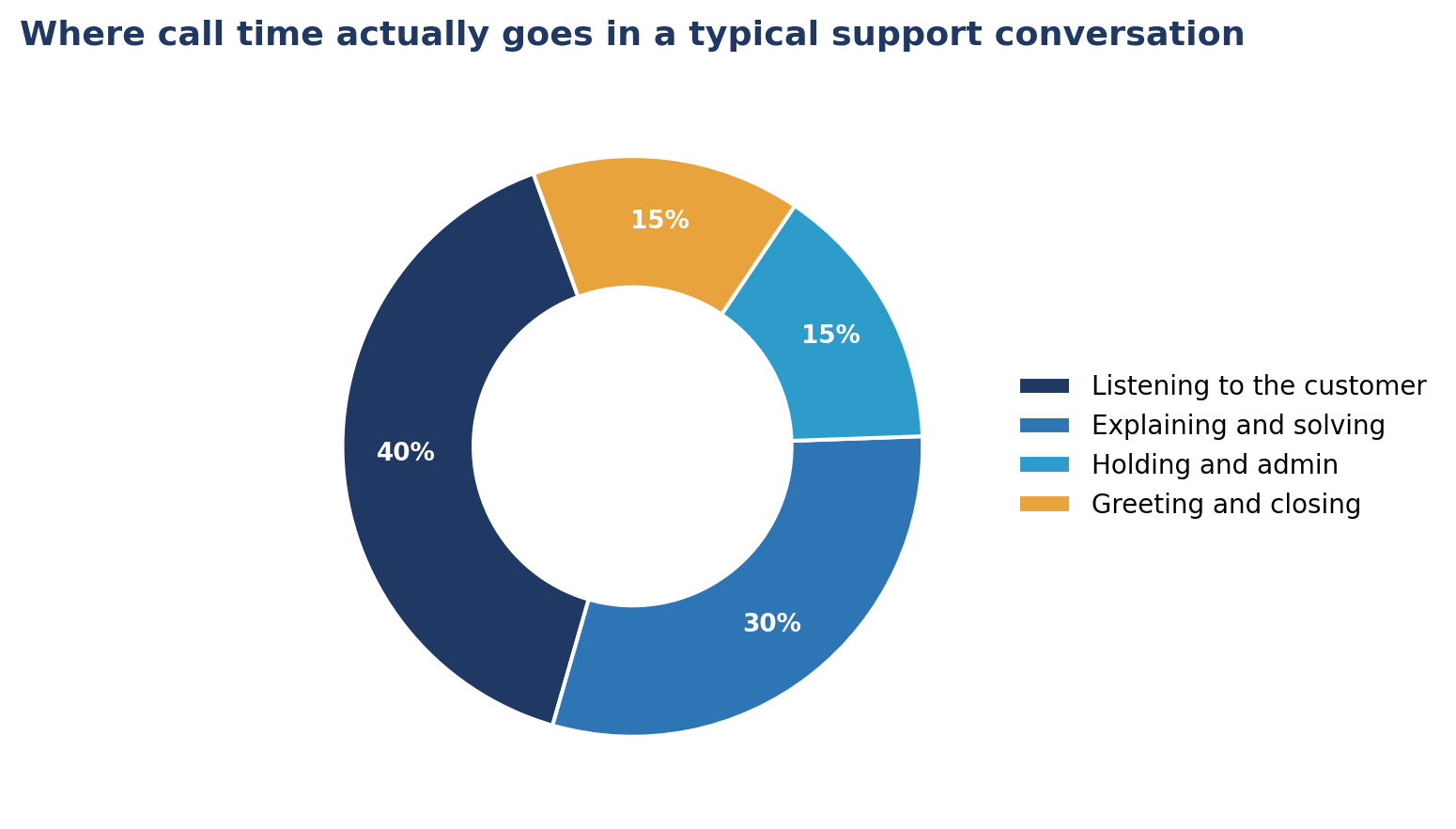
Look at that slice: listening is the biggest job, not talking. Yet almost every learner drills production and ignores comprehension. Reverse it.
Train the call, not the textbook.
A personal AI voice tutor at B1 puts you in realistic service scenarios — angry caller, hold script, escalation — and gives you feedback on your register on the spot. Twenty minutes of speaking practice beats two hours of grammar.
Start Spanish for work →Create a free accountThe vocabulary that keeps you professional
Some words do quiet, important work in Spanish support.
For written channels, use estimado/a to open and quedo a su disposición to close. For chat and WhatsApp, shorten to buenas and quedamos atentos. Register tracks the channel, and getting this wrong reads as sloppy rather than warm.
A practice routine that builds phone nerve
You cannot learn phone Spanish by reading about it.
Two things make this work. Recording yourself, because your ear lies about your accent. And speaking practice with the AI voice tutor, because it gives you instant feedback without the pressure of a self-paced lesson.
If you need a certificate, DELE B1 from the Instituto Cervantes is the recognised proof — and its speaking paper mirrors exactly these situations. IELTS has a familiar pattern of exam-task design if you like comparing structures. Choose the exam that fits your market; then practise the tasks, not the topic list.
Frequently Asked Questions
Do I need B2 to work in Spanish customer service? B1 is the practical entry line for back-office and written support. Phone-based roles usually want B2, because accent, speed and slang are unforgiving without visual cues. Start at B1, then push listening hard.
How do I deal with a customer who speaks very fast? Slow them with a polite request rather than guessing: ¿Podría hablar un poco más despacio, por favor? Then confirm what you heard. Confirming costs five seconds; misunderstanding costs a call-back.
Is Latin American Spanish different enough to worry about? Grammar is shared; vocabulary and rhythm are not. Carro in Mexico is coche in Spain, and ahorita means several different things depending on the country. Learn your market's version, and keep the formal scripts stable.
How long does it take to get phone-confident? With daily script practice and weekly roleplay, most B1 learners handle routine calls comfortably in six to ten weeks. Escalations and technical calls take longer, because they need vocabulary, not courage.
References & Further Reading
- Instituto Cervantes — DELE levels and exam structure: https://www.cervantes.es
- Real Academia Española — dictionary and usage reference: https://www.rae.es
- FundéuRAE — style guidance for professional Spanish: https://www.fundeu.es
- Council of Europe — CEFR descriptors for B1 and B2: https://www.coe.int/en/web/common-european-framework-reference-languages
- Centro Virtual Cervantes — practical language materials: https://cvc.cervantes.es
Be the agent who calms the call, not the one who transfers it.
Spanish for work covers the scripts, the usted rules and the listening drills that make phone calls feel manageable. Study at your own pace and start this week.
Start Spanish for work →Create a free account