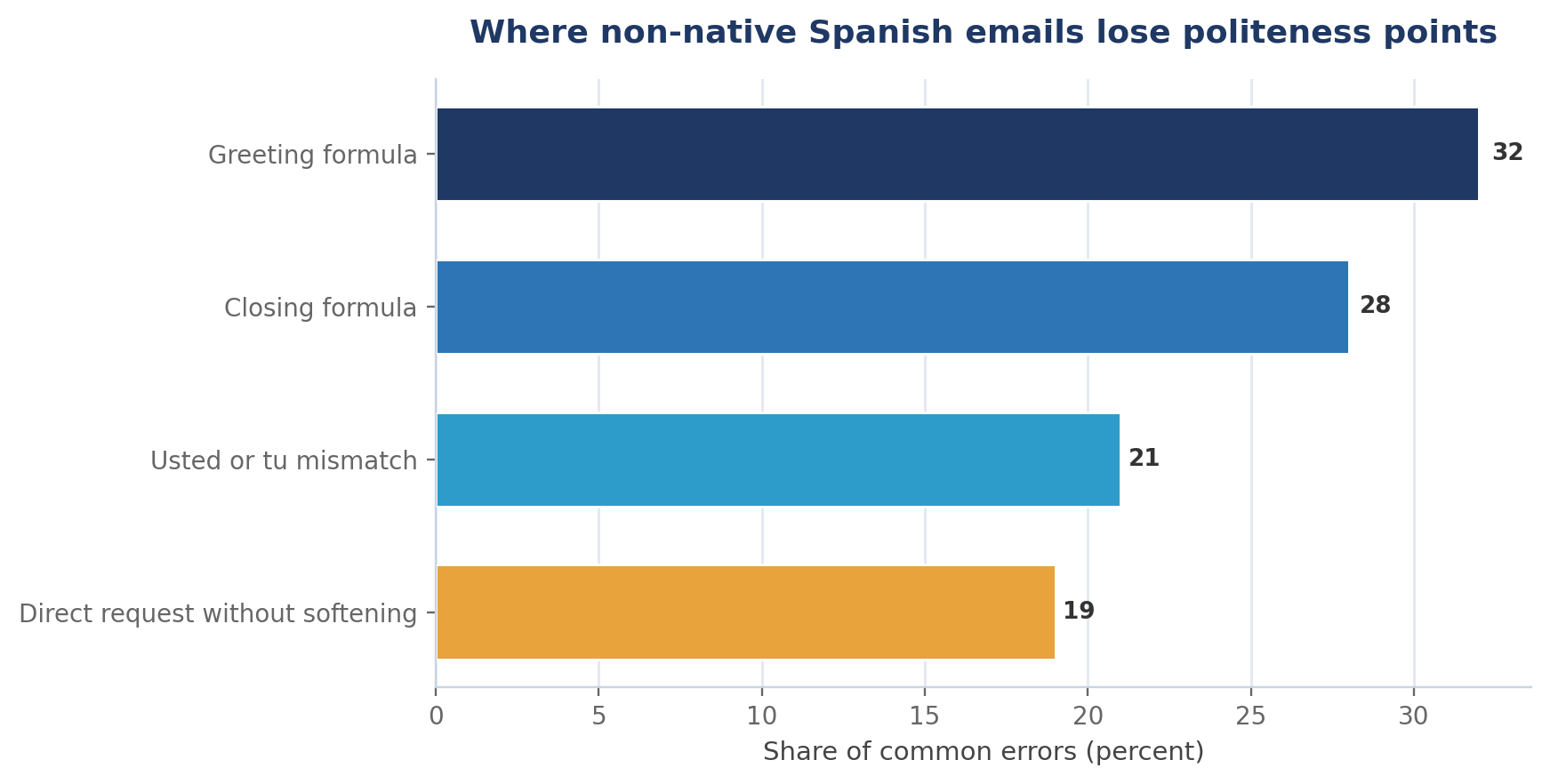
Here is the fastest way to look incompetent in Spanish: write a fluent email and sign off with the wrong formula. Your grammar can be flawless and your courtesy can still be an insult.
Spanish professional writing runs on formulas. Learn eight of them and you will sound polite in Madrid, Mexico City and Buenos Aires alike.
What you will get from this guide
- The five-part skeleton every Spanish business email follows
- Formal greetings and closings matched to region and relationship
- Usted vs tú decided by a simple rule
- A copy-ready model email with the phrases explained
The Five-Part Skeleton
Spanish business emails are noticeably more formal than English ones. You do not open with "Hi" and close with "Thanks".
Skipping the cierre is the most common foreign mistake. In English it feels redundant. In Spanish it reads as abrupt.
Greetings: Match the Formula to the Relationship
Use a colon after the greeting, not a comma. This is a real convention in Spanish correspondence and readers notice.
Usted or tú? One Rule Settles It
The rule: **start with usted and let them invite you down.** If they write tú, mirror it in your reply. Switching without an invitation is the single most common faux pas.
Phrase Bank: What to Write and When
Notice that grammar barely appears. Nearly every problem is register, not conjugation.
Grammar gets you understood. Register gets you respected.
Business Spanish is a skill you practise with real feedback, not a phrase list you memorise. On LanguageSkills.net, a personal AI voice tutor guides structured lessons and gives speaking feedback, so you can practise business Spanish at your own pace, any time.
Ver cursos de español de negocios →Create a free accountA Model Email You Can Adapt
Estimada Sra. Fernández: Me pongo en contacto con usted en relación con la propuesta enviada la semana pasada. Le escribo para confirmar si ha tenido ocasión de revisarla. Adjunto encontrará la versión actualizada con los cambios comentados. Quedo a su disposición para cualquier duda o para agendar una llamada. Atentamente, Ana Ruiz
Four sentences, no filler, every formula in place. That is a complete professional email in Spanish.
Five Mistakes That Undo Good Spanish
- Translating "Dear Sir/Madam" literally. Estimado señor alone can feel incomplete — add a surname when you have one.
- Closing with Gracias instead of Atentamente. It is not wrong, it is just weak.
- Using exclamation marks for enthusiasm. Spanish business writing uses them far less than casual Spanish.
- Writing long, indirect paragraphs. Spanish formality lives in the formulas, not in length.
- Mixing tú and usted in the same email. Pick one and hold it.
Write like a professional, not like a textbook
Our Spanish business track covers email, meetings, negotiation and presentations — with a personal AI voice tutor giving you feedback on your register before a client ever does.
Empezar con español profesional →Create a free accountFrequently Asked Questions
Is Spanish email more formal than English email? Yes, noticeably. Spanish correspondence retains courtesy formulas that English business writing dropped decades ago. Omitting them reads as cold rather than efficient.
How do I close a formal email in Spanish? Atentamente is the safest universal close. Un cordial saludo is slightly warmer and works well once you know the person. Avoid Saludos in a first formal contact.
Should I use usted in a first email? Always. It costs nothing and offends no one. Move to tú only after the other person does.
Does the formula change by country? The structure holds across Spain and Latin America, though Spain tends slightly more formal in first contact and some Latin American markets are warmer sooner. When unsure, stay formal.
References & Further Reading
- Real Academia Española — Diccionario panhispánico de dudas, usage of usted and tú: https://www.rae.es
- Instituto Cervantes — Spanish for professional purposes and DELE business certificates: https://www.cervantes.es
- FundéuRAE — style and usage guidance for professional Spanish writing: https://www.fundeu.es
- Council of Europe — CEFR descriptors for written correspondence: https://www.coe.int
- LanguageSkills.net — Spanish business and professional courses: https://languageskills.net/spanish
The Takeaway
Spanish professional writing is mostly courtesy engineering. Learn the greeting formulas, learn the closings, decide usted or tú deliberately, and your grammar can lag a level behind without anyone noticing. Get the register wrong and nobody remembers your vocabulary.