Here is the sentence that ruins applications: "Se requiere un nivel B2 de español." Two letters and a number, buried on page four of a university website. Miss it, and your degree place collapses in July.
The Spanish language requirements for studying in Spain are not one rule. They are a stack: the university's rule, the degree's rule, and the student visa's rule. Get them out of order and you refile everything.
What you will get from this guide
- The real Spanish level each type of programme demands
- Which certificates universities actually accept (DELE, SIELE, and the loopholes)
- How visa paperwork and language proof intersect
- A realistic timeline from zero Spanish to enrolment
The Default Answer Is B2 — and C1 for the Hard Cases
Almost every Spanish-taught bachelor's and master's degree in Spain sets DELE B2 as the entry bar. That is the honest headline. Medicine, law, journalism and psychology at competitive faculties often push to B2, because the workload is reading-heavy and clinical.
Degrees taught fully in English usually ask for no Spanish certificate at all — but that is a trap. You still live in Spain. Landlord, bank, health centre, group project. B1 conversational Spanish is the difference between a good year and a lonely one.
Certificates Spain Actually Accepts
Spain invented DELE. Instituto Cervantes runs it, the Spanish Ministry of Education backs it, and it never expires. That permanence is the whole point: a DELE B2 from 2019 still opens doors in 2030.
SIELE is the younger sibling — faster, computer-based, valid for five years. Universities increasingly accept it, but not universally, so check before you book a test date. University-owned ELE certificates (from the language centre attached to the university you're applying to) are often accepted for that institution only.
The Visa Layer Nobody Warns You About
The Spanish student visa (visado de estudios) doesn't demand a DELE certificate. It demands evidence that you can follow the course you've been accepted onto. If your offer letter says the programme is in Spanish, the consulate may ask for proof. If the letter is silent, get a letter from the university stating your level — a one-page document, but it takes weeks.
Rules shift. Always confirm on the consulate page for your country before you spend money on a test.
Hit B2 with a plan, not a guess
Our self-paced Spanish course is built around DELE levels, with an AI voice tutor that gives feedback on your speaking and writing. Most learners book it precisely because an acceptance letter depends on one certificate.
Get to DELE B2 with a course →Create a free accountThe English-Taught Escape Hatch — and Its Cost
Roughly a third of Spanish master's programmes now run in English, especially in business, engineering and data science. Zero language requirement, and admissions are simpler.
Then you land in Madrid. The landlord speaks Spanish. The pharmacy speaks Spanish. Your classmates switch to Spanish the moment the professor leaves. Students who arrive at B1 report a completely different year from those who arrive at A2.
How Long Does It Actually Take?
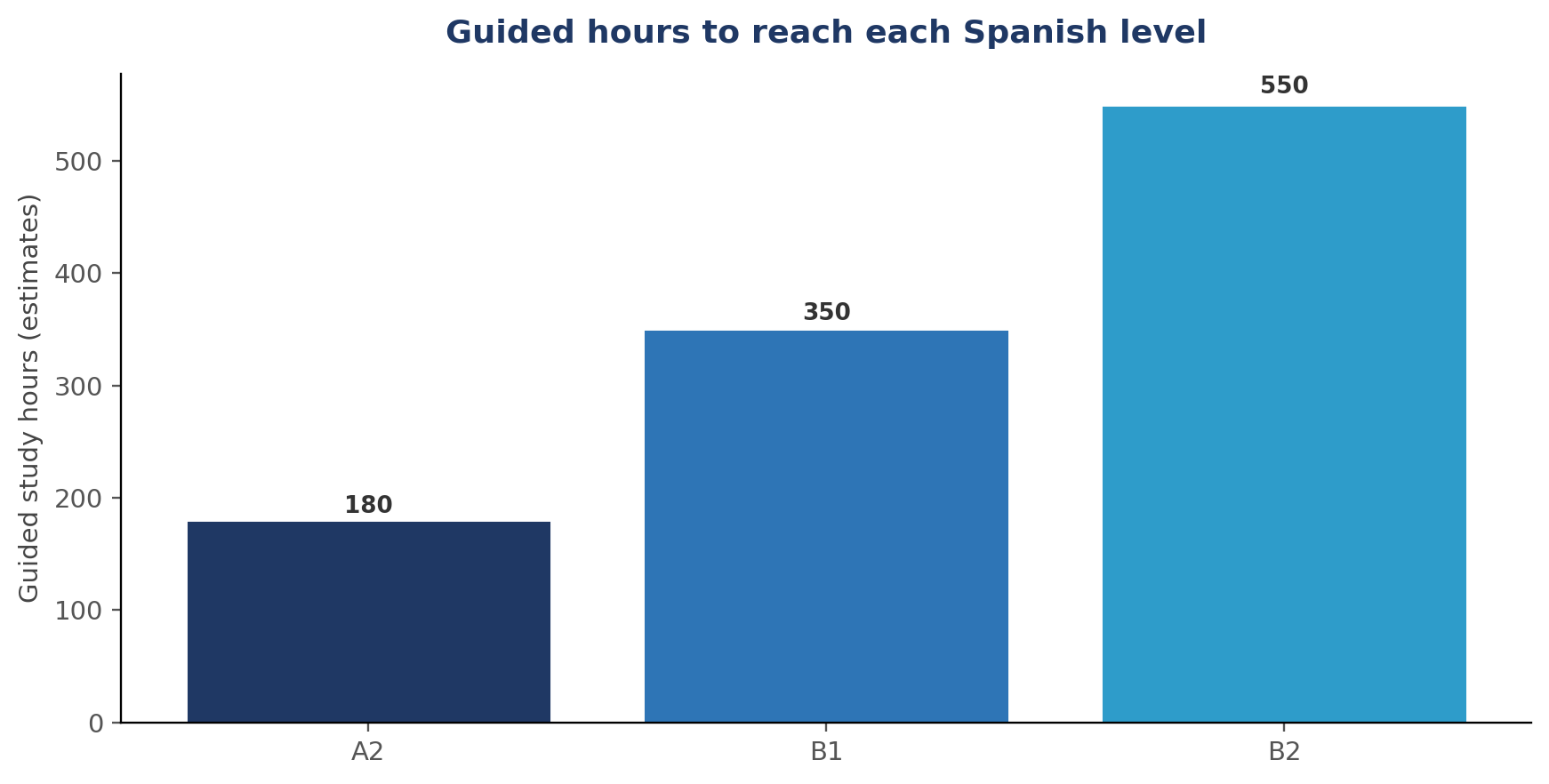
People make the same arithmetic error. They look at "B2" and assume three months. From zero, B2 is typically 500 to 700 guided hours for an English speaker with consistent practice. From A2, it's around 350–400. From B1, closer to 200.
Deadlines decide your schedule, not your enthusiasm. If your application closes in November, count backwards and pick an intensity that fits. Then check when DELE exam sittings actually happen — they are fixed dates, usually spring, summer and autumn, and places in big cities fill fast.
Book the test with the certificate already in your pocket
Self-paced Spanish, DELE-aligned levels, AI tutor feedback. You walk into the exam room knowing what the writing rubric wants.
Check course levels and start →Create a free accountFrequently Asked Questions
What Spanish level do I need to study in Spain? For a degree taught in Spanish, DELE B2 is the standard requirement. Competitive degrees such as medicine, law and journalism often require C1. English-taught programmes usually require no Spanish certificate.
Is SIELE accepted instead of DELE? Frequently, yes — but not by every university. SIELE is valid for five years, DELE never expires. Confirm with the admissions office in writing before booking either exam.
Do I need a language certificate for a Spanish student visa? Not always, but the consulate may ask for proof that you can follow your course if it's taught in Spanish. A university letter confirming the programme's language and required level usually satisfies this.
Can I apply first and take DELE later? Sometimes. Many universities allow conditional offers, with the certificate due before enrolment. Read the offer letter carefully — that deadline is firm.
References & Further Reading
- Instituto Cervantes — official DELE information and exam dates: https://cervantes.es
- SIELE — official site for the Servicio Internacional de Evaluación de la Lengua Española: https://siele.org
- Ministerio de Universidades (Spain) — official higher education information: https://universidades.gob.es
- UNEDasiss — credential recognition for international students applying to Spanish universities: https://unedasiss.uned.es
- Council of Europe — Common European Framework of Reference for Languages, the source of the A1 to B2 bands
Compare self-paced Spanish courses at languageskills.net.