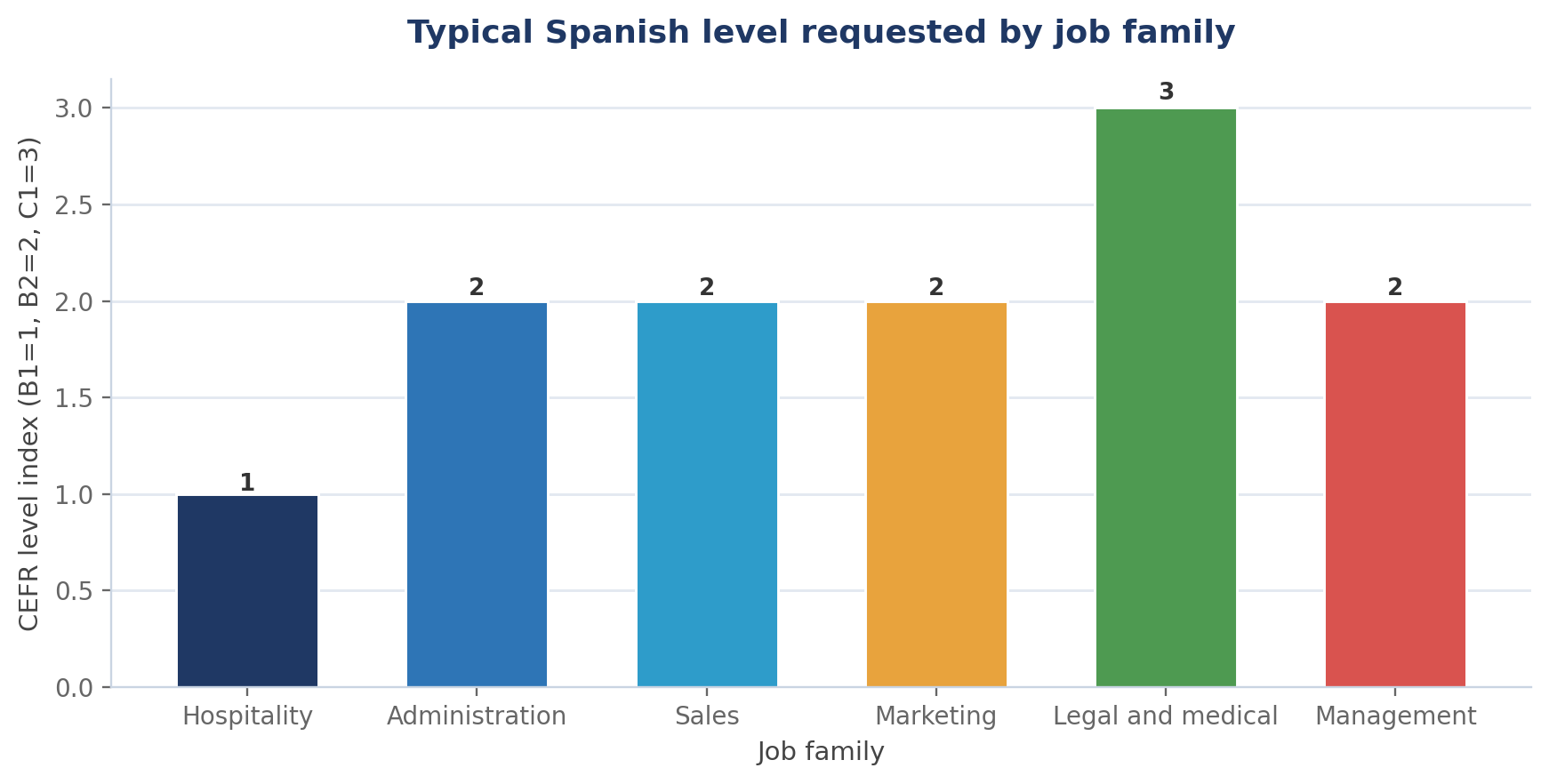
Here is the sentence that decides most job applications in Spanish: se requiere español fluido. Fluent. It sounds absolute, and it sends capable people running for the delete button. But "fluent" in a job advert rarely means native-level. It means can do the job in Spanish — and that threshold depends enormously on the sector, the role and the country.
This guide gives you the real numbers, the sector differences, and the vocabulary that gets you hired.
What you will get from this guide
- The Spanish level employers typically request, by sector
- How requirements differ between Spain and Latin America
- The job-specific language that matters more than perfect grammar
- What to put on a Spanish-language CV
The short answer
Notice the pattern: the requirement tracks risk, not prestige. A customer service agent handles complaints all day, so B1 with strong listening matters more than advanced grammar. A lawyer's mistakes cost money or liberty, so the bar is B2.
The level that gets the interview
The uncomfortable truth: you can pass the CV screen and phone call at B1 and then fail the interview at B2 pressure. Interview Spanish is unpredictable, which is exactly why it needs regular speaking practice with feedback rather than a textbook alone.
Spain versus Latin America
If you target one market, learn that market's vocabulary. Neutral Spanish works everywhere, but local words build trust in the first thirty seconds.
Get to the level your target job actually requires
A Course Pass (Spanish) gives you a personal AI voice tutor who builds job-specific Spanish: interviews, meetings, emails and client calls. Self-paced, level-matched (A1–B2), and no wasted lessons.
Prepare Spanish for work →Create a free accountVocabulary that matters more than grammar
Employers rarely notice a misplaced subjunctive. They do notice whether you can name your own job in Spanish.
That last line is pure gold in an email. It signals professionalism in seven words and is almost always remembered.
Your Spanish CV, without the mistakes
Write the level precisely: Español: B2 (DELE). A certificate with a level beats the word "fluent" every time, because it is verifiable.
How long until you are employable?
The last row matters for a different reason. Advanced learners often lose ground through disuse; maintenance is cheaper than repair.
Walk into the interview already speaking
Self-paced lessons with an AI voice tutor who knows business Spanish — including interview practice and sector vocabulary — help you walk into the interview ready.
Explore business Spanish courses →Create a free accountFrequently Asked Questions
What Spanish level do most employers require? B1 for customer-facing routine roles and B2 for professional, sales and office work. Regulated professions such as law and medicine typically ask for B2.
Do I need a certificate or just the ability? A certificate helps you pass the CV screen; the interview tests the ability. Both matter, and DELE or SIELE is the most widely recognised proof.
Is Spanish useful for jobs outside Spain? Extremely. Spanish is an official language in around twenty countries and widely used in the United States, where bilingual roles are often paid at a premium.
How do I prove my level without an exam? Describe what you can do — lead meetings, write reports, handle calls — and offer to do part of the interview in Spanish. Employers care about capability.
References & Further Reading
- Instituto Cervantes — DELE diplomas, recognised by employers worldwide
- SIELE — International Spanish Language Evaluation Service
- Council of Europe — CEFR level descriptors
- Instituto Cervantes — El español en el mundo: annual report
- EURES — Working and living in Spain: official EU portal