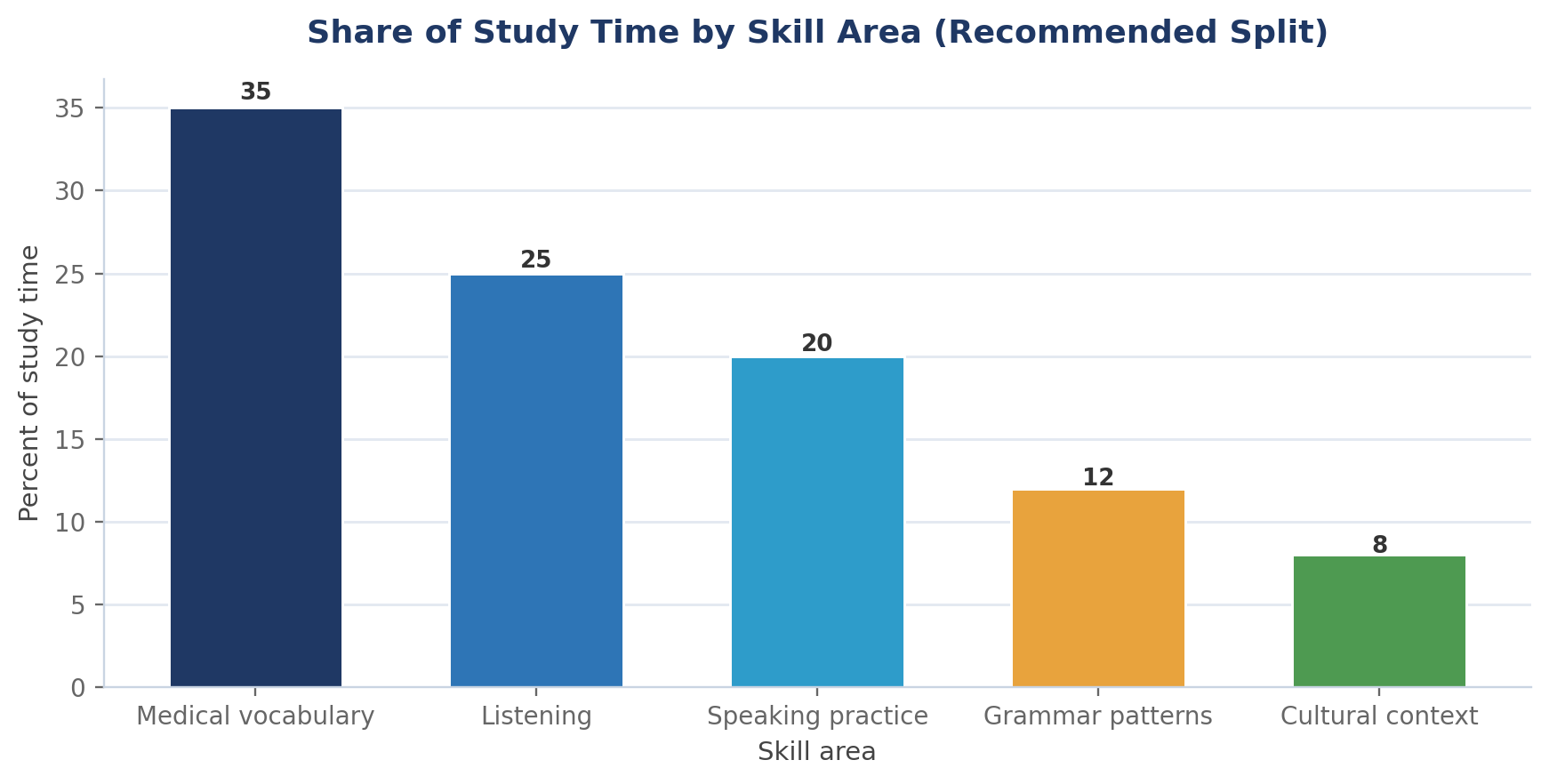
You already know medicine. You already know how to listen, reassure, and explain under pressure. The only thing standing between you and a fuller waiting room — and a fatter paycheck — is one language: Spanish. And here is the delicious part. You don't need to learn all of Spanish. You need roughly 1,200 high-frequency words, a handful of grammar patterns, and the confidence to use them with a real human being who is scared and hurting.
That's it. That's the whole mountain. Let's climb it.
Why Spanish, Why Now
In the United States, Spanish is the most common language spoken at home after English — a pattern the U.S. Census Bureau has documented for decades through the American Community Survey. Hospitals, clinics, dental offices, pharmacies, and home-care agencies all feel the squeeze of interpreter shortages. Bilingual staff get pulled into rooms, promoted faster, and trusted more. Employers notice. Patients remember.
Licensing bodies notice too. Many U.S. states accept documented language proficiency as part of continuing education or cultural-competency requirements, and professional associations such as the American Nurses Association publish position statements on culturally congruent care. Add competence in Spanish and you stop being one of many qualified clinicians. You become the clinician people ask for by name.
What Level Do You Actually Need?
This is where most healthcare workers get lost. They buy a generic beginner course, drift through "la manzana" and "el perro," and quit — because the material never touches a blood pressure cuff. Here is the honest map, aligned to the CEFR scale used across Europe, Latin America, and increasingly by U.S. employers and universities.
Most working nurses and physicians report feeling genuinely functional somewhere in the B1–B2 band. Interpreters, by contrast, are typically held to a higher standard, with formal training. That distinction matters: you are not trying to replace a certified interpreter. You are trying to be useful, warm, and safe.
That last word deserves a flag. For any high-stakes consent, legal, or psychiatric conversation, professional interpretation remains the standard of care. Think of your Spanish as a bridge, not a replacement for the bridge engineers.
The Vocabulary That Pays the Rent
Skip the fruit. Skip the zoo animals. Learn the words that show up in a fifteen-minute encounter. Below are the core clusters, and they are worth memorizing cold.
Now the verbs that unlock everything. Sentir (to feel), tomar (to take, as in medication), doler (to hurt), respirar (to breathe), medir (to measure), recetar (to prescribe). Once you can conjugate these in the present and simple past, you can run a surprising amount of a clinical conversation.
And the phrase that buys you infinite goodwill: "Perdón, mi español no es perfecto. ¿Puede hablar más despacio?" Patients forgive imperfect grammar instantly. They never forgive feeling rushed.
Body Parts and Symptoms, Fast
The pattern me duele + body part is the single most productive sentence in medical Spanish. Drill it until it is automatic.
CTA
Learn the 1,200 words that actually show up in your clinic
Our Spanish course pass drills medical vocabulary in real clinical scenes — intake, triage, discharge — until the words come out without thinking. Start free and see your first patient conversation in week one.
Start your Spanish course pass →Create a free accountGrammar You Cannot Skip
You do not need the subjunctive on day one. You do need these five structures, and you need them well.
Notice that nearly all of these live in the usted register. In healthcare, you almost always use formal address with adults — it signals respect and keeps the relationship professional even when the conversation gets warm and human.
Cultural Fluency Is Clinical Skill
Language without culture is a menu with no kitchen. Latin American patients are not a monolith — Mexican, Puerto Rican, Cuban, Guatemalan, and Colombian families differ in food, family structure, and expectations of authority. Respeto (respect), personalismo (warmth and personal connection), and familismo (the centrality of family) shape how patients hear your advice. Involve the family when appropriate. Ask, don't assume, about herbal remedies and sobadores or curanderos. Ask about faith. These questions are not small talk; they change adherence, and adherence changes outcomes.
CTA
Turn grammar drills into bedside confidence
Our course pass pairs structured lessons with role-play audio so you rehearse discharge instructions before you ever have to improvise them. One pass, every Spanish level, one price.
Get your Spanish course pass →Create a free accountA Realistic 90-Day Plan
Weeks one through four: 300 words, present tense, greetings, vitals, and numbers. Weeks five through eight: symptom vocabulary, preterite, and intake questions — record yourself and cringe, then improve. Weeks nine through twelve: role-play discharge instructions, medication counseling, and empathy phrases with a tutor. Twenty minutes daily beats four hours on Sunday. Every time.
Track yourself against the CEFR table above. When you can hold a five-minute intake without switching to English, you are B1 — and you are already more useful to your patients than you were ninety days ago. Sign up and start the clock.
Frequently Asked Questions
Do I need to be fluent before using Spanish with patients? No — but you do need to be honest about your limits. Use Spanish for routine, low-risk exchanges and keep a professional interpreter available for consent, legal, and mental-health conversations.
How long does medical Spanish take to learn? Learners moving from zero to functional B1 typically need several hundred hours of study, though prior language experience and daily practice shift that substantially. Reports vary, so treat any single number as a rough guide.
Is a medical Spanish course worth it if I already took Spanish in school? Usually yes. General courses teach travel and school vocabulary; a medical Spanish course re-tools that base for clinical scenes — a far shorter and more targeted route.
Which level should I target? Aim for B1 if you work front desk or triage, and B2 if you are a nurse or physician holding most patient conversations.
References & Further Reading
- U.S. Census Bureau — Language Use in the United States
- Council of Europe — Common European Framework of Reference for Languages (CEFR)
- American Council on the Teaching of Foreign Languages (ACTFL) — Proficiency Guidelines
- U.S. Department of Health and Human Services — National CLAS Standards
- American Nurses Association — Position Statements