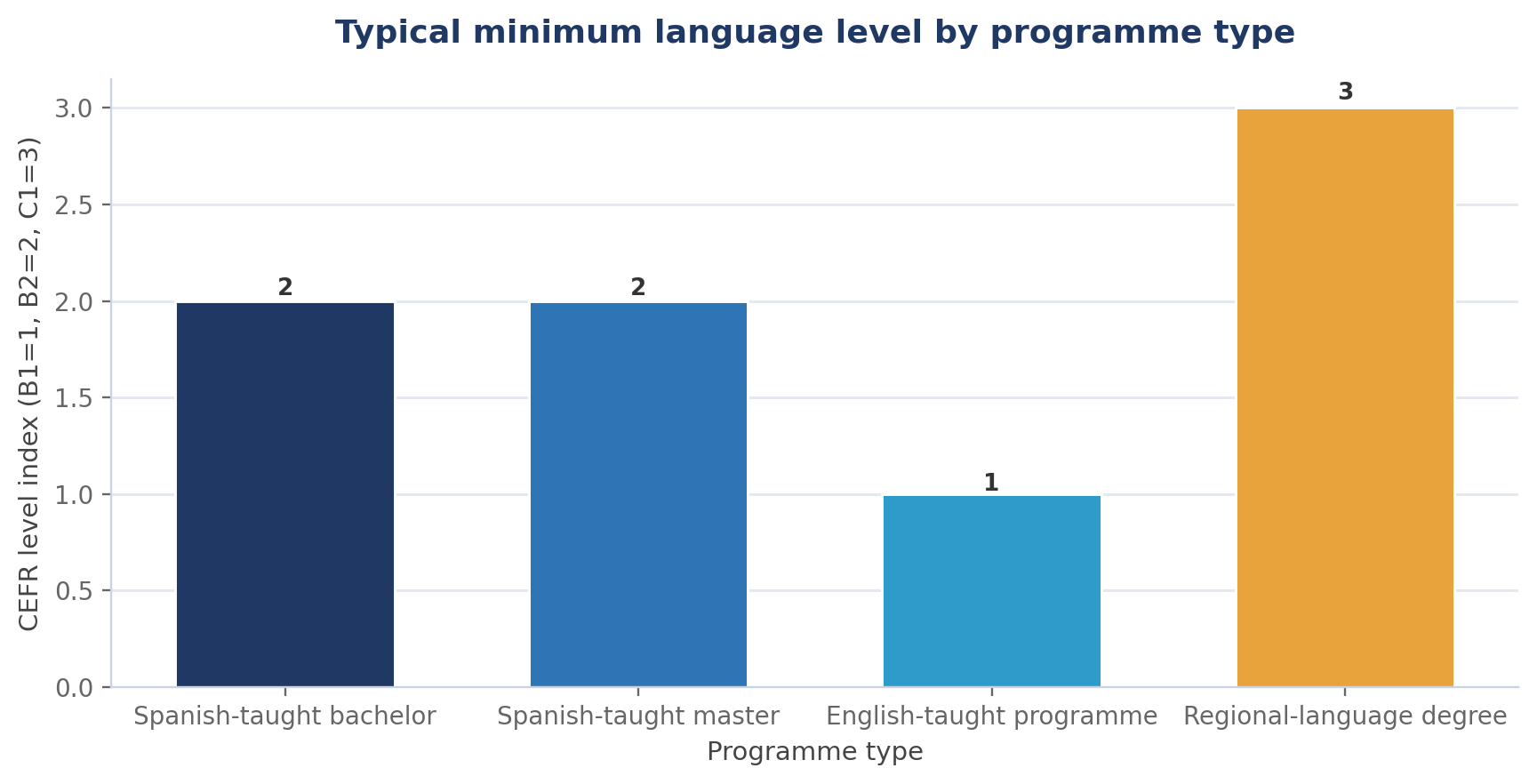
Short answer: most Spanish-taught degrees expect B2, some accept B1 with conditions, and English-taught programmes usually want B2 English instead. The longer answer matters much more, because the level on your certificate and the Spanish you need to survive a lecture hall are not the same thing.
This guide sets out the requirements, the entrance routes, the certificates universities accept, and a realistic timeline for getting from where you are now to enrolled.
What you will get from this guide
- The typical Spanish level required by programme type
- Which certificates universities accept, and which they do not
- The two main admission routes for international students
- A realistic preparation timeline, counted backwards from enrolment
The typical requirements, by programme
What B2 actually means in a lecture hall
A B2 certificate says you can follow complex text and interact with a degree of fluency. A lecture is a different test. Lecturers speak at natural speed, argue, digress, use academic register and expect you to write an exam by hand in an hour.
That is why so many students who "have B2" struggle in their first semester. The certificate opens the door; the fluency has to follow.
Certificates universities accept
Always confirm with the Oficina de Relaciones Internacionales of the specific university. Requirements vary by faculty, by year, and by whether the programme is officially regulated.
The two admission routes
The UNEDasiss credencial is the standard route for many international applicants and can require sitting Pruebas de Competencias Específicas (PCEs) in chosen subjects. Rules change, so check the official UNEDasiss guidance for the current cycle.
Regional languages: the fine print
Degrees in these regions may require proof of the regional language as well as Spanish. If you are targeting Catalonia or Galicia, plan for two languages, not one.
Get to B2 with a plan, not a wish
A personal AI voice tutor teaches structured lessons built around academic language — lectures, seminars, essays — at your own pace, any time, to get you past the certificate and into the classroom. Start with a level check and a realistic timeline.
Prepare Spanish for university →Create a free accountWorking backwards: a realistic timeline
If you are starting from zero, this timeline compresses to roughly two years. If you are already a comfortable B1, six to nine months of focused work is usually enough.
Vocabulary you will meet immediately
Learning this vocabulary before you arrive is a small investment with an outsized payoff. Administrative Spanish is the most stressful Spanish there is, and the easiest to prepare for.
Cost, and why B2 saves you money
Many students budget for a year of language school in Spain before starting a degree. That year costs tuition, rent and living expenses — often tens of thousands of euros. Reaching B2 before you arrive can remove an entire year from the plan. Seen that way, a structured course is not an expense; it is a discount.
Arrive already able to follow the lecture
The students who thrive in Spain are the ones who prepared before they landed. Self-paced Spanish courses with an AI voice tutor, focused on academic skills, mean your first semester is about your subject, not about survival.
Start your university Spanish plan →Create a free accountFrequently Asked Questions
Do I need DELE B2 to study in Spain? Many universities require B2-level proof and accept DELE B2. Some accept SIELE or their own internal test, so confirm with the specific faculty.
Can I study in Spain with B1 Spanish? Sometimes, especially at private universities or with a conditional offer requiring further study. For Spanish-taught public degrees, B2 is the realistic minimum.
Is Spanish needed for English-taught programmes? Not for the course itself, but daily life in Spain runs in Spanish. Even A2 makes accommodation, bureaucracy and friendships immeasurably easier.
How long does it take to reach B2 from scratch? From zero, plan for roughly eighteen months to two years of consistent study. From a solid B1, six to twelve months is realistic.
References & Further Reading
- UNEDasiss — Admission for international students to Spanish universities
- Instituto Cervantes — DELE diplomas and levels
- Ministerio de Universidades — Official information on Spanish university access
- Council of Europe — CEFR level descriptors
- SIELE — International Spanish Language Evaluation Service