Dutch business culture is famously direct — but "direct" never means "rude." A great Dutch business email is short, clear, warm enough to build trust, and structured so the reader knows exactly what happens next. Get the formula right and you sound instantly credible. Get it wrong and even perfect grammar can feel off-key.
This guide gives you the full blueprint: salutations, openings, the polite mid-sentence moves that Dutch professionals actually use, closings, and ready-to-adapt templates. Everything here is aimed at B1 learners who want to stop translating from English and start writing Dutch that lands.
The Anatomy of a Dutch Business Email
A professional Dutch email has six working parts. Miss one and the reader senses something is missing — usually at the end, where the call to action lives.
Dutch readers skim. Put your request in the first three lines and repeat it once at the end. That repetition is not clumsy — it is considered helpful.
Subject Lines and Salutations That Set the Right Tone
The subject line is where Dutch directness pays off. Be concrete: a name, a project, a reference number, a date.
Now the salutation. Dutch has a clear ladder, and choosing the wrong rung signals how you see the relationship.
Two rules that trip up learners constantly. First, Dutch keeps the comma after the salutation and starts the next line with a lowercase letter — "Beste Mark, / ik schrijf je..." — though capitalising is now widely accepted in business. Second, use "u" until the other person offers "jij" or "je." Mirroring their pronoun is the safest social move in the Dutch workplace.
Dutch Email Phrases That Do the Heavy Lifting
Learn these as whole units. Dutch formality lives in fixed phrases, not in long sentences.
Notice how often "graag," "zou u," and "alvast" appear. These little words are the politeness engine of Dutch business writing. Compare "Stuur mij de offerte" (an order) with "Kunt u mij de offerte sturen?" (a request). Same information, completely different relationship.
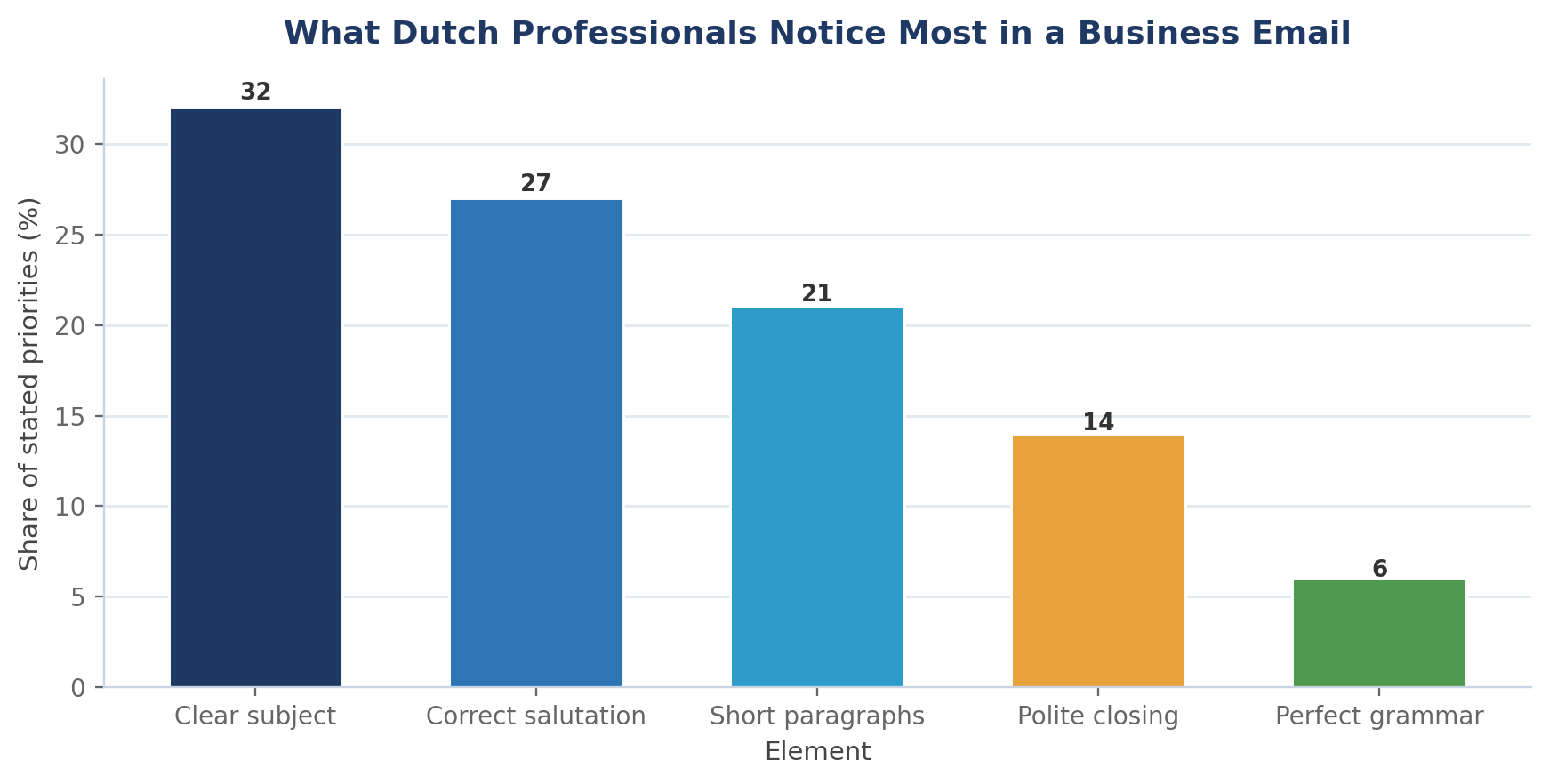
The chart reflects a useful truth: grammar is the least noticed variable. Clarity, tone and structure do the persuasive work.
Structure, Length and Tone: The Dutch Style Rules
Dutch business writing values brevity more than British or American equivalents often do. Aim for a maximum of five short paragraphs and one screen of text before scrolling.
One cultural note worth having: the famous Dutch directness shows up as frankness, not bluntness. "Ik denk dat een andere aanpak beter werkt" is normal and respected. What is not normal is implied criticism or vague hedging — Dutch readers find it harder to act on, and they will simply ask you what you mean.
Closings, Sign-offs and Follow-ups
End as cleanly as you started.
Use "Met vriendelijke groet," as your default. It is safe, warm and universally professional. "Hoogachtend," is reserved for formal letters to institutions or legal correspondence — in email it can read as cold. For follow-ups, a short nudge works best: "Ik wilde even kort op mijn eerdere bericht terugkomen." That one sentence, after three or four working days, is perfectly acceptable in the Netherlands.
Explore structured Dutch business writing lessons at LanguageSkills and build these phrases into reflexes rather than translations.
Write Dutch Emails Without the Hesitation
Our Dutch course pass drills real business scenarios until salutations, softeners and closings come out automatically. Stop drafting in English and start sending emails you are proud of.
Get your Dutch Course Pass →Create a free accountReady-to-Use Dutch Email Templates
Two templates cover most of your week. Adapt freely.
Template 1 — Request with a deadline
Onderwerp: Offerte aanvraag – [project] Beste [naam], Ik neem contact met u op naar aanleiding van ons gesprek van [datum]. Hierbij stuur ik u de specificaties van het project. Zou u mij een offerte kunnen sturen? Ik zou het op prijs stellen als dat voor [datum] lukt. Alvast bedankt voor uw reactie. Met vriendelijke groet, [Jouw naam]
Template 2 — Polite follow-up
Onderwerp: Opvolging eerdere e-mail – [onderwerp] Beste [naam], Ik wilde even kort terugkomen op mijn bericht van [datum]. Heeft u al de kans gehad om ernaar te kijken? Ik hoor graag of u nog informatie nodig heeft. Met vriendelijke groet, [Jouw naam]
Both templates stay under 120 words. That is not laziness — it is Dutch professionalism in action.
Common Mistakes to Avoid
Turn These Rules Into Instinct
Reading templates is step one; writing them under pressure is the real skill. With a LanguageSkills pass you practise graded email tasks and get feedback on tone, not just grammar.
Start Dutch Course Pass →Create a free accountFrequently Asked Questions
Is "Beste" too informal for a first email? No. "Beste" followed by a surname and title ("Beste mevrouw De Vries,") is the standard professional salutation in the Netherlands and Belgium. Reserve "Geachte" for official or legal correspondence.
Should I use "u" or "jij" in a Dutch business email? Default to "u" with anyone you have not met, and switch only when they address you informally first. Mirroring their pronoun is the most reliable social rule.
How long should a Dutch business email be? Keep it under roughly 150 words and five short paragraphs. Dutch readers value brevity; if the topic is complex, attach a document and summarise it in three lines.
Do I need a Dutch-language email signature? A simple sign-off with name, role, company and phone number is standard. Avoid long inspirational quotes or image-based signatures that may not display correctly.