You studied for two years. You can read Le Monde. Then a Parisian barista says "vouszavépa vu le menu" and your brain files it under "fire alarm."
That is not failure. That is connected speech — and it has rules. Once you can hear the rules, fast French stops being noise and becomes a signal you can decode in real time. This guide shows you how to understand fast French the way natives actually speak it.
What you will get from this guide
- Why fast French sounds like one word (and which four rules cause it)
- A daily listening routine you can run in 20 minutes
- Shadowing and dictée drills that move comprehension, not just exposure
- Realistic timelines for each CEFR level (A1–B2)
Why Fast French Sounds Like One Long Word
French does not stress syllables the way English does. It stresses the end of a rhythmic group — a chunk of meaning that might be three, five, or seven words long. Inside that chunk, everything links together.
Four mechanisms do the damage:
Notice the pattern. French learners spend years memorising written forms, then meet the spoken forms for the first time in a café. The gap is not intelligence. The gap is register.
The Five Words That Ambush Everyone
Some words have a written version and a spoken version that barely resemble each other. Learn the spoken version first and you skip months of confusion.
Print that table. Tape it to your mirror. Every one of those appears in normal polite conversation with strangers, not just slang.
Hear it before you fear it
Reading the rules gets you 20% of the way. The other 80% is ears on real audio with feedback on your guesses. Our self-paced French course pairs you with a personal AI voice tutor that slows down, speeds up, and never lets you hide in the subtitles.
Start your French listening course →Create a free accountThe 20-Minute Daily Listening Routine
Comprehension grows through predictable repetition with feedback, not passive background noise. Netflix with English subtitles is entertainment. This is training.
Do this five days a week for six weeks and you will notice the shift: you stop translating in your head and start hearing meaning arrive directly.
What "Fast" Really Means: A Speed Reality Check
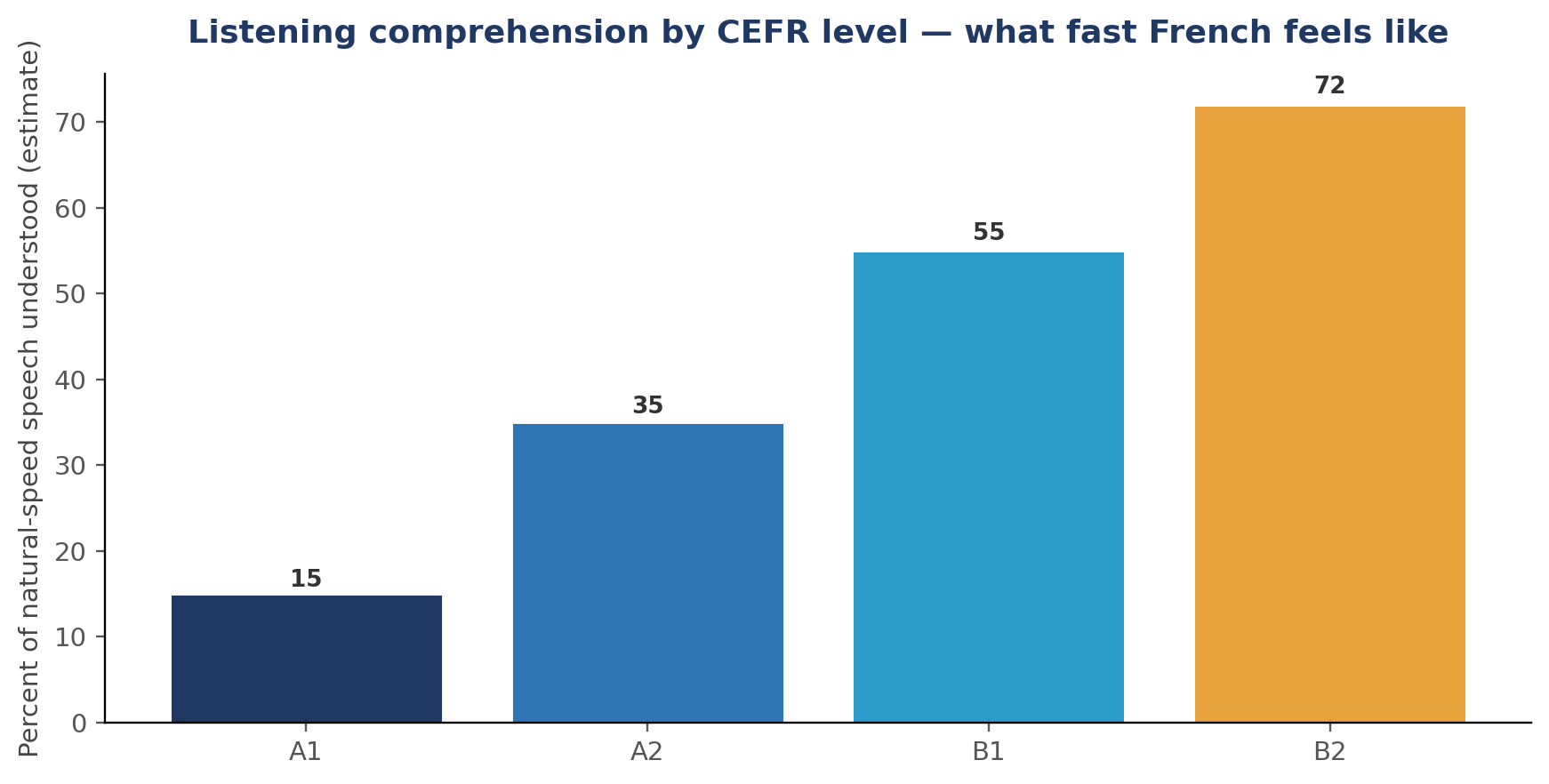
Native French conversation runs hundreds of syllables per minute in bursts, and news anchors are faster still. Here is the honest picture of where learners sit by level.
Read that chart carefully. A B1 listener already catches more than half. The jump from B1 to B2 is the steepest climb in the entire chart — which is exactly why most learners stall there.
Training Your Ears, Not Your Eyes
Three drills, ranked by return on effort.
Dictée. Play 20 seconds of audio. Write every word. Compare to the transcript. Count the misses. The misses are your syllabus.
Shadowing. Play the audio and speak along half a beat behind, copying rhythm and intonation, not accuracy. Do it with a podcast in the exact accent you want — Parisian, Québécois, Senegalese, Belgian.
Speed ramping. Find an audio clip with a transcript. Play it at 0.75x, then 1x, then 1.25x. Your 1x comprehension will feel like slow motion afterwards.
Choosing Practice Material That Won't Bore You
Motivation collapses faster than any grammar rule. Pick material you would watch in English.
Two rules for material: it must be scripted or transcribed, and you must like it. No transcript means no feedback loop.
From decryption to conversation
You have the drills and the material list. What you still need is a patient tutor in front of you — a personal AI voice tutor that pushes the speed up 10% each week until French feels like a language and not a test. That is what our self-paced French course is built for.
Start your French listening course →Create a free accountFrequently Asked Questions
How long before I can understand fast French? From A2, expect roughly 150–250 hours of focused listening practice (about 20 minutes a day for two to three months per level band) to move one CEFR level of comprehension. The estimates in the chart above follow the standard CEFR listening descriptors, but individual timelines vary with exposure and accent variety.
Should I use French subtitles or English subtitles? French subtitles — always. English subtitles turn listening into reading. French subtitles still train the ear because you must match sound to spelling. Use them on the second pass, then remove them on the third.
Why can I understand my teacher but not real French people? Teachers use français standard, articulated at controlled speed. Real speakers reduce syllables, swallow vowels and run words together. You are not backsliding; you are meeting a new register. Add unscripted audio and shadowing, and the gap closes.
Is Québec French much harder than France French? Different, not harder. Québécois vowels and some affrication (like tsu for tu) take a few weeks of deliberate exposure. Pick one accent first, get to B2 comprehension, then diversify.
References & Further Reading
- Council of Europe — Common European Framework of Reference for Languages: Companion Volume, listening scales. https://www.coe.int/en/web/common-european-framework-reference-languages
- France Inter — Affaires sensibles, full-episode audio archive. https://www.radiofrance.fr/franceinter/podcasts/affaires-sensibles
- RFI — Journal en français facile, daily scripted news with transcript. https://www.rfi.fr/fr/podcasts/journal-en-francais-facile
- Alliance Française — Listening and oral comprehension practice resources. https://www.fondation-alliancefr.org
- Dictionnaire de l'Académie française — authoritative reference on liaison and elision conventions. https://www.dictionnaire-academie.fr