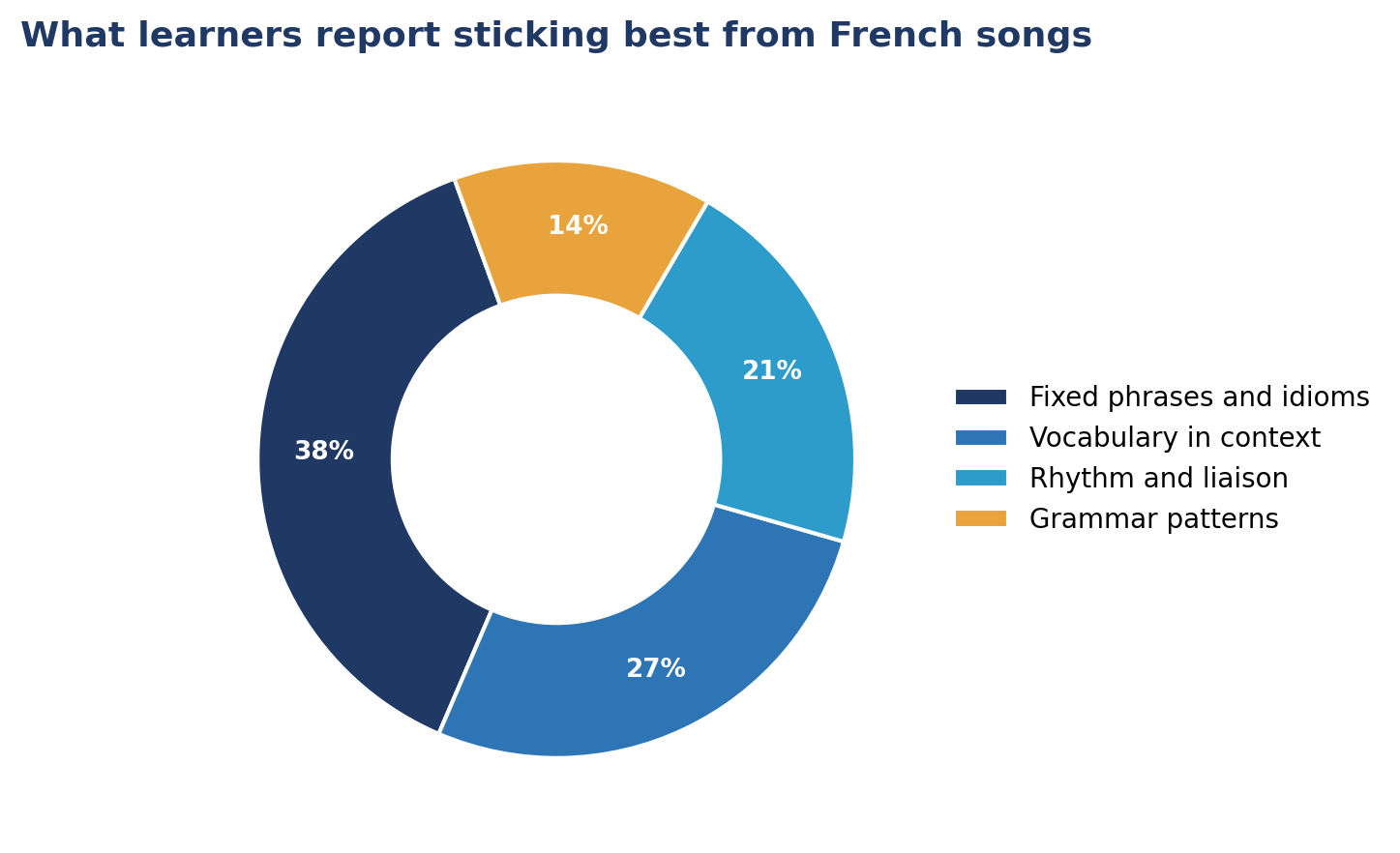
Here is an uncomfortable experiment. Play a French song you have heard twenty times, then read the lyrics. Most learners discover they were humming sounds, not words.
That gap — between melody you know and text you cannot parse — is not a failure. It is a target. Music gives you three things no textbook can: rhythm networks, emotional memory, and the same phrase repeated twelve times without you noticing.
What you will get from this guide
- Why songs lodge vocabulary deeper than lists do
- A level-by-level playlist, from A1 to B2, with real artists
- The four-step listening method that turns a song into a lesson
- Where to find legal lyrics and official subtitles
Why Music Works on Your Brain
Songs do something word lists cannot. They attach language to pitch, rhythm, and emotion, and they repeat it. Repetition plus emotion is a near-perfect memory recipe.
Three specific effects matter for French learners.
There is one catch. Songs also use poetic license: dropped words, broken syntax, invented contractions. That is why you need a level-appropriate playlist, not just whatever Spotify recommends.
The A1–A2 Playlist: Simple, Slow, Repeatable
At beginner level, chase clarity. Look for singers who articulate, moderate tempo, and clear diction.
Stromae is a gift to learners from Belgium: he sings clearly, his phrasing is rhythmic, and his vocabulary is contemporary rather than literary.
The B1–B2 Playlist: Slang, Speed, and Storytelling
Once you can follow the chorus, chase the verses. This is where French music stops being vocabulary practice and becomes cultural immersion.
Grand Corps Malade writes slam, poetry over music, and it is arguably the single best listening resource for intermediate French. His lines are dense with real syntax and he does not hide behind heavy production.
The Four-Step Method That Turns a Song into a Lesson
Playing music in the background is pleasant and nearly useless. Do this instead.
Step one is the uncomfortable one and the most valuable. Writing down what you think you heard exposes exactly which sounds your ear is still inventing. Beginners routinely transcribe three or four words where the line has twelve.
Step four is where the accent moves from your eyes into your mouth. Singing forces you to match rhythm and nasal vowels simultaneously, which is precisely what conversation demands.
Where to Find Lyrics Legally
Do not hunt sketchy lyric sites full of typos. Use the official channels.
RFI and TV5Monde both produce exercises specifically designed around French songs for language learners, with vocabulary notes and CEFR level tags. That is a shortcut worth taking.
You can sing along and still not understand a café
Music builds your ear beautifully, but it skips one thing: someone waiting for your answer. A personal AI voice tutor turns listening into speaking practice, with structured lessons you take at your own pace, any time.
Turn songs into speaking practice →Create a free accountFive Traps That Waste Your Playlist
Trap one: only listening passively. Background music at dinner does almost nothing. Fifteen focused minutes beat three hours of ambience.
Trap two: choosing songs above your level. If you understand under 60% of the words, the song teaches you frustration, not French. Drop a level.
Trap three: translating every line. You need the gist plus five new words. Translating all of it kills the rhythm and your motivation in the same evening.
Trap four: copying slang from rap as your default register. Knowing verlan is great. Using it in a job interview in Lyon is not.
Trap five: never saying anything aloud. Silent listening builds recognition only. If your mouth never moves, your speaking will not move either.
Do Songs Count as CEFR Listening Practice?
Partly. CEFR listening descriptors are built around spoken interaction and announcements, not lyrics. Songs are an excellent supplement — they build prosody, idiom, and motivation — but they do not replace dialogue practice.
The honest split for a beginner is roughly: 30% dialogue and podcast listening, 20% songs, 50% speaking practice with feedback that corrects you. Songs are the fun third that keeps the other two alive.
To make the practice measurable, keep a running list of phrases you stole from songs. If after a month you can produce twenty of them in conversation without thinking, the playlist earned its place.
Your playlist is a warm-up. The lesson is the workout.
Bring your favourite French songs into your self-paced lessons and let your AI voice tutor unpack the liaisons, the idioms, and the register — then have you use them out loud.
Add French listening practice →Create a free accountFrequently Asked Questions
Can you really learn French from songs alone? No. Songs build vocabulary, idiom, and rhythm brilliantly, but they do not build interactive speaking. Use them as a supplement to conversation practice, not a substitute.
What are the easiest French songs for beginners? Dernière danse by Indila, Je veux by Zaz, and Les Champs-Élysées by Joe Dassin are the standard recommendations: slow delivery, clear diction, and heavy repetition.
Where can I find French song lyrics with translations legally? Official YouTube channels, streaming lyrics features, RFI's Paroles de chansons series, and TV5Monde's learner exercises are reliable. Avoid unofficial lyric aggregators, which frequently contain errors.
How many new words should I take from a song? Five is the sweet spot. Learn them as phrases, not isolated words, and say each one aloud. Ten or more per song and none of them will stick.
References & Further Reading
- RFI — Paroles de chansons, French song listening exercises for learners: https://francaisfacile.rfi.fr/fr/
- TV5Monde — Apprendre le français, music-based exercises by CEFR level: https://apprendre.tv5monde.com/fr
- Institut français — French music and cultural programming worldwide: https://www.institutfrancais.com/en
- Alliance Française — French courses and cultural events network: https://www.fondation-alliancefr.org/
- Council of Europe — CEFR listening comprehension descriptors: https://www.coe.int/en/web/common-european-framework-reference-languages