You studied French for years. You can read Camus. Then a Parisian asks you something and what reaches your ears is shuh-vee-tam-ay, a single liquid syllable where you expected five tidy words.
Welcome to the gap. Written French and spoken French are close relatives who barely visit each other.
What you will get from this guide
- Why spoken French sounds nothing like the textbook
- The four sound rules that unlock 80% of comprehension
- A weekly drill routine with real French audio
- The listening traps that keep learners stuck at B1
Why Your Ear Fails When Your Eye Succeeds
French hides its words. English speakers say I do not know; French says Je ne sais pas — and then, in real speech, drops two of those words entirely: chais pas. Textbook French is the formal register. Street French is a different creature.
Three forces are working against you:
Nobody lied to you. They just taught you the writing system and called it the language.
Rule One: Liaison Is Not Optional
Liaison is where a normally silent final consonant gets pronounced because the next word begins with a vowel. Miss it and you hear one word where the speaker said two.
Liaison is obligatory in fixed phrases, forbidden after et, and optional in between — which is precisely what makes listening hard. Train your ear on the obligatory ones first. They carry the most weight.
Rule Two: The Vanishing Vowels
Spoken French deletes the e in the middle of words, then runs what is left together.
Je te le donne becomes j'te l'donne. Petit becomes p'tit. Je suis becomes chuis in casual Parisian speech. This is not sloppiness — it is the accent, and every native speaker does it.
The practical fix: whenever you learn a word in your head, learn its spoken form too. If you have only ever seen je suis, you will not recognise chuis in the wild.
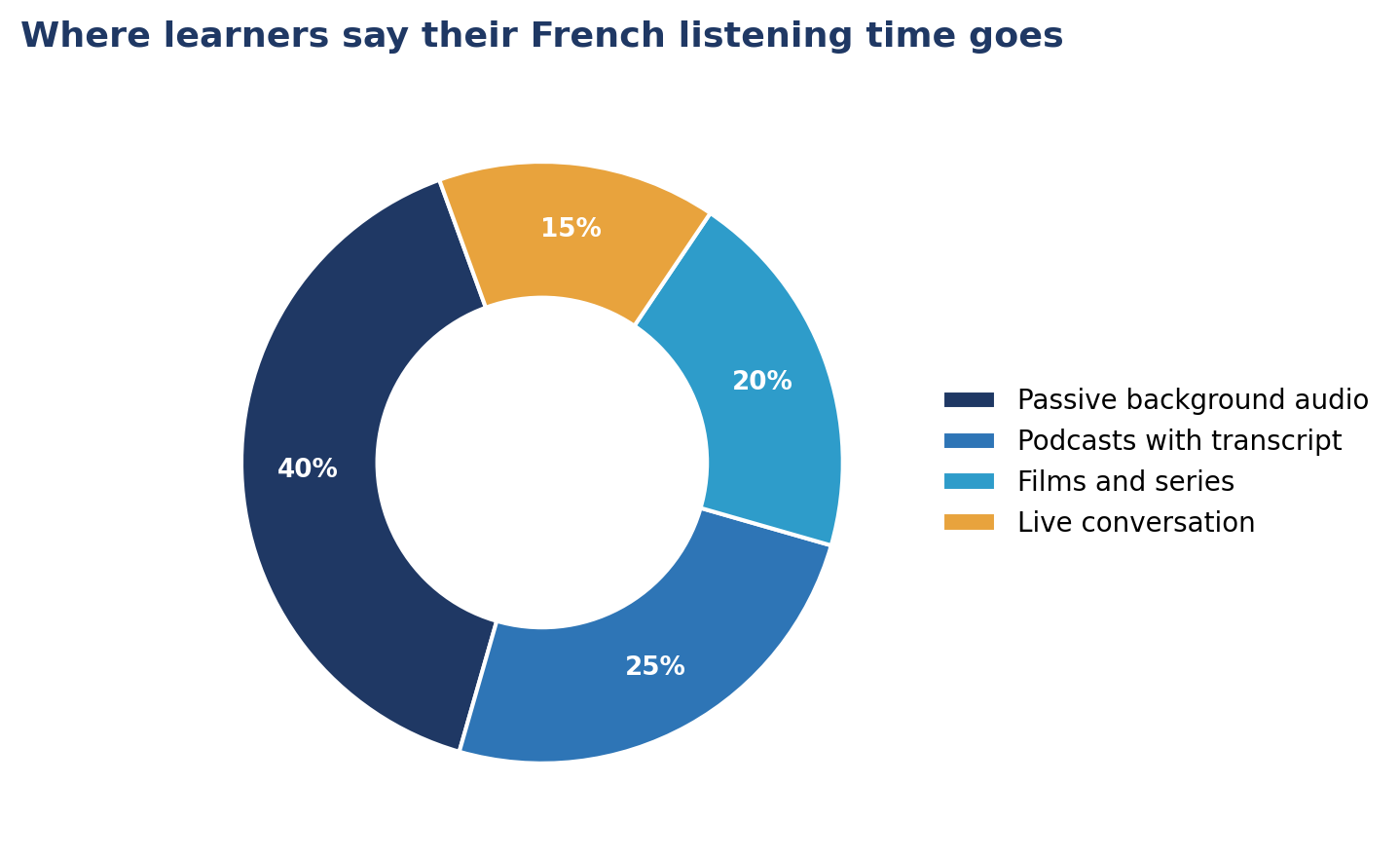
Notice the problem in that chart. Passive background audio — French radio playing while you cook — is the most common habit and the least effective. You cannot learn to catch words you never attend to.
Rule Three: Learn the Connectors by Sound
Fast speech is glued together by a small set of connectors. Learn them as sounds, not spellings, and comprehension jumps immediately.
Six expressions. Say them out loud twenty times a day for a week and you will start hearing them in real audio. This is the cheapest listening upgrade available.
Transcripts plus AI feedback change everything
Ready to turn reading into real French? Start your self-paced course today.
Start the French course →Create a free accountShadowing alone hits a ceiling — you cannot hear what you keep missing. With our AI voice tutor you work through authentic audio at your own pace, and it isolates the liaison you missed and drills it until your ear owns it. Button: Practise French listening →
Rule Four: Rhythm Before Words
French stress falls at the end of a group of words, not on individual syllables. English punches one syllable per word; French flows until a small stop.
That is why learners who listen word-by-word drown. You are listening at the wrong granularity. Listen for the phrase — je voudrais un café, s'il vous plaît — as one melodic unit.
A Weekly Routine That Works
The critical rule is subtitles in French, never in English. English subtitles turn listening practice into reading practice with background music.
Sources Worth Your Ears
RFI's Journal en français facile gives you real news at a survivable tempo, with a full transcript. TV5Monde's Apprendre le français section builds exercises on authentic clips. InnerFrench offers slower, natural monologues for intermediate learners. And the Alliance Française network runs conversation groups where you hear real humans, at real speed, in real rooms.
Three Traps That Keep You Stuck
First, translating as you listen. You cannot translate and listen simultaneously — the buffer overflows. Aim for gist, not precision.
Second, only easy audio. If you understand 100%, you are not training. Aim for roughly 70–80% comprehension and let context do the rest.
Third, no speaking. Production and perception are linked; the sounds you cannot make are the sounds you struggle to hear. Speaking practice improves listening more than most learners expect.
Turn French noise into French meaning
Ready to turn reading into real French? Start your self-paced course today.
Start the French course →Create a free accountOur self-paced French listening lessons use authentic audio — news, interviews, podcast clips — with an AI voice tutor that pauses exactly where your ear drops out. Transcript work, shadowing, and speaking practice, all at your own pace. Start with the guided lessons and build your own rhythm. Button: Start French listening practice →
Frequently Asked Questions
Why can I read French but not understand it spoken? Because spoken French applies liaison, elision and vowel erosion that the writing system hides completely. Written je ne sais pas becomes chais pas in casual speech. Your vocabulary is fine — your ear was never trained on the real sound stream.
How long does it take to improve French listening? With twenty minutes a day of active listening plus regular speaking practice, most learners at A2–B1 report clear improvement within six to ten weeks. Passive background audio alone can take years and deliver very little.
Should I use subtitles when watching French films? Yes — but French subtitles only. English subtitles convert the exercise into reading comprehension. For a harder workout, watch once with French subtitles, then again without.
What is the best free French listening resource? RFI's Journal en français facile is excellent: real news, slower delivery, and a complete transcript you can check afterwards. TV5Monde also offers free exercises built on authentic video at every CEFR level.