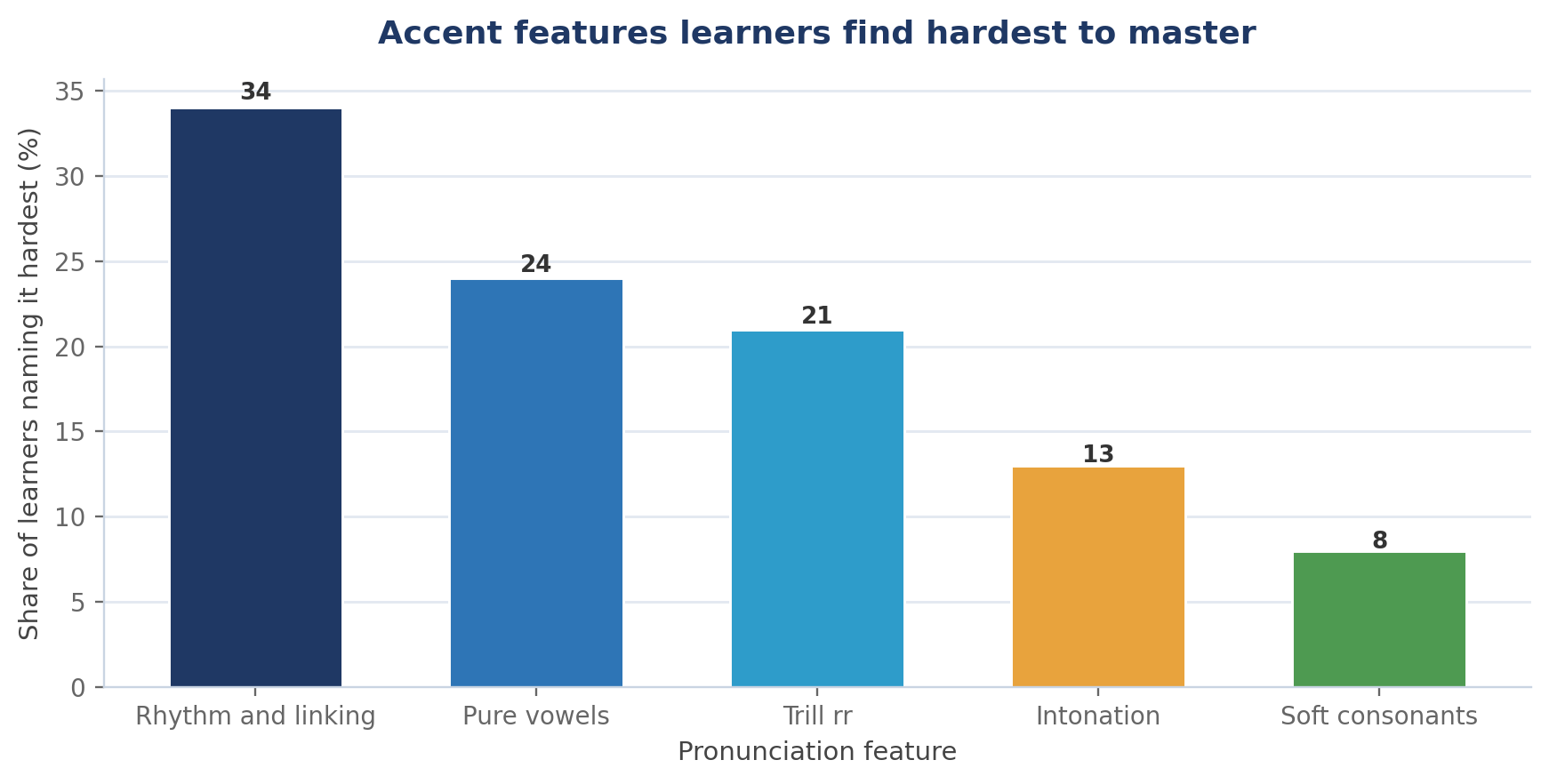
Here is a small, uncomfortable truth. You can conjugate the imperfect subjunctive flawlessly and still be spotted as a foreigner in four seconds. Accent and grammar are different skills, and most courses teach only one of them.
The good news is that Spanish is one of the most rewarding languages in the world to sound good in. Its sounds are few, its spelling is honest, and its rhythm is learnable. Six habits do most of the work.
What you will get from this guide
- Why Spanish sounds so different from English at the rhythm level
- Six specific pronunciation habits that make you sound native
- The regional differences worth choosing between
- A weekly routine that turns accent practice into reflex
Why Spanish sounds so different
English is a stress-timed language: it squashes unstressed syllables and stretches stressed ones, so photograph and photography have different rhythms. Spanish is syllable-timed: every syllable gets roughly the same length. Say extraordinario in English rhythm and it collapses. Say it in Spanish rhythm — e-xtra-or-di-na-rio, each beat even — and it suddenly sounds right.
The second difference is vowels. English has around twenty vowel sounds; Spanish has five, and they never glide. The English o in go is really two sounds. The Spanish o in no is one, held steady. Killing that glide is the single fastest accent upgrade available.
Habit 1: keep your vowels pure
Say no and hold it. If the sound moves at the end, you are gliding. Do it again without the movement. Now try casa, mesa, cosa, cuna, cine — five clean vowels, no drift.
Habit 2: stop separating words
Spanish runs words together, and the boundaries shift. ¿Estás aquí? becomes está-saquí. La amiga becomes laamiga. Native speakers do not pause between words; they pause between thought groups.
Practise by reading a sentence and marking it into thought groups, not words: Quiero ir a la playa / porque hace mucho calor. Breathe at the slashes, nowhere else.
Habit 3: get friendly with the soft consonants
Three consonants change completely between vowels, and missing this is one of the loudest "foreigner" signals.
Also worth knowing: final d is often dropped — Madrid becomes Madrí, verdad becomes verdá — and b and v are the same sound in Spanish, so vaca and baca are homophones.
Habit 4: learn the trill as a physical skill
The rolled rr is not a sound you hear and copy. It is a physical event: the tongue tip taps against the ridge behind the upper teeth, driven by airflow. Start with butter said fast in an American accent — the tt is the same motion. Then try pero, carro, perro, arriba.
Find out which habits are holding your accent back
A short AI voice assessment tells you in ten minutes what months of self-recording never will: exactly which three sounds give you away. Then a Course Pass lets you drill them with your personal AI voice tutor until they stick.
Take a Spanish speaking assessment →Create a free accountHabit 5: copy the melody, not just the words
Spanish intonation rises and falls in patterns that differ from English, especially in questions. English questions often rise at the end; Spanish information questions frequently fall.
Shadowing is the tool. Play ten seconds of native audio, then speak simultaneously with it, matching pitch and speed. It feels absurd for two weeks and then it transforms your speech.
Habit 6: choose a variety and be consistent
Spanish has many accents, and mixing them is more distracting than having any single foreign accent. Pick one target and stay with it.
There is no "best" variety. There is only the one you will hear most and use most. Choose it, and model it deliberately.
Practise your accent with an AI voice tutor for the variety you want
Books cannot tell you if your vowels glide. A personal AI voice tutor can give you instant speaking feedback and keep correcting until the habit is permanent.
Start Spanish speaking practice →Create a free accountA weekly accent routine that works
That last step matters most. Recordings are brutally honest, and comparing Monday with Friday is the only evidence you will ever have that anything is improving.
Frequently Asked Questions
Can adults lose a foreign accent? Adults can improve dramatically, and most can reach a natural, pleasant accent. A perfect native accent after childhood is rare, but sounding native enough to be effortless in conversation is very achievable.
Which Spanish accent is easiest to learn? Mexican and Castilian have the most learning material. Caribbean accents are faster and drop final s, which makes them harder to model early on.
How long does accent work take? Expect noticeable change in four to eight weeks of daily ten-minute practice, and real comfort after three to six months with regular speaking practice.
Does accent affect exam scores? Yes. DELE and SIELE oral exams score pronunciation and fluency. A clear, consistent accent helps; a heavily English-influenced one can cost marks.
References & Further Reading
- Instituto Cervantes — DELE oral exam criteria and scoring
- Real Academia Española — Diccionario panhispánico de dudas: pronunciation guidance
- Council of Europe — CEFR descriptors for phonological control
- Instituto Cervantes — Spanish language resources and courses
- RAE / ASALE — Corpus and pronunciation resources for Spanish