You can read Spanish novels. You understand podcasts. And yet, when a waiter asks a simple question, your mind empties and you answer in English. If that sounds familiar, you are not bad at Spanish. You have language anxiety — and it is one of the most common, most survivable obstacles in language learning.
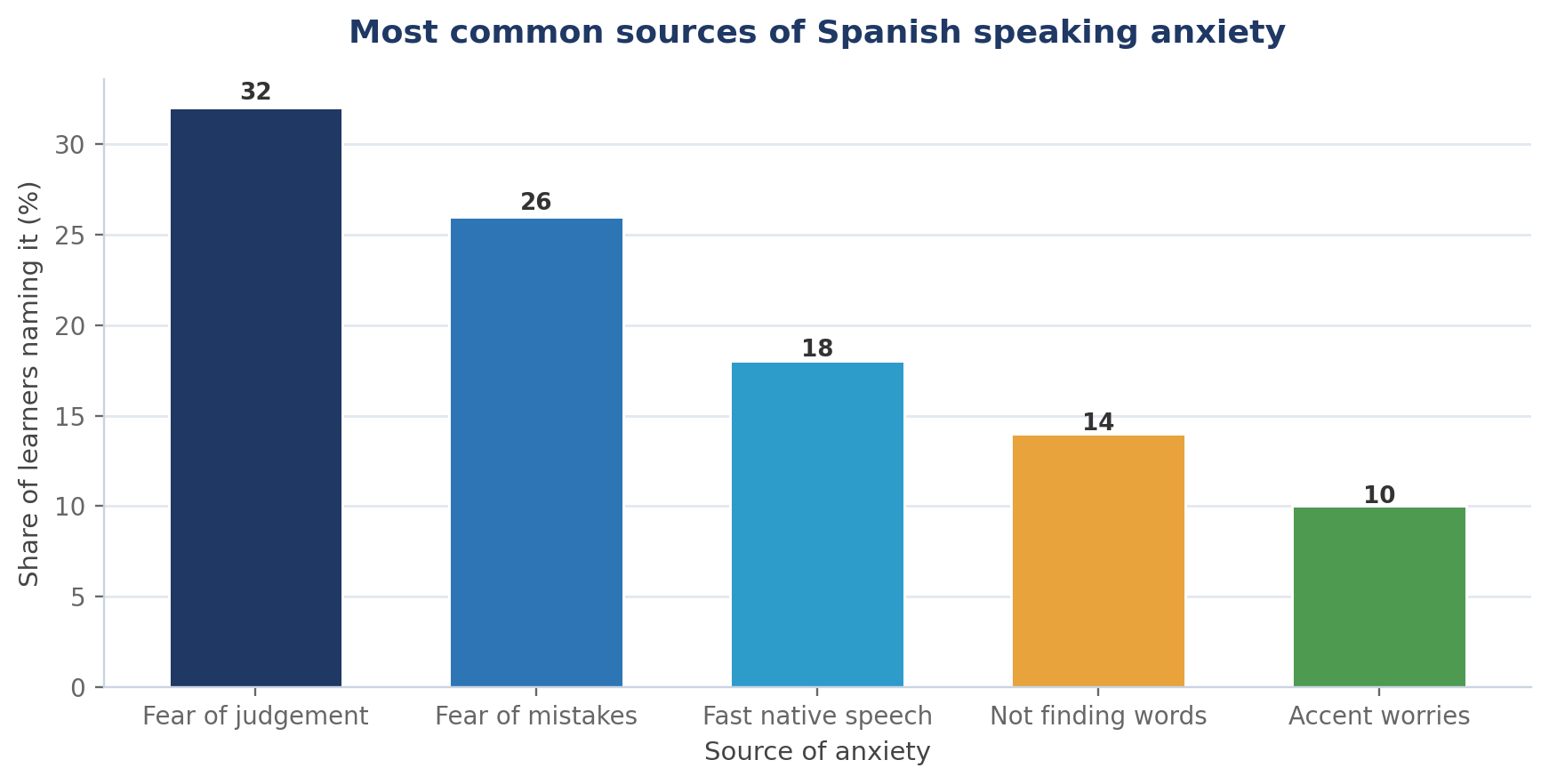
The fear is not irrational. It is a fear of being judged, of sounding stupid, of losing the identity of a competent adult. The cure is not confidence. Confidence is the result of practice, not the prerequisite for it.
What you will get from this guide
- Why anxiety hits advanced learners hardest
- The physical symptoms, and what they mean
- A six-step exposure ladder from silent to fluent
- Phrases that buy you time when your mind blanks
Why the fear gets worse as you improve
Beginners are often fearless, because they expect to be bad. Intermediate learners are the most anxious group — good enough to know what they are getting wrong, not yet automatic enough to fix it in real time.
If you feel worse at B1 than you did at A1, that is a sign of progress, not regression.
What anxiety actually does to you
The six-step exposure ladder
You do not jump from silence to a dinner party. You climb. Each rung is small enough to be uncomfortable and large enough to matter.
Move up when a step feels boring rather than frightening. Boredom is the signal that a rung has done its job.
Climb the ladder with a patient AI voice tutor
A self-paced AI voice tutor is the safest possible place to be bad at Spanish. It expects mistakes, gives you gentle feedback, and provides the repetition that makes speaking normal rather than terrifying.
Start speaking Spanish with an AI voice tutor →Create a free accountPhrases that buy you time
When your mind blanks, you do not need vocabulary. You need a bridge.
These are not weaknesses. Native speakers use fillers constantly. Using them fluently is a skill, not a confession.
The reframe that actually works
Stop measuring yourself on accuracy. Measure yourself on communication events: did the other person understand, and did the interaction continue? Under that standard, a grammatically imperfect sentence that achieves the goal is a success — and those successes, repeated, are what build confidence.
A three-week anxiety plan
Notice that week one involves no humans at all. That is deliberate. You are building the physical habit of speaking Spanish before adding an audience.
Practise where mistakes are the point
A Course Pass gives you a self-paced AI voice tutor whose entire job is to make you comfortable speaking, then push you one step further each week. Confidence is a by-product of repetition.
Learn Spanish with an AI voice tutor →Create a free accountFrequently Asked Questions
Why do I freeze when I speak Spanish? Anxiety consumes working memory, which is exactly what you need to retrieve vocabulary. It is a biological response, not a sign of poor ability — and it fades with repeated exposure.
Is it normal to be afraid to speak a foreign language? Extremely normal. Language anxiety is reported by learners at every level, and it is most intense for intermediate learners who know what they are getting wrong.
How do I stop translating in my head? Practice, not willpower. Shadowing, phrase learning and guided speaking practice gradually replace translation with recognition. Expect it to take a few months, not a few days.
Should I wait until I am better to start speaking? No. Waiting makes the fear stronger and the gap wider. Start now, badly, with safe partners — that is how "better" happens.
References & Further Reading
- Council of Europe — CEFR descriptors for spoken interaction
- Instituto Cervantes — Spanish learning resources and courses
- Instituto Cervantes — DELE oral examination criteria
- Real Academia Española — Diccionario panhispánico de dudas
- Council of Europe — Plurilingual and intercultural education resources