You know more Spanish than you can say. That gap — between what sits in your head and what actually leaves your mouth — is not a knowledge problem. It is a confidence problem, and it has a different cure.
Most learners try to fix it by studying more. Another grammar book, another five hundred words. Then a real person asks ¿Y tú qué haces? and the brain slams the door. The fix is not more input. It is deliberate, small, repeated speaking.
What you will get from this guide
- Why confidence lags behind ability, and why that is normal
- The four-part daily loop that builds real speaking confidence
- A fear ladder so you never jump from silence to terror
- The practice types that transfer to real conversation, and the ones that do not
Why confidence lags behind knowledge
Confidence is not a personality trait. It is a memory of success. Your brain trusts a behaviour it has done twenty times and distrusts one it has done twice. That is the entire mechanism.
So the goal is not to feel ready and then speak. It is to speak badly, briefly and often, until your nervous system downgrades the threat.
The four-part daily loop
The review stage is the one everybody skips and the one that converts a conversation into confidence. Write down what you actually pulled off. Your brain needs the receipt.
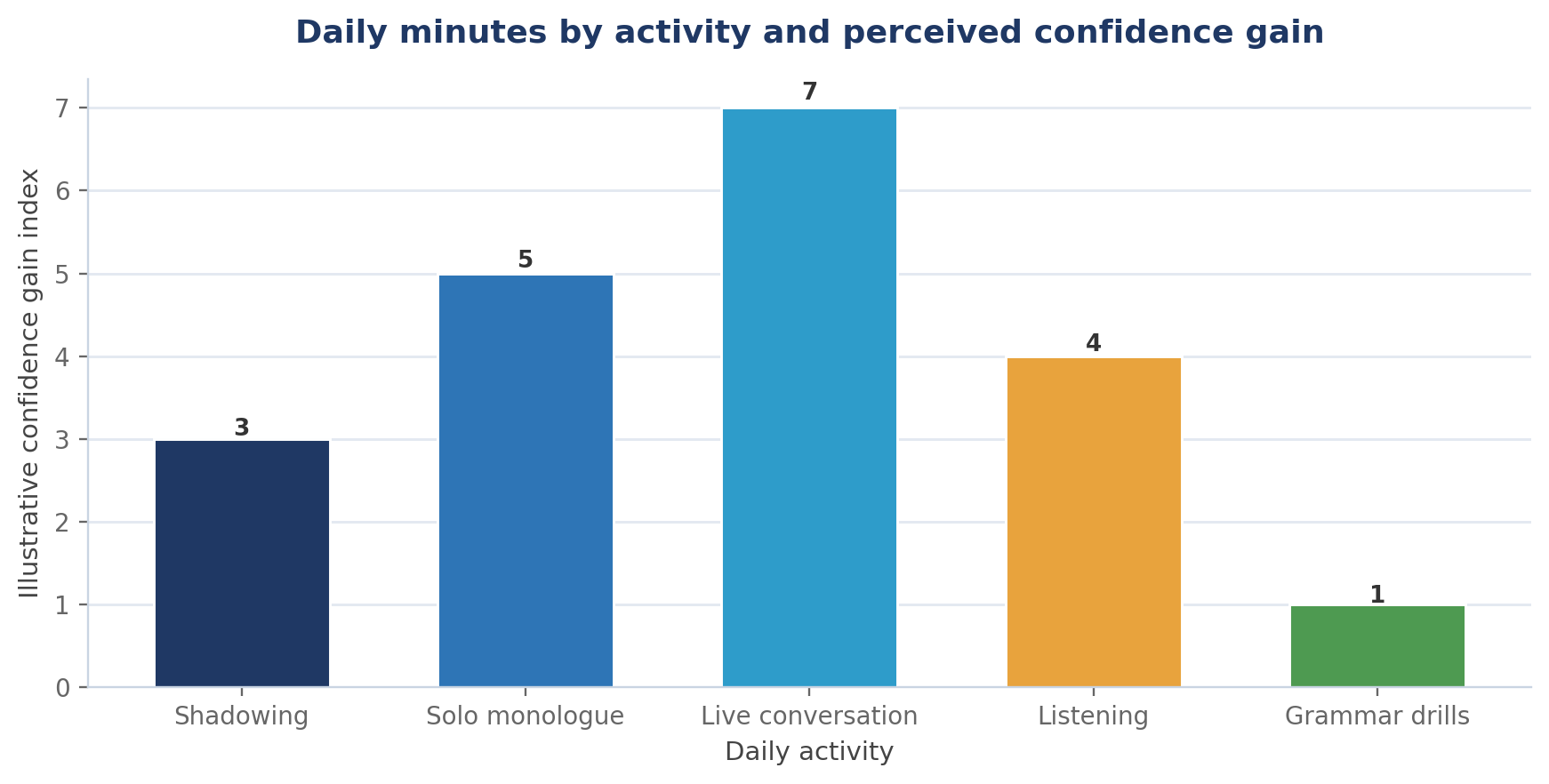
Practice types, and what each one really builds
A good week uses at least three of these. If you only ever do one, your confidence curve flatlines — and you will blame yourself instead of the routine.
Turn shy Spanish into spoken Spanish
A Course Pass gives you a personal AI voice tutor that trains exactly this loop — warm-up, repetition, speaking practice with feedback, review — and tracks your progress instead of leaving it to guesswork.
Book a Spanish speaking assessment →Create a free accountBuild your fear ladder
Nerves do not vanish with a pep talk. They shrink when you climb in small steps. Start at the rung that feels slightly uncomfortable.
Stay on a rung until it becomes boring, then climb. Most learners try to jump from rung one to rung five, panic, and conclude they are "not natural at languages". Nobody is natural at rung five. You earn it at rung four.
Repair phrases: your emergency exit
Freezing feels catastrophic because you have no way out. Give yourself a scripted exit and the freeze becomes a pause.
Say them out loud twenty times each before you need them. A repair phrase you have never practised is not a repair phrase — it is a hope.
How long until it feels easy
Honest answer: it depends, and anyone promising a fixed number is guessing. Learner reports and teaching experience generally describe noticeable comfort emerging after several weeks to a few months of daily speaking — not daily study, daily speaking.
Two things reliably accelerate it. Speaking with someone who does not flinch at your mistakes, and reviewing your own recordings rather than your own feelings. Feelings lie; recordings do not.
Practise with people who have heard it all before
Our AI voice tutor is built for nervous learners and for the "I understand everything but say nothing" wall. Guided speaking practice turns knowledge into speech, session by session, at your own pace.
Start speaking Spanish with support →Create a free accountFrequently Asked Questions
How do I stop freezing mid-sentence in Spanish? Learn a repair phrase and drill it until it is automatic. Freezing feels catastrophic because you have no exit; give yourself a scripted exit and it becomes an ordinary pause.
Is it better to practise speaking alone or with people? Both, but not equally. Solo practice builds fluency and speed; speaking practice with feedback builds the social tolerance that confidence actually is. If you must choose, choose guided speaking practice.
How often should I do Spanish speaking practice? Daily, even briefly. Fifteen to twenty focused minutes a day beats one long weekly session, because confidence is built by repetition, not volume.
Can I build confidence without living in a Spanish-speaking country? Yes. An AI voice tutor, language exchanges and voice-note partners make daily speaking practice possible from anywhere. Immersion is a shortcut, not a requirement.
References & Further Reading
- Council of Europe — CEFR descriptors for spoken interaction
- Instituto Cervantes — Spanish learning resources and courses
- Instituto Cervantes — DELE oral examination information
- Real Academia Española — Diccionario panhispánico de dudas
- Council of Europe — Plurilingual and intercultural education resources