Your eyes can read Spanish. Your mouth cannot speak it. That gap is not a talent problem — it is a rehearsal problem.
Nobody ever handed you a stage. So build one in your kitchen, tonight.
What you will get from this guide
- Five solo drills that train the muscles of real speech
- A weekly routine you can start with a timer and a phone
- Honest benchmarks for the moment solo practice stops working
Why Solo Speakers Stall
Reading, listening and grammar study all work in silence. Speaking does not. Speech is timing, breath and muscle memory — three things that only improve when air leaves your body in Spanish.
The classic failure looks like this. A learner finishes a B1 textbook, understands a podcast, then freezes when a waiter in Madrid asks ¿Qué le pongo? The knowledge is there. The reflex is not.
You need repetition that feels slightly embarrassing. Talk to your ceiling. It has infinite patience.
Five Drills That Actually Move Your Mouth
Each drill targets one weak link. Rotate them so your practice never becomes a single habit wearing a disguise.
Two rules hold this together. Say it out loud, always. Never stop mid-sentence to fix grammar — repair it on the second pass.
Shadowing: Steal the Rhythm
Shadowing means playing native audio and speaking almost on top of it, half a second behind. You do not translate. You copy music.
Pick twenty seconds of clear speech — a Cervantes Institute podcast, a news bulletin, a film scene you already understand. Loop it eight times. By the fifth pass your mouth stops guessing and starts predicting.
Spanish has a machine-gun rhythm compared with English. Vowels stay short and pure. Words fuse: ¿Qué haces? becomes kéa-ses. Shadowing teaches you that fusion faster than any phonetic chart.
Record Yourself: The Cheapest Teacher Alive
Your phone is a hard, fair examiner. Record sixty seconds of free speech, wait ten minutes, then listen with a checklist instead of a critic.
Do this twice a week. In a month you will hear yourself change, and that recording is proof no one can argue with.
A Weekly Routine You Can Keep
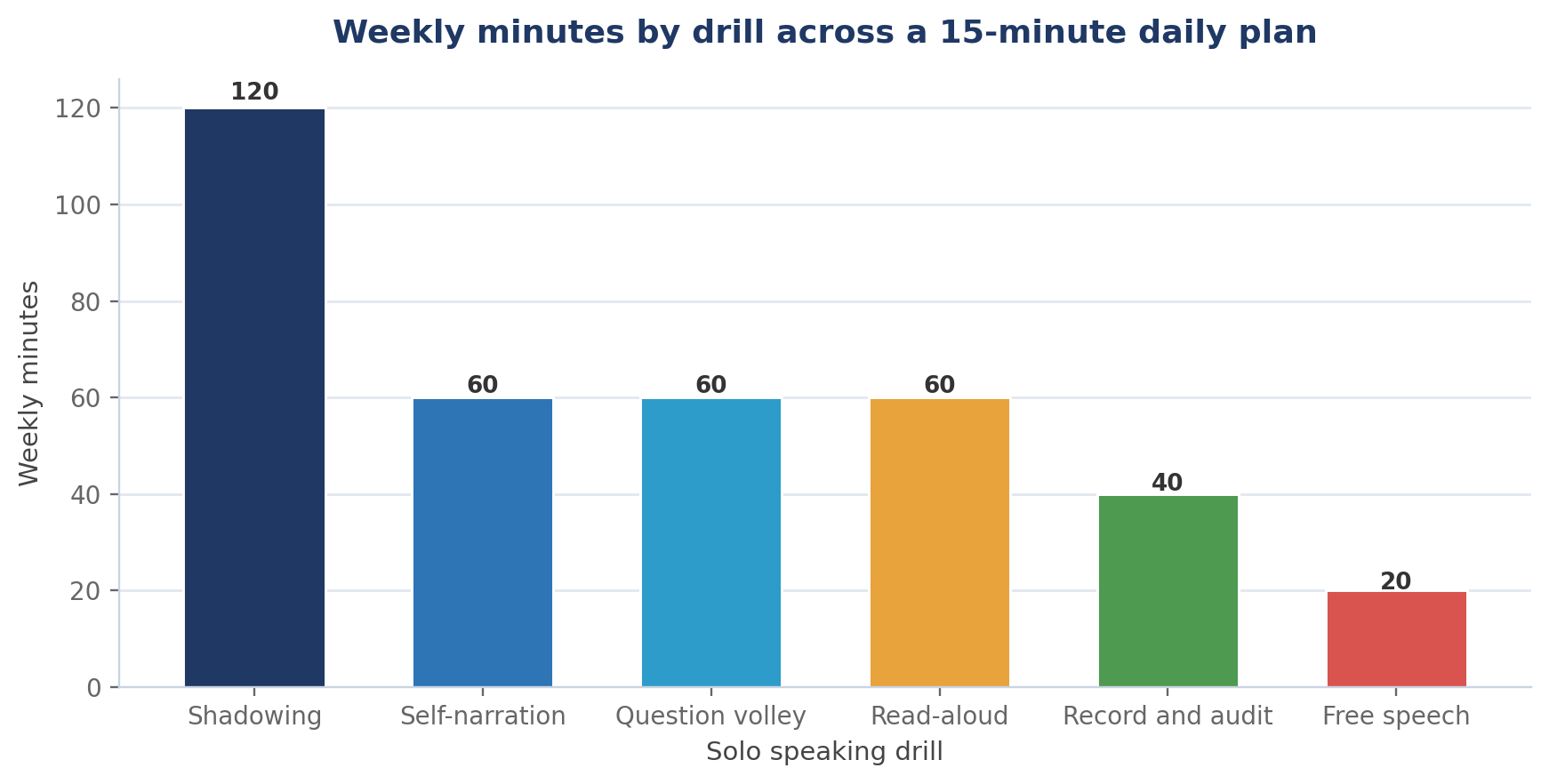
Consistency beats intensity. Fifteen focused minutes daily will beat a three-hour Sunday marathon, because speech is a skill of the nervous system, not a pile of facts.
Total: six and a half hours a month. That is enough to build a reflex.
When Solo Practice Hits Its Ceiling
You will know the exact moment. Your monologues get polished, your accent gets clean, and then someone answers you — and the conversation collapses.
That is not failure. That is a missing ingredient. Solo drills teach you to produce Spanish. Only another human teaches you to respond in it, because real speakers interrupt, change subject, use slang, and expect you to follow.
At that point the fastest gains come from structured speaking practice with an AI voice tutor that gives feedback in the moment: pronunciation, register, and the small repairs that make you sound like a person, not a textbook.
Find out what your Spanish sounds like to a native ear
A self-paced speaking assessment tells you exactly which sounds, tenses and habits are holding you back — then a course fixes them.
Start your speaking assessment →Create a free accountHow Long Until You Can Actually Chat?
Nobody can promise a date. What we can do is give you the standard CEFR landmarks, mapped to guided study hours. Treat the hours as planning estimates, not laws of physics.
Speaking is usually the last skill to arrive and the first to fade. A learner who reads for a year and speaks for a month will outperform a learner who reads for a month and speaks for a year — in conversation, at least. That is the whole point of this routine.
Frequently Asked Questions
Can I really improve my Spanish speaking without a partner? Yes, for pronunciation, rhythm and fluency. Shadowing, recording and self-narration all work alone. What you cannot rehearse solo is unpredictability, which is why structured speaking practice becomes essential around B1.
How many minutes a day do I need? Fifteen focused, out-loud minutes daily is a strong starting dose. Below ten minutes, progress becomes hard to feel. Above thirty, most learners burn out within two weeks.
Should I speak Spanish in my head or out loud? Out loud, always. Silent speech skips the breathing, mouth shape and timing that make Spanish Spanish. Your neighbours will survive.
What if I have no one to talk to at all? Use structured lessons with an AI voice tutor, as often as you like, and fill the gap with recorded monologues. Then compare month-old recordings. The difference will keep you motivated.
Your mouth is ready. Give it an audience.
Turn those kitchen rehearsals into real conversation with self-paced, AI-tutor-led Spanish lessons built around speaking from minute one.
Start speaking Spanish →Create a free accountReferences & Further Reading
- Instituto Cervantes — official information on DELE Spanish diplomas and level descriptors: https://www.cervantes.es
- Council of Europe — Common European Framework of Reference for Languages, Companion Volume: https://www.coe.int/en/web/common-european-framework-reference-languages
- Instituto Cervantes — El español en el mundo annual yearbook on Spanish worldwide: https://www.cervantes.es/lengua_y_ensenanza/el_espanol_en_el_mundo.htm
- LanguageSkills.net — self-paced Spanish courses and speaking practice: https://languageskills.net/register
- Real Academia Española — Diccionario de la lengua española, for checking pronunciation and usage: https://www.rae.es