There is no lip-reading on the phone. No gestures, no shared screen, no helpful context. Just a voice, slightly compressed, speaking the fastest register of French there is.
That is why french phone calls terrify even B2 learners who present confidently in meetings. This guide gives you the phrases, the structure and the recovery lines — so you never freeze into silence on a call again.
What you will get from this guide
- The standard four-part arc of a French business call
- Ready-to-use phrases for every stage, including transfers and holds
- Recovery lines for when you lose the thread
- Etiquette rules that matter more in France than elsewhere
The Four Parts of Every Professional Call
French business calls follow a rigid, comforting choreography. Learn the skeleton and you can hang any conversation on it.
That last row is not politeness. Repeating actions at the end of a French call is standard professional practice and protects you both.
Opening: Naming Yourself Properly
Notice the avoidance of je veux — that reads as a demand. Use je souhaiterais, pourrais-je, or je voudrais and the temperature of the call drops immediately.
Asking, Holding, Transferring
Keep one recovery phrase loaded and memorised. Pourriez-vous répéter, s'il vous plaît ? buys you eight seconds of thinking time and never sounds rude.
Phone French needs rehearsal, not reading
Nobody learns to swim from a diagram. In our self-paced B1+ business French course you practise with an AI voice tutor: you speak, get interrupted mid-sentence and recover — with instant AI feedback that corrects your phrasing in real time. That repetition is what turns a list of phrases into reflex.
Practise live French phone calls →Create a free accountTaking and Leaving Messages
Spelling aloud is a lifeline. French letters are not intuitive over a bad connection — G and J, B and P, E and É. Learn the alphabet cleanly and add a reference word when it matters: B comme Bordeaux.
Where French Calls Actually Break Down
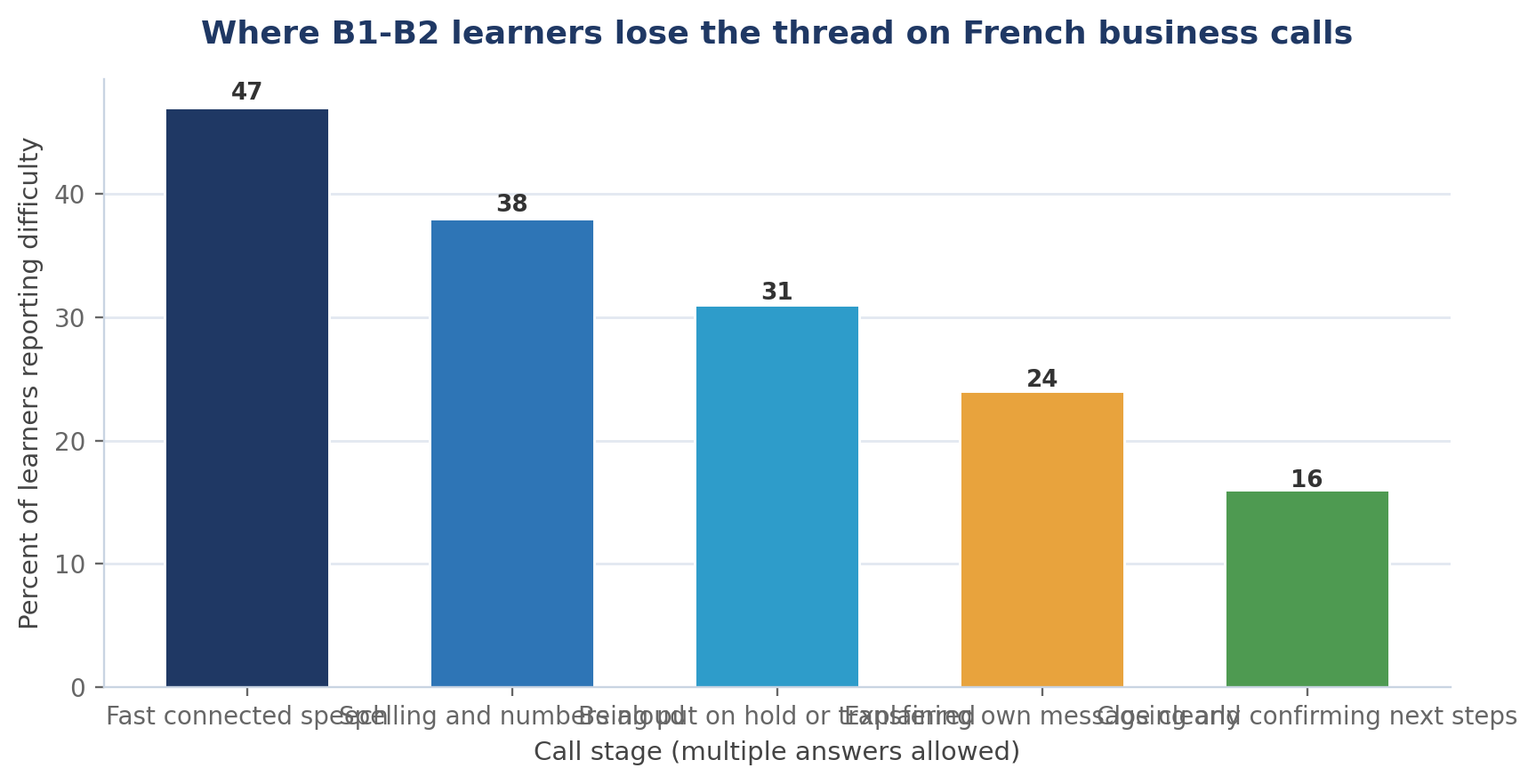
The failure points are remarkably consistent across learners. They are not vocabulary problems; they are processing-speed problems.
Connected speech wins. Which is good news, because connected speech is trainable — and the fix is the same as for any listening work: audio, transcripts, repetition, shadowing.
Numbers: The Real Boss Fight
French numbers between 70 and 99 break foreign ears.
Belgian and Swiss French use septante, octante/huitante and nonante. If you're calling Brussels or Geneva, listen for them — they're simpler, and hearing them unprepared can derail you.
Phone numbers. French numbers are read in pairs. 06 12 34 56 78 is zéro six, douze, trente-quatre, cinquante-six, soixante-dix-huit. Practise reading your own number aloud until it's automatic.
Ending the Call Like a Professional
Two French etiquette notes. First, always greet before stating your purpose — skipping bonjour is read as brusque, almost hostile. Second, address people by title unless invited otherwise; Madame, Monsieur, and Maître for lawyers stay in play for years.
Etiquette Table for Business Calls
Turn phone anxiety into phone fluency
Structured, self-paced call practice with an AI voice tutor removes most of the fear. Bring a real scenario — a supplier, a client, a recruitment call — and rehearse it at your own pace until the words arrive before the panic does.
Book your business French start →Create a free accountFrequently Asked Questions
What level of French do I need for business calls? B1 is a practical starting point: you can sustain the conversation, ask for clarification politely and handle a message. B2 is where you stop preparing scripts and start negotiating freely.
How do I ask someone to repeat themselves politely in French? Pourriez-vous répéter, s'il vous plaît ? is neutral and safe. For a slower pace, pourriez-vous parler un peu plus lentement, s'il vous plaît ? works everywhere. Add excusez-moi to soften either one.
Is it correct to say "Allô" in a professional call? Allô is used when answering a call, and it is standard in France. It is less formal than a full company greeting, so when representing an employer, use the company name first: [Société] bonjour.
How should I write French email follow-ups after a call? Keep it short and structured: greeting, one-line reference to the call, bulleted confirmations, clear next step, courteous close. Use vous forms, and sign off with Cordialement — the standard professional register.
References & Further Reading
- Académie française — usage guidance on courtesy and address forms. https://www.dictionnaire-academie.fr
- Alliance Française — professional French and business communication courses. https://www.fondation-alliancefr.org
- France Éducation international — DELF Pro and professional French certifications. https://www.france-education-international.fr
- Le Robert — dictionary entries for formal register and business usage. https://www.lerobert.com
- CCI France (Chambre de commerce et d'industrie) — professional French communication resources. https://www.cci.fr