The interviewer smiles, says bonjour, and asks you to talk about yourself. In French. You have rehearsed this sentence forty times in the shower and it vanishes like steam.
The good news: French interviews are formulaic. Learn the formulas and you walk in armed.
What you will get from this guide
- The questions that appear in almost every French interview
- Answer templates at B2 level you can adapt to your own history
- The formal register markers that separate tu from vous at work
- Follow-up phrases that leave a professional impression
How a French interview actually runs
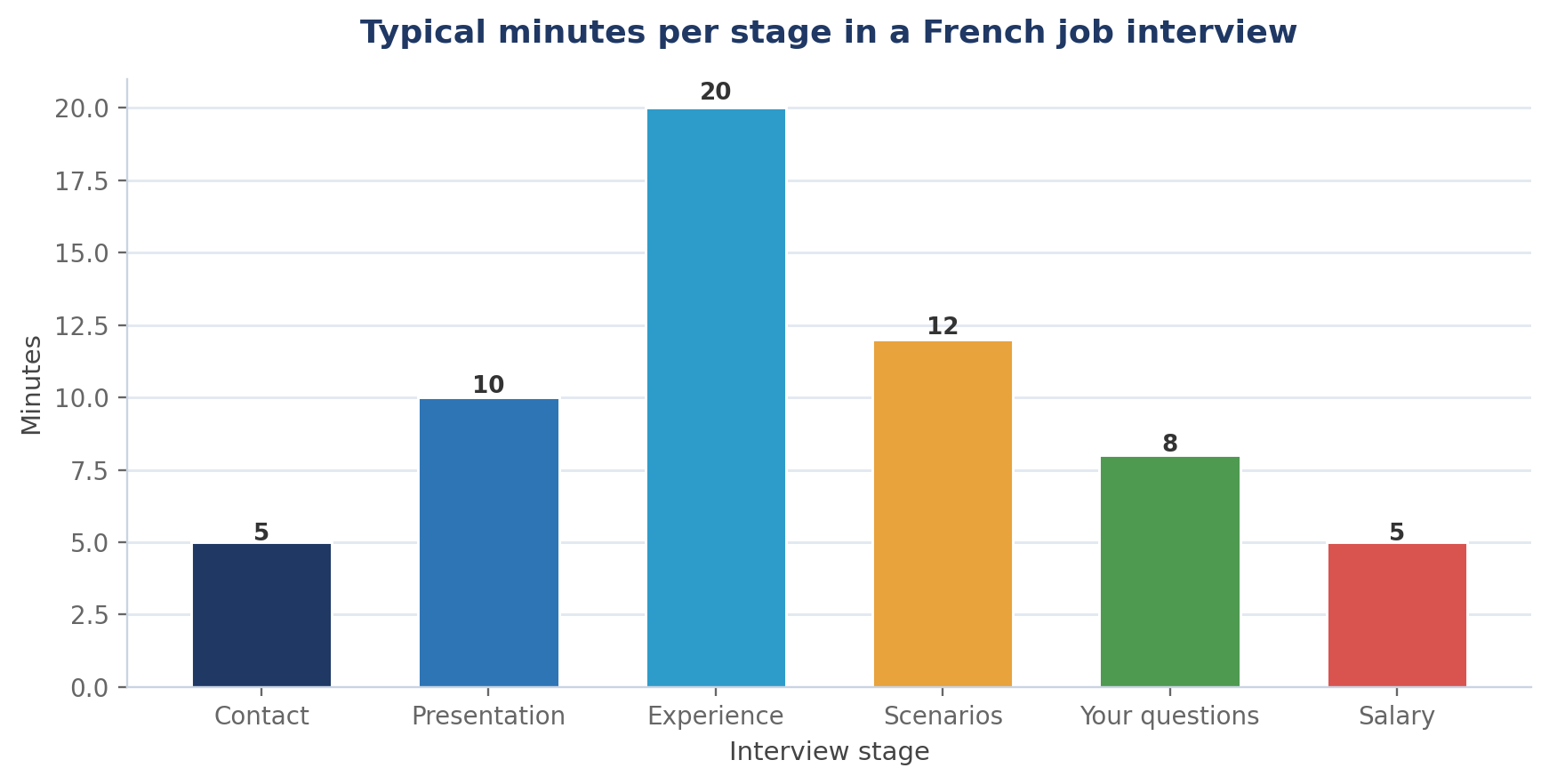
Expect structure, directness and a bias for facts. French interviewers tend to probe your formation and your reasoning more than your enthusiasm. Grand statements about passion land flat; a clear account of what you did and what it produced lands hard.
Notice how early the self-presentation comes. It sets the tone for everything after.
The questions you will hear
The 90-second self-presentation
Structure it in three beats: present, past, future. Say who you are professionally now, what got you here, and why this role is the logical next step.
Use connectors — d'abord, ensuite, enfin — because they signal control. Keep to ninety seconds. French interviewers notice when you ramble, and they will interrupt.
Answer difficult questions with structure
Use the STAR frame — situation, task, action, result. In French: contexte, mission, action, résultat.
Numbers do heavy lifting. Even an approximate figure — environ un tiers — beats vague adjectives like beaucoup.
Register: the phrases that decide your impression
French professional life runs on vous until a colleague explicitly offers on se tutoie. Never assume.
Interview French is its own dialect
Ready to turn reading into real French? Start your self-paced course today.
Start the French course →Create a free accountTextbook French will not hand you si je comprends bien under pressure. Self-paced lessons with an AI voice tutor and role-play practice make these phrases automatic before you need them. Button: Practise French for work →
The salary question, handled
French employers often ask for prétentions salariales early. Answer with a researched range, in gross annual terms, and add a phrase that keeps the door open.
Say: D'après mes recherches, la fourchette pour ce poste se situe entre X et Y euros brut annuel. Je suis ouvert à en discuter selon les responsabilités. Then stop talking. Silence is not your enemy.
Answers that quietly fail
Three patterns sink strong candidates. Criticising a former employer at length — French recruiters read it as a future risk. Answering je suis perfectionniste to the weakness question, which everyone spots instantly. And treating the votre plus grand défaut question as a trap to dodge rather than a chance to show self-awareness.
A workable answer names a real weakness, then names the system you built to compensate for it.
Your questions, and the follow-up
Prepare four questions about the team, the tools, the success measures and the first ninety days. Avoid opening with holiday entitlement.
Within twenty-four hours, send a short, formal message: Madame / Monsieur, je vous remercie pour notre échange. L'opportunité correspond pleinement à mon projet professionnel. Je reste à votre disposition pour tout complément d'information. Two sentences. No emojis, no exclamation marks.
Then rehearse aloud, out loud, repeatedly. French fluency in interviews is a performance skill, and performances are rehearsed. If you are targeting B2 professional French, the DELF B2 oral format is excellent practice for exactly this kind of pressure.
Walk in already fluent in the format
Ready to turn reading into real French? Start your self-paced course today.
Start the French course →Create a free accountRole-play realistic French interviews with an AI voice tutor, get instant feedback, and arrive knowing your own answers cold. Button: Get interview-ready →
Frequently Asked Questions
What French level do I need for a job interview in France? B2 is the practical threshold for most roles. At B2 you can explain your experience, argue a position and handle unscripted questions, which is exactly what interviews test.
Should I use tu or vous in a French job interview? Always vous. Use Madame or Monsieur with the surname until the interviewer invites informality. Switching to tu on your own is a genuine mistake.
How do I answer "parlez-moi de vous" in French? Use a three-part arc — present, past, future — in ninety seconds, with connectors such as d'abord and c'est pourquoi. Practise it aloud until it sounds spoken, not recited.
Is it acceptable to ask for time to think in French? Yes, and doing it gracefully is a strength. Phrases like laissez-moi réfléchir un instant read as composure rather than hesitation.
References & Further Reading
- France Éducation International — DELF B2 and DALF C1 professional and oral examination formats.
- Ministère du Travail (France) — recruitment practices and candidate rights in French hiring.
- Alliance Française — business French courses and professional communication programmes.
- Académie française — guidance on formal written French for correspondence.
- Pôle emploi (France Travail) — official resources on interviews and job applications in France.